Home
Class 12
CHEMISTRY
The bromination of acetone that occurs i...

The bromination of acetone that occurs in acid solution is represented by
`CH_(3)COCH_(3)(aq.)+Br_(2)(aq.)rarrCH_(3)COCH_(2)Br(aq.)+H^(+)(aq.)+Br^(-)(aq.)`
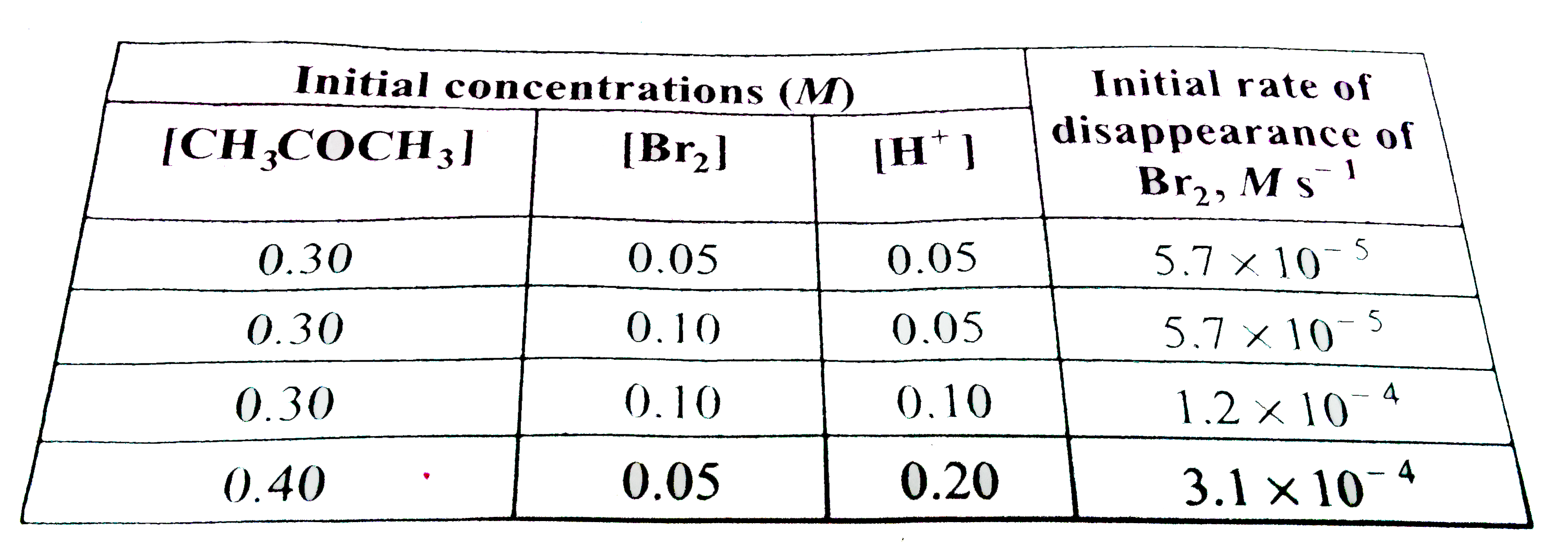
These kinetic data were obtained for given reaction concentrations :

Based on these data, rate equations is :

A

`"Rate"=k[CH_(3)COCH_(3)][Br_(2)][H^(+)]^(2)`

B

`"Rate"=k[CH_(3)COCH_(3)][Br_(2)][H^(+)]`

C

`"Rate"=k[CH_(3)COCH_(3)[H^(+)]`

D

`"Rate"=k[CH_(3)COCH_(3)[Br_(2)]`

Text Solution

Verified by Experts

`"Rate"=k[CH_(3)COCH_(3)]^(alpha)[Br_(2)]^(beta)[H^(+)]^(gamma)`
`5.7xx10^(-5)=k[[0.30]^(alpha)[0.05]^(beta)[0.05]^(gamma)" ".....(i)`
`5.7xx10^(-5)=k[0.30]^(alpha)[0.10]^(beta)[0.05]^(gamma)" ".....(ii)`
`1.2xx10^(-4)=k[0.30]^(alpha)[0.10]^(beta)[0.10]^(gamma)" ".....(iii)`
`3.1xx10^(-4)=k[0.40]^(alpha)[0.05]^(beta)[0.20]^(gamma)" ".....(iv)`
Divinding eq. (i), be eq. (ii)
`1=[(1)/(2)]^(beta),i.e.,beta=0`
Dividing eq. (ii) by eq. (ii),
`1=[(1)/(2)]^(gamma),i.e.,gamma=1`
Dividing eq (i) by eq. (iv)
`(5.7xx10^(-5))/(3.1xx10^(-4))=[(3)/(4)]^(alpha)xx[(1)/(4)]^(1)`
Thus, rate law will be
rate `k=[CH_(3)COCH_(3)]^(1)[H^(+)]^(1)`
Promotional Banner

Topper's Solved these Questions

  • CHEMICAL KINETICS

    OP TANDON|Exercise PRACTICE PROBLEMS|70 Videos
  • CHEMICAL KINETICS

    OP TANDON|Exercise OBJECTIVE QUESTIONS (LEVEL-A)|192 Videos
  • CHEMICAL KINETICS

    OP TANDON|Exercise LINKED COMPRESHENSION TYPE QUESTIONS ( SECTION-VI)|4 Videos
  • CARBOXYLIC ACIDS AND THEIR DERIVATIVES

    OP TANDON|Exercise Integer|4 Videos
  • Chemical Thermodynamics and Thermochemistry

    OP TANDON|Exercise Self Assessment (Integer type).|3 Videos

Similar Questions

Explore conceptually related problems

The bromination of acetone that occurs in acid solution is represented by this equation. CH_(3)COCH_(3) (aq) + Br_(2) (aq) rarr CH_(3)COCH_(2) Br(aq) + H^(+) (aq) + Br(aq) These kinetic data were obtained for given reaction concentrations. Initial concentration, M {:([CH_(2)COCH_(3)],[Br_(2)],[H^(+)],("Initail rate) (disappearance of "Br_(2)),),(0.30,0.05,0.05,1.5 xx 10^(-5),),(0.30,0.10,0.05,5.7xx10^(-5),),(0.30,0.10,0.10,1.2xx10^(-4),),(0.40,0.5,0.20,3.1xx10^(-4),):}

For the reaction : (CH_(3))_(3)CBr(aq)+OH^(-)(aq)rarr(CH_(3))_(3)COH(aq)+Br^(-)(aq) it is found that halving the concentration of (CH_(3))_(3)CBr causes the reaction rate to be halved but halving the concentration of OH^(-) has no effect on the rate. What is the rate law?

Consider the reaction: H_(2)SO_(3)(aq)+Sn^(4+)(aq)+H_(2)O(l)toSn^(2+)(aq)+HSO_(4)^(-)(aq)+3H^(+)(aq) Which of the following statements is correct?

Assertion :- Bromide ion is serving as a reducing agent in the reaction 2MnO_(4)^(-)(aq.)+Br^(-)(aq.)+H_(2)Orarr2MnO_(2)(aq.)+BrO_(3)^(-)(aq.)+2OH^(-)(aq.) Reason :- Oxidation number of Br increases from -1 to +5

OP TANDON-CHEMICAL KINETICS-ILLUSTRATIONS
  1. For the decompoistion of HI at 1000 K(2HI rarr H(2)+I(2)), following d...

    Text Solution

    |

  2. Conisder a reaction A rarr B + C . The initial concentration of A was ...

    Text Solution

    |

  3. The rate of a gaseous reaction is given by the expresison k[A]^(2)[B]^...

    Text Solution

    |

  4. For a chemical reaction A rarr B, the rate of reaction increases by a ...

    Text Solution

    |

  5. The rate of the reaction 3A + 2B rarr Products is given by the rat...

    Text Solution

    |

  6. For the reaction A + Brarr C +D, if concentratiton of A is doubled wit...

    Text Solution

    |

  7. Inversion of can sugar in dilute acid (conversion into glucose and fru...

    Text Solution

    |

  8. The bromination of acetone that occurs in acid solution is represente...

    Text Solution

    |

  9. A first order reaction has half life of 14.5 hrs. What percentage of t...

    Text Solution

    |

  10. Half life of a first order reaction in 10 min. What % of reaction will...

    Text Solution

    |

  11. A certain zero order reaction has k = 0.025 M s^(-1) for the disappear...

    Text Solution

    |

  12. The first order reaction 2N(2)O(g)rarr2N(2)(g)+O(2)(g) has a rate cons...

    Text Solution

    |

  13. The reaction of O(3) with chlorine atom is given as : O(3)(g)+Cl(g)r...

    Text Solution

    |

  14. If a first order reaction takes 32 minutes for 75% completion, then ti...

    Text Solution

    |

  15. Rate constant of a reaction (k) is 175 "litre"^(2) "mol"^(-2)sec^(-1)....

    Text Solution

    |

  16. The half life of a first order reaction having rate constant k=1.7xx10...

    Text Solution

    |

  17. At 500 K, the half-life period of a gaseous reaction at the initial pr...

    Text Solution

    |

  18. 90% of the first order reaction is completed in 70 minutes. The veloci...

    Text Solution

    |

  19. The half life period of a first reaction is 1 min 40 seconds. Calulate...

    Text Solution

    |

  20. At T (K) , if the rate constant of a first order reaction is 4.606xx1...

    Text Solution

    |

