Home
Class 12
CHEMISTRY
If a homogeneous catalytic reaction can ...

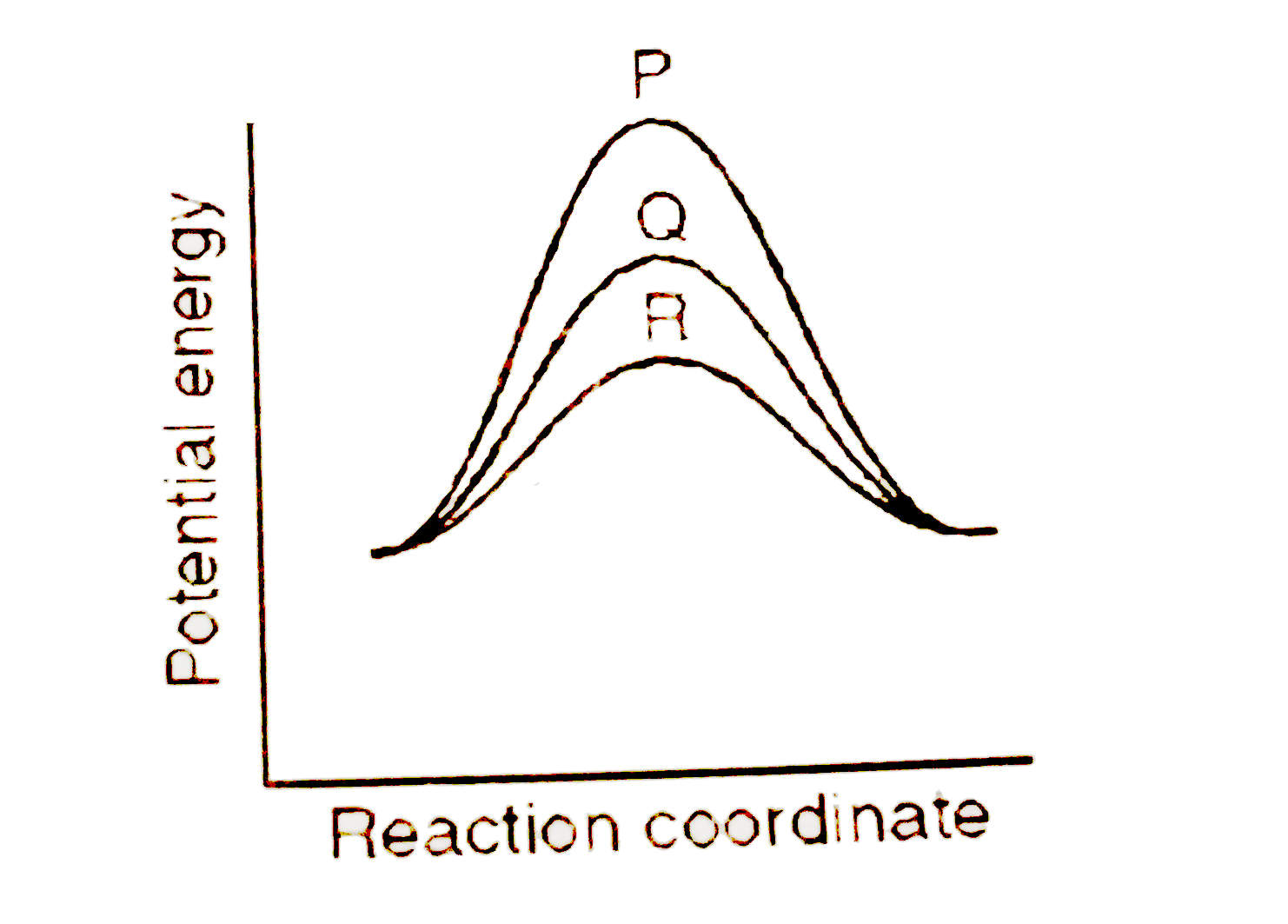
If a homogeneous catalytic reaction can take place through three alternative paths as depicted below, the catalytic efficiency of P,Q R representing the relative case would be

A

`AgtBgtC`

B

`CgtBgtA`

C

`AgtCgtB`

D

A=B=C

Text Solution

Verified by Experts

The correct Answer is:

B
Promotional Banner

Topper's Solved these Questions

  • CHEMICAL KINETICS

    OP TANDON|Exercise OBJECTIVE QUESTIONS (LEVEL-B) SET II|13 Videos
  • CHEMICAL KINETICS

    OP TANDON|Exercise ASSERTION- REASON TYPE QUESTIONS|14 Videos
  • CHEMICAL KINETICS

    OP TANDON|Exercise OBJECTIVE QUESTIONS (LEVEL-A)|192 Videos
  • CARBOXYLIC ACIDS AND THEIR DERIVATIVES

    OP TANDON|Exercise Integer|4 Videos
  • Chemical Thermodynamics and Thermochemistry

    OP TANDON|Exercise Self Assessment (Integer type).|3 Videos

Similar Questions

Explore conceptually related problems

A homogenous catalytic reaction takes place through the three alternative plots A, B, and C shown in the given figure. Which one of the following indicates the relative ease with which the reaction cant take place?

If a homogeneous catalytic reaction follows three alternative paths A, B and C, then which of the following indicates the relative ease with which the reaction moves?

Substances which alter the velocity of a reaction by mere presence, without undergoing any change in mass and compossition are termed catalyst and the phenomenon is known as catalysis In homogenous catalytic reactions, there are three alternative paths A, B, and C (shown in figure). Which one of the following indicates the relative ease with which the reaction can take place?

Assertion (A): A certain recation is catalysed by acids and the catalytic activity of 0.1M solutions of the acids in water decrease in the order, HCI, HCOOH , and CH_(3)COOH . The same reaction takes place in anhydrous NH_(3) , but the three acids have same catalytic effect in 0.1M solution. Reason (R) : The order of catalytic activity in water is the same as the order of acidity. in anhyrous NH_(3) , all the three acids are strong.

Organic reactions take place through the formations of reactive carbon intermediates formed by cleavage of covalent bonds. Formation of these intermediates depends upon the dissociation energies of covalent bonds. In which cases, free radicals can be formed by homolytic fission ?

Organic reactions take place through the formations of reactive carbon intermediates formed by cleavage of covalent bonds. Formation of these intermediates depends upon the dissociation energies of covalent bonds. 3. In the following diagram, stability of different radicals have been represented. These can be Match the potential curve with free radical

Hydrogenation of alkenes and alkynes takes place in presence of certain catalysts. In Sabatier Senderen's reaction, the addition of hydrogen takes place I presence of Raney nickel catalyst. Platininm and palladium can also be used as catalyst and used in finley divided state. Experimentally, it is observed that less crowded alkenes adsorb H_(2) with faster rate. Controlled hydrogenation of alkyne H_(2) with faster rate. Controlled hydrogenation of alkyne in presence of Lindlar's catalyst yields cis product i.e., 'cis' alkene. Thus, in presence of Lindlar's catalyst 'syn' addition takes place. The relative rate of hydrogenation follows the order: Non-terminal alkynes are reduced in presence of Na or Li metal dissolved in liquid ammonia. In this reaction, anti-addition of hydrogen results into the trans-product. Answer the following questions: The relative rate of catalytic hydrogenation of following alkenes is:

OP TANDON-CHEMICAL KINETICS-OBJECTIVE QUESTIONS (LEVEL-B) SET I
  1. Half life of a reaction becomes half when intial concentrations of rea...

    Text Solution

    |

  2. Arrehnius equation is : k=Ae^(-E(a)//RT) Which of the following gr...

    Text Solution

    |

  3. If a homogeneous catalytic reaction can take place through three alter...

    Text Solution

    |

  4. The rate constant for the reaction: 2N(2)O(5) rarr 4NO(2)+O(2) is 3....

    Text Solution

    |

  5. Consider the following statement : 1 The rate of reaction is always ...

    Text Solution

    |

  6. Two different first order reactions have rate consants k(1) and k(2) "...

    Text Solution

    |

  7. In the reaction A+BrarrC+D, the rate ((dx)/(dt)) when plotted against ...

    Text Solution

    |

  8. In the hober's process of ammonia manufacture, N(2)(g)+3H(2)(g) rarr...

    Text Solution

    |

  9. A reaction ArarrB , involes following mechanism : Step1 : Aoverset(...

    Text Solution

    |

  10. For a gaseous reaction, the following data were recorded : The or...

    Text Solution

    |

  11. The half of second order reactin is :

    Text Solution

    |

  12. What names apply to chemical species corresponding to locations 1 and ...

    Text Solution

    |

  13. Consider this reaction : 2NO(2)(g)+O(3)(g)rarrN(2)O(5)(g)+O(2)(g) ...

    Text Solution

    |

  14. Use the experimental data in the table to determine was studies ...

    Text Solution

    |

  15. In which of the following reactions, the increase in the rate of react...

    Text Solution

    |

  16. Which of the reactions represented in these diagrams will show the gre...

    Text Solution

    |

  17. Which function of [X] . Polleted against time, will give a straight li...

    Text Solution

    |

  18. Decomposition of H(2)O(2), is a first order reaction. A 16 volume solu...

    Text Solution

    |

  19. What is the activation energy for the reverse of this reaction? N(2)...

    Text Solution

    |

  20. The reaction between chloroform, CHCl(3)(g) and chlorine Cl(2)(g) to f...

    Text Solution

    |
