
Home
Class 12
CHEMISTRY
For a first order reaction A(g)rarr2B(g)...

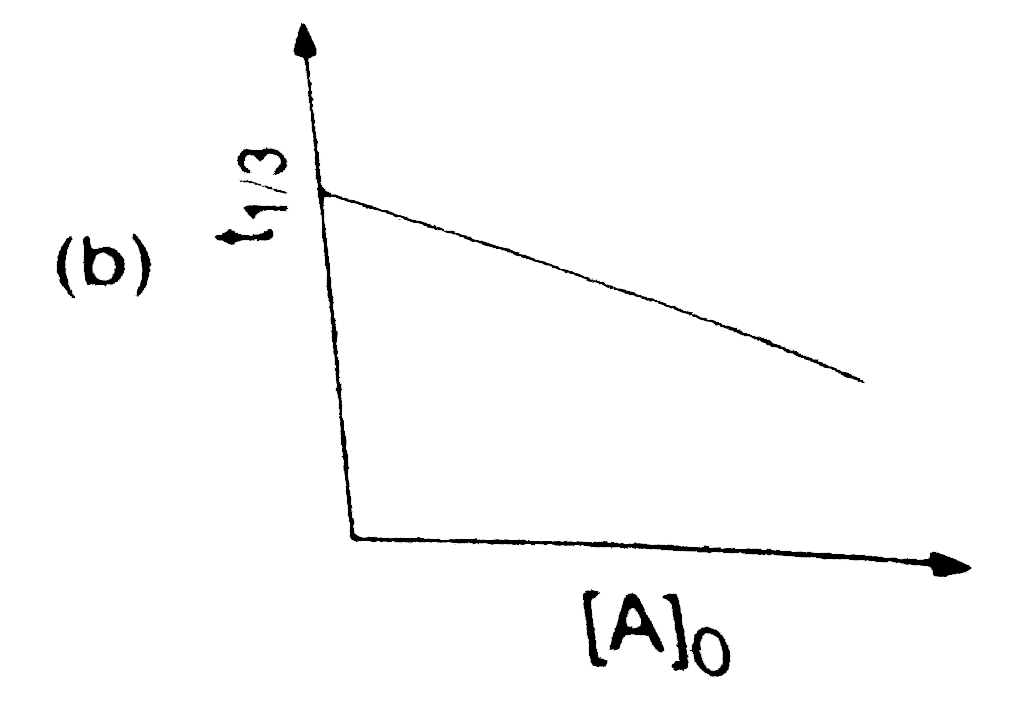
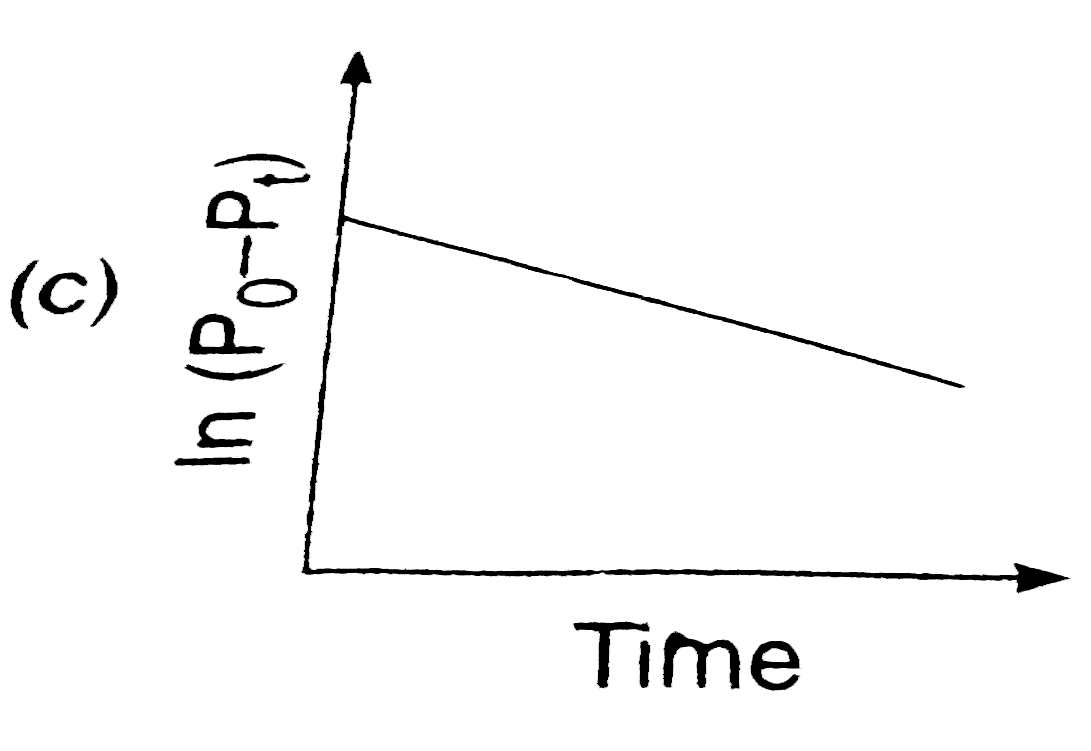
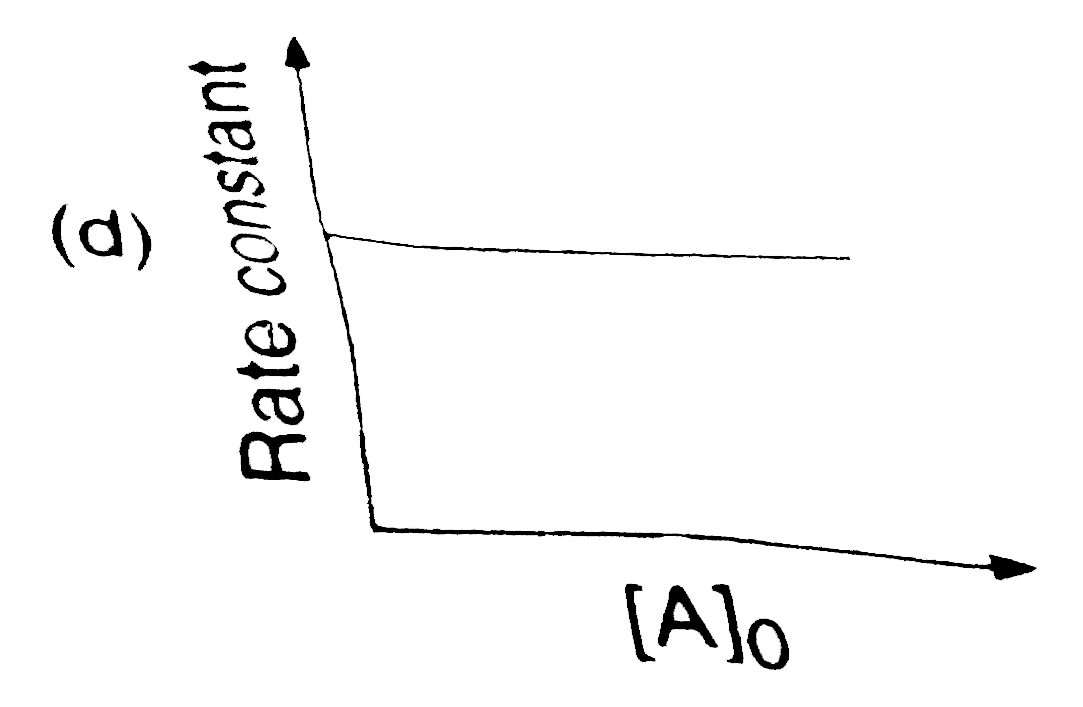
For a first order reaction `A(g)rarr2B(g)+C(g)` at constant volume and 300 K, the total pressure at the beginning (t=0) and at time t ae `P_(0) and P_(t)` respectively. Initially, only A is present with concentration `[A]_(0) and t_(1//3)` is the time required for the partial pressure of A to reach 1/3rd of its initial value. The correct options (s) is (are) :
(Assume that all these behave as ideal gases)

A

B

C

D

Text Solution

AI Generated Solution

The correct Answer is:

To solve the problem step by step, we will analyze the first-order reaction given and derive the necessary relationships. ### Step 1: Understand the Reaction The reaction is given as: \[ A(g) \rightarrow 2B(g) + C(g) \] Initially, only A is present. Let's denote: - Initial pressure of A as \( P_0 \) - Partial pressure of A at time \( t \) as \( P \) - Total pressure at time \( t \) as \( P_t \) ### Step 2: Express Total Pressure At time \( t = 0 \), the total pressure \( P_0 \) is due to A alone. As the reaction proceeds, A is converted into products B and C. If \( x \) is the decrease in pressure of A at time \( t \): - The pressure of A at time \( t \) is \( P_0 - x \) - The pressure of B produced is \( 2x \) - The pressure of C produced is \( x \) Thus, the total pressure at time \( t \) can be expressed as: \[ P_t = (P_0 - x) + 2x + x = P_0 + 2x \] ### Step 3: Relate Change in Pressure to Time For a first-order reaction, the rate constant \( k \) is related to the concentration (or pressure) of the reactant by the equation: \[ k = \frac{1}{t} \ln\left(\frac{P_0}{P_0 - x}\right) \] ### Step 4: Determine \( x \) at \( t_{1/3} \) We are given that \( t_{1/3} \) is the time required for the partial pressure of A to reach \( \frac{1}{3} P_0 \). Thus, at \( t = t_{1/3} \): \[ P = \frac{1}{3} P_0 \] This means: \[ x = P_0 - P = P_0 - \frac{1}{3} P_0 = \frac{2}{3} P_0 \] ### Step 5: Substitute \( x \) into Total Pressure Equation Now substituting \( x \) back into the total pressure equation: \[ P_t = P_0 + 2\left(\frac{2}{3} P_0\right) = P_0 + \frac{4}{3} P_0 = \frac{7}{3} P_0 \] ### Step 6: Relate \( P_t \) to the Rate Constant Now substituting \( x \) into the rate constant equation: \[ k = \frac{1}{t_{1/3}} \ln\left(\frac{P_0}{\frac{1}{3} P_0}\right) = \frac{1}{t_{1/3}} \ln(3) \] Thus, we can express \( t_{1/3} \) in terms of \( k \): \[ t_{1/3} = \frac{1}{k} \ln(3) \] ### Step 7: Analyze Graphs From the derived relationships, we can analyze the graphs: 1. The graph of \( \ln(3P_0 - P_t) \) vs. time will be a straight line with a negative slope, indicating a first-order reaction. 2. The relationship between \( t_{1/3} \) and concentration does not show a direct correlation, hence a graph showing a negative slope would be incorrect. 3. The relationship between the rate constant \( k \) and initial pressure \( P_0 \) shows no direct correlation, as \( k \) is constant for a given reaction. ### Conclusion The correct options based on the analysis would be the graphs that depict the relationship of \( \ln(3P_0 - P_t) \) vs. time and the graph showing no relationship between \( k \) and \( P_0 \). ---

To solve the problem step by step, we will analyze the first-order reaction given and derive the necessary relationships. ### Step 1: Understand the Reaction The reaction is given as: \[ A(g) \rightarrow 2B(g) + C(g) \] Initially, only A is present. Let's denote: - Initial pressure of A as \( P_0 \) - Partial pressure of A at time \( t \) as \( P \) ...
Promotional Banner

Topper's Solved these Questions

  • CHEMICAL KINETICS

    OP TANDON|Exercise ASSERTION- REASON TYPE QUESTIONS|14 Videos
  • CHEMICAL KINETICS

    OP TANDON|Exercise MATRIX MATCHING TYPE QUESTIONS|11 Videos
  • CHEMICAL KINETICS

    OP TANDON|Exercise OBJECTIVE QUESTIONS (LEVEL-B) SET I|48 Videos
  • CARBOXYLIC ACIDS AND THEIR DERIVATIVES

    OP TANDON|Exercise Integer|4 Videos
  • Chemical Thermodynamics and Thermochemistry

    OP TANDON|Exercise Self Assessment (Integer type).|3 Videos

Similar Questions

Explore conceptually related problems

For a first order gas phase reaction : A_((g)) to 2B_((g)) +C_((g)) P_(0) be initial pressure of A and P_(t) the total pressure at time 't'. Integrated rate equation is :

For the first order reaction A(g) rarr 2B(g) + C(g) , the initial presuure is P_(A) = 90 m Hg , the pressure after 10 minutes is found to be 180 mm Hg . The rate constant of the reaction is

For a gas phase first order reaction, A(g) rightarrow B(g)+2C(g)+D(g) The initial pressure was P_(0) While pressure after 't' time becomes P_(t) ( P_(t) > P_(0) ). The expression for the rate constant (K) would be

Consider a first order reaction at "450K X(g)rarr Y(g)+Z(g) What is the rate constant of the reaction using given data? [Assume initially only X is present ] [[Time(s),0, 5 ],[(" Total Pressure "),15,20]]
