Home
Class 12
CHEMISTRY
Which of the following reacts fastest wi...

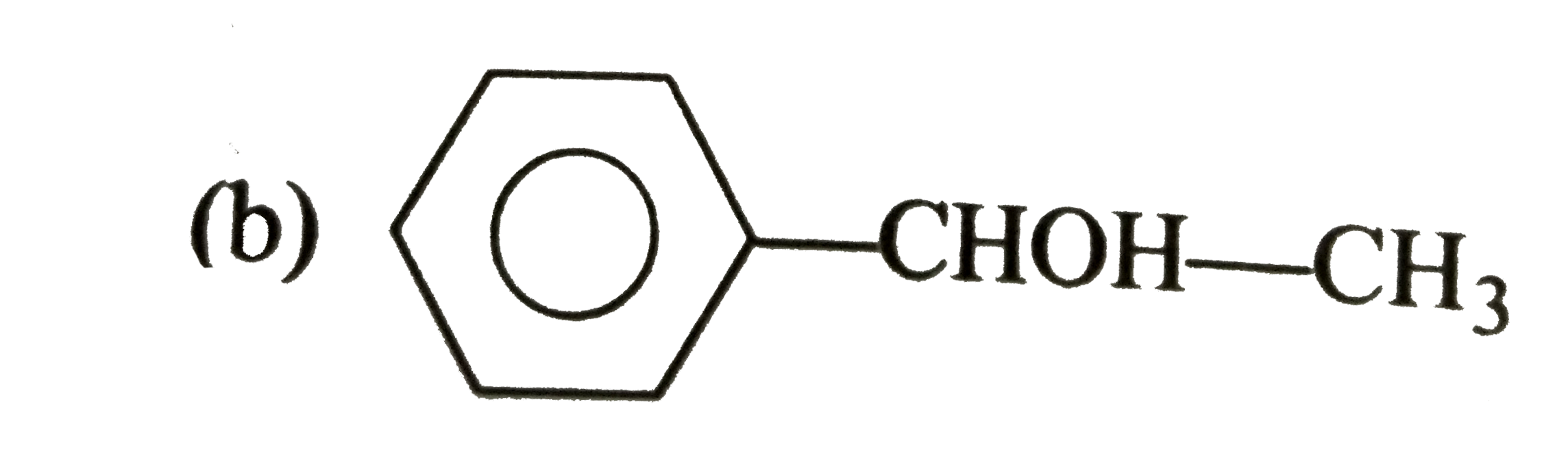
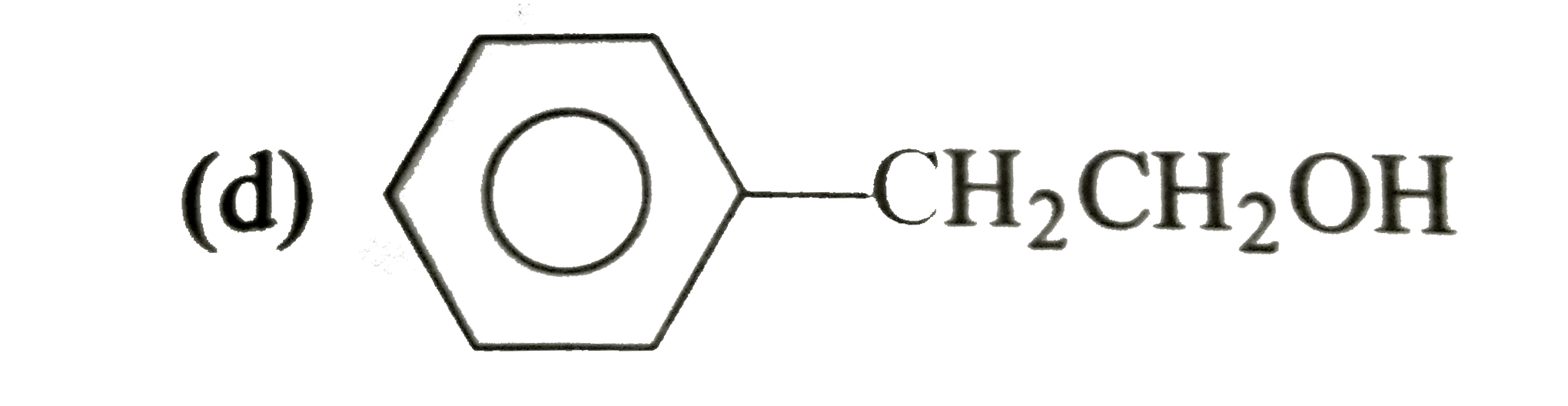
Which of the following reacts fastest with conc. HCl ?

A

`(CH_(3))_(3)C-OH`

B

C

`H_(2)C=CH-CH_(2)OH`

D

Text Solution

AI Generated Solution

The correct Answer is:

To determine which compound reacts fastest with concentrated HCl, we need to analyze the stability of the carbocations formed from each compound when they react with HCl. The stability of carbocations is a crucial factor in determining the rate of reaction. ### Step-by-Step Solution: 1. **Identify the Compounds**: We have four compounds to consider: - Tertiary alcohol: \( \text{(CH}_3\text{)}_3\text{COH} \) - Benzyl alcohol: \( \text{C}_6\text{H}_5\text{CH}_2\text{OH} \) - Allyl alcohol: \( \text{CH}_2=\text{CH}\text{CH}_2\text{OH} \) - 2-Phenyl ethanol: \( \text{C}_6\text{H}_5\text{CH}_2\text{CH}_2\text{OH} \) 2. **Reaction with HCl**: When these alcohols react with concentrated HCl, they form oxonium ions (protonated alcohols) which then lose water to form carbocations: - Tertiary alcohol forms a tertiary carbocation. - Benzyl alcohol forms a benzyl carbocation. - Allyl alcohol forms an allyl carbocation. - 2-Phenyl ethanol forms a primary carbocation. 3. **Stability of Carbocations**: - **Tertiary Carbocation**: Very stable due to hyperconjugation and inductive effects from three alkyl groups. - **Benzyl Carbocation**: Very stable due to resonance stabilization from the adjacent benzene ring. - **Allyl Carbocation**: Moderately stable due to resonance but less than benzyl. - **Primary Carbocation**: Least stable as it has no alkyl groups to stabilize the positive charge. 4. **Comparison of Stability**: - The order of stability of the carbocations formed is: - Benzyl carbocation > Tertiary carbocation > Allyl carbocation > Primary carbocation. 5. **Conclusion**: Since the benzyl carbocation is the most stable, the compound that reacts fastest with concentrated HCl is the benzyl alcohol \( \text{C}_6\text{H}_5\text{CH}_2\text{OH} \). ### Final Answer: The compound that reacts fastest with concentrated HCl is **Benzyl alcohol**.
Promotional Banner

Topper's Solved these Questions

  • ALCOHOLS, PHENOLS AND ETHERS

    OP TANDON|Exercise (C )ETHERS|90 Videos
  • ALCOHOLS, PHENOLS AND ETHERS

    OP TANDON|Exercise OBJECTIVE QUESTIONS (LEVEL-B)|30 Videos
  • ALCOHOLS, PHENOLS AND ETHERS

    OP TANDON|Exercise BRAI STORMING PROBLEMS|32 Videos
  • ALDEHYDES AND KETONES

    OP TANDON|Exercise SINGLE INTEGER ANSWER TYPE QUESTIONS|10 Videos
OP TANDON-ALCOHOLS, PHENOLS AND ETHERS-OBJECTIVE QUESTIONS (LEVEL-A)
  1. CH(3)CH(2)OHunderset("Step 1")overset(Cl(2))(rarr)CH(3)CHOunderset("St...

    Text Solution

    |

  2. Starch is converted to ethanol by fermentation , the sequence of enzym...

    Text Solution

    |

  3. Which of the following reacts fastest with conc. HCl ?

    Text Solution

    |

  4. In the following reactions, (a) H(3)C-overset(CH(3))overset("| "...

    Text Solution

    |

  5. Which of the following reagents can be used to oxidise primary alcohol...

    Text Solution

    |

  6. An organic liquid A containing C,H and O has a pleasant odour with a b...

    Text Solution

    |

  7. In the following sequence of reactions, CH(3)CH(2)OHoverset(P+I(2))(...

    Text Solution

    |

  8. A liquid was mixed with ethanol and a drop of concentrated H(2) SO(4) ...

    Text Solution

    |

  9. An organic compound 'X' on treatment with pyridinium chlorochromate in...

    Text Solution

    |

  10. Methyl alcohol when reacted with carbon monoxide using cobalt or rhodi...

    Text Solution

    |

  11. (X) is :

    Text Solution

    |

  12. CH(3)COOHoverset(LiAlH(4))(rarr)(A), (A)+CH(3)COOHoverset(H(3)O^(+))(r...

    Text Solution

    |

  13. Which among the following compounds will give a secondary alcohol on r...

    Text Solution

    |

  14. The reagent most suitable for converting a primary alcohol into an ald...

    Text Solution

    |

  15. In the following reaction A is

    Text Solution

    |

  16. When CH(2)=CH -CO OH is reduced with LiAlH(4) the compound obtained wi...

    Text Solution

    |

  17. The compound on dehydrogenation gives a ketone. The original compound ...

    Text Solution

    |

  18. R-CH(2)-CH(2)OH can be converted into RCH(2)CH(2)COOH the correct seq...

    Text Solution

    |

  19. Which of the following will produce only one product on reduction with...

    Text Solution

    |

  20. The hydrolysis of 2-bromo-3-methylbutane by S(N^(1)) mechanism gives m...

    Text Solution

    |
