

Home
Class 12
CHEMISTRY
Which of the following carbocation can n...

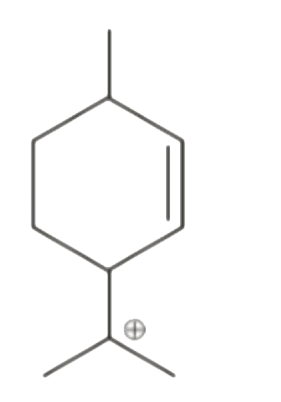
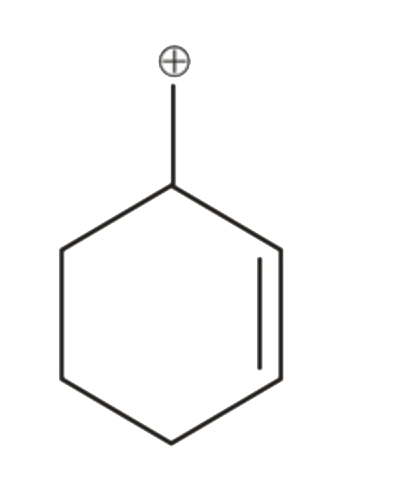
Which of the following carbocation can not undergo rearrangement ?

A

B

C

`CH_3-underset(CH_3)underset(|)overset(o+)(C )-CH-CH_3`

D

`C_6H_5-CH-overset(o+)(C )H_2`

Text Solution

AI Generated Solution

The correct Answer is:
To determine which carbocation cannot undergo rearrangement, we need to analyze the stability of the carbocations presented in the options. Carbocations tend to rearrange to achieve a more stable state, typically moving from a less stable to a more stable form (e.g., from primary to secondary to tertiary). ### Step-by-Step Solution: 1. **Identify the Carbocations**: - We have several carbocations to analyze. Let's denote them as: - Option 1: Tertiary Carbocation (3°) - Option 2: Primary Carbocation (1°) - Option 3: Tertiary Carbocation (3°) - Option 4: Primary Carbocation (1°) 2. **Understanding Carbocation Stability**: - Carbocations are classified based on their degree: - Tertiary (3°) > Secondary (2°) > Primary (1°) - The most stable carbocation is tertiary, followed by secondary, and the least stable is primary. 3. **Analyze Each Option**: - **Option 1 (3°)**: - This is a tertiary carbocation. If a hydrogen shifts to form a new carbocation, it would still be a tertiary carbocation. Thus, rearrangement is possible. - **Option 2 (1°)**: - This is a primary carbocation. If a hydrogen shifts, it can form a more stable tertiary carbocation. Hence, rearrangement is possible. - **Option 3 (3°)**: - This is also a tertiary carbocation. Any rearrangement would lead to a less stable primary carbocation. Therefore, rearrangement will not occur because it would decrease stability. - **Option 4 (1°)**: - This is a primary carbocation. If a hydrogen shifts, it can form a more stable secondary or tertiary carbocation. Thus, rearrangement is possible. 4. **Conclusion**: - The only carbocation that cannot undergo rearrangement is **Option 3**, which is a tertiary carbocation that would lead to a less stable primary carbocation if rearranged. ### Final Answer: **Option 3** is the carbocation that cannot undergo rearrangement.
Promotional Banner

Topper's Solved these Questions

  • NTA NEET TEST 102

    NTA MOCK TESTS|Exercise CHEMISTRY|45 Videos
  • NTA NEET TEST 111

    NTA MOCK TESTS|Exercise CHEMISTRY|45 Videos

Similar Questions

Explore conceptually related problems

Which of the following carbocation will undergo rarrangement ?

Which of the following carbocation is most stable ?

Which of the following carbocation is most stable?

Which of the following carbocation is most stable ?

NTA MOCK TESTS-NTA NEET TEST 103-CHEMISTRY
  1. Which of the following change represents a disproportionation reaction...

    Text Solution

    |

  2. The compound which does not react with sodium is

    Text Solution

    |

  3. Which of the following carbocation can not undergo rearrangement ?

    Text Solution

    |

  4. For two gases, A and B with molecular weights M(A) and M(B). It is obs...

    Text Solution

    |

  5. Formaldehyde reacts with excess of ammonia to give

    Text Solution

    |

  6. When CO2 is passed through brine solution , saturated with ammonia, wh...

    Text Solution

    |

  7. Which arrangement of electrons leads to ferromagnetism ?

    Text Solution

    |

  8. Which oxide of carbon is formed when malonic acid is warmed with P(2)O...

    Text Solution

    |

  9. Saccharin is imide of

    Text Solution

    |

  10. AsF5 reacts with XeF4 to form an adduct. The shapes of cation and anio...

    Text Solution

    |

  11. For the gaseous reaction C2H4 + H2 <implies C2H6 The equilibrium c...

    Text Solution

    |

  12. If the K(a) value in the hydrolysis reaction, B^(+) + H(2)O to BOH + H...

    Text Solution

    |

  13. Dehydration of alcohol into alkene by concentration H2SO4 involves whi...

    Text Solution

    |

  14. What is the name of the complex [Al(OH)(2)(H(2)O)(4)]SO(4) ?

    Text Solution

    |

  15. Which of the following is an incorrect statement ?

    Text Solution

    |

  16. Standard molar enthalpy of formation of CO(2) is equal to :

    Text Solution

    |

  17. The equivalent conductivity of 0.1 M weak acid is 100 times less than ...

    Text Solution

    |

  18. H2O has net dipole moment while BeF2 has zero dipole moment because

    Text Solution

    |

  19. 0.50g sample of impure CaCO3 is dissolved in 50 ml of 0.0985 (N) HCl. ...

    Text Solution

    |

  20. In which of the following redox reaction precipitate is not formed?

    Text Solution

    |