Home
Class 12
CHEMISTRY
In the given reaction, OHC-(CH(2))(3)-...

In the given reaction,
`OHC-(CH_(2))_(3)-overset(O)overset(||)C-CH_(3)overset(overset(Theta)(O)H//Delta)rarr (X)'`
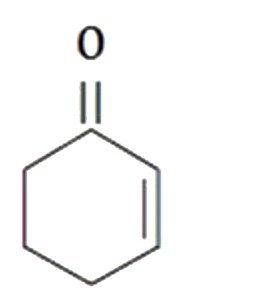
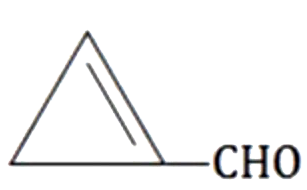
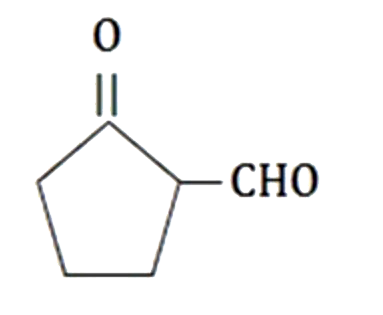
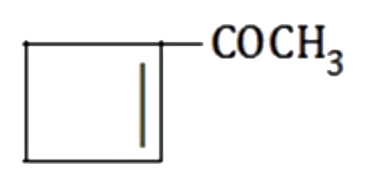
the major product 'X' will be

A

B

C

D

Text Solution

AI Generated Solution

The correct Answer is:

To solve the given reaction step by step, we need to analyze the structure and the reaction conditions provided. The reaction involves a carbonyl compound with hydroxide ion (OH-) as a base, and we are looking for the major product 'X'. ### Step 1: Identify the Structure The compound given is: \[ \text{OHC-(CH}_2\text{)}_3-\text{C=O-CH}_3 \] This structure includes an aldehyde (OHC-) and a ketone (C=O) functional group. ### Step 2: Identify the Alpha Protons In this compound, the alpha protons are located on the carbon atoms adjacent to the carbonyl groups. We have two potential alpha positions: 1. The carbon adjacent to the aldehyde (CHO). 2. The carbon adjacent to the ketone (C=O). ### Step 3: Deprotonation by OH- When OH- acts as a base, it can deprotonate one of the alpha protons. Let's denote the alpha carbon next to the aldehyde as alpha (α) and the one next to the ketone as alpha dash (α'). ### Step 4: Formation of Enolate Ion If we deprotonate the alpha carbon (α), we form an enolate ion: \[ \text{OHC-(CH}_2\text{)}_3-\text{C=O-CH}_3 \rightarrow \text{OHC-(CH}_2\text{)}_3-\text{C=O-CH}_3^- \] This enolate ion can then attack the carbonyl carbon of the ketone. ### Step 5: Nucleophilic Attack The enolate ion will attack the carbonyl carbon of the ketone, leading to the formation of a cyclic intermediate. The nucleophilic attack will lead to the formation of a six-membered ring due to the stability of larger rings compared to smaller ones. ### Step 6: Cyclization The nucleophilic attack results in a six-membered ring structure, which is more stable than a four-membered ring. The structure will look like this: \[ \text{Cyclic structure with a ketone and an aldehyde} \] ### Step 7: Proton Transfer and Dehydration After the formation of the cyclic intermediate, a proton transfer occurs, followed by dehydration (loss of water) to form a double bond, resulting in the alkene product. ### Step 8: Identify the Major Product The major product 'X' is a stable alkene formed from the dehydration of the cyclic intermediate. The major product will be the one that is more stable due to the absence of strain, which is the product formed from the six-membered ring. ### Final Answer The major product 'X' will be: **Option A** (the specific structure of the alkene product). ---
Promotional Banner

Topper's Solved these Questions

  • NTA JEE MOCK TEST 107

    NTA MOCK TESTS|Exercise CHEMISTRY|25 Videos
  • NTA JEE MOCK TEST 109

    NTA MOCK TESTS|Exercise CHEMISTRY|25 Videos

Similar Questions

Explore conceptually related problems

H_(3)C-Ch_(2)-overset(O)overset(||)C-Ch_(3)overset(overset(Theta)OD//D_(2)O)rarr Final product is :

In the given reaction [C_6H_5-CH_2-CH_2-overset(o+)(N)(CH_3)_2-CH_2-CH_3]overset(Theta)(OH)overset(Delta)rarr (X) as major product will be

H_(2)N-overset(O)overset(||)C-CH_(2)-CH_(2)-overset(O)overset(||)C-N_(3)overset(Delta)rarr P P is :

Ch_(3)-overset(O)overset(||)C-overset(O)overset(||)C-Phoverset(CH_(3)CO_(3)H)rarr product, Product will be :

In the given reaction, CH_(3)-underset(CH_3)underset(|)(CH)-overset(O)overset(||)(C )-CH_2-CH_3 overset(CF_3CO_3H)(rarr)(X) as main product, 'X' will be

In the reaction 2 CH_(3)underset(O)underset(||)(C)CH_(3)overset("Base")(rarr)A overset(Delta)(rarr)B the product B is :

CH_(3)CH_(2)-overset(O)overset(||)(C)-CH_(3) overset(NaNO_(2))underset(HCl)(to) , Major product of this reaction is :

NTA MOCK TESTS-NTA JEE MOCK TEST 108-CHEMISTRY
  1. The ionization constant of overset(o+)(NH(4)) ion in water is 5.6 xx 1...

    Text Solution

    |

  2. Match List I with List II and select the correct anwer using the codes...

    Text Solution

    |

  3. When H(2) is added to two isomeric alkenes A and B having molecular fo...

    Text Solution

    |

  4. Which of the following set is having correct statements here regarding...

    Text Solution

    |

  5. The heat of neutralisation of a strong base and a strong acid is 13.7 ...

    Text Solution

    |

  6. Approximate pH of 0.01M aqueous H(2)S solution, when K(1) and K(2) for...

    Text Solution

    |

  7. The ionization enthalpies of Li and Na are "520 kJ mol"^(-1) and "495 ...

    Text Solution

    |

  8. Which of the following given below can liberate Br(2) from KBr? F(2)...

    Text Solution

    |

  9. In the given reaction, OHC-(CH(2))(3)-overset(O)overset(||)C-CH(3)ov...

    Text Solution

    |

  10. 5g sulphur is present in 100 g of CS(2). DeltaT(b) of solution 0.954 a...

    Text Solution

    |

  11. The halides which can react with water or undergo hydrolysis are PCl(5...

    Text Solution

    |

  12. Which one of the following are examples of Sandmeyer reaction?

    Text Solution

    |

  13. Identify the final product 'W' in the given reaction sequence

    Text Solution

    |

  14. In the given reaction CH(3)-COOH underset(underset("(iii) "H(2)O //H^(...

    Text Solution

    |

  15. Arrange the following in increasing order of acidic strength

    Text Solution

    |

  16. An organic compound (P) having molecular mass 180 is acylated with CH(...

    Text Solution

    |

  17. A sample of H(2) SO(4) (density 1.787 g mL^(-1)) is labelled as 86% by...

    Text Solution

    |

  18. The possible numerof structural and stereo isomers for the complex [MB...

    Text Solution

    |

  19. An electrolytic cell is constructed for preparing hydrogen. For an ave...

    Text Solution

    |

  20. For the equilibrium: LiCl.3NH(3(s))hArrLiCl.NH(3(s))+2NH(3), K(p)=9 ...

    Text Solution

    |
