Home
Class 12
CHEMISTRY
In the given reaction CH(3)-COOH underse...

In the given reaction `CH_(3)-COOH underset(underset("(iii) "H_(2)O //H^(o+))("(ii) "NaCN))overset("(i) Red "-P+Br_(2))rarr(X)`
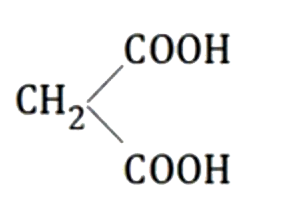
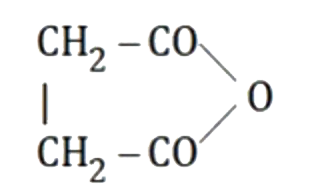
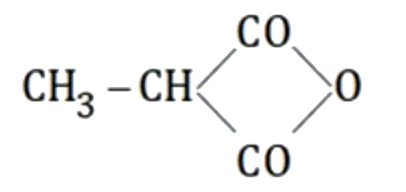
'X' will be

A

B

`COOH-CH_(2)-CH_(2)-COOH`

C

D

Text Solution

AI Generated Solution

The correct Answer is:

To determine the product 'X' from the given reaction sequence involving acetic acid (CH₃COOH), we will break down the reaction into three steps as described in the video transcript. ### Step 1: Reaction with Red Phosphorus and Bromine 1. **Starting Material**: Acetic acid (CH₃COOH). 2. **Reagents**: Red phosphorus (P) and bromine (Br₂). 3. **Reaction Type**: This is known as the Hell-Volhard-Zelinsky (HVZ) reaction, where the acidic hydrogen at the alpha position (the carbon adjacent to the carboxylic acid group) is replaced by bromine. 4. **Mechanism**: The red phosphorus and bromine will remove the hydrogen atom from the alpha carbon (CH₃-), resulting in the formation of a brominated acetic acid. 5. **Product**: The product after this step will be 2-bromoacetic acid (CH₂BrCOOH). ### Step 2: Reaction with Sodium Cyanide (NaCN) 1. **Starting Material**: 2-bromoacetic acid (CH₂BrCOOH). 2. **Reagent**: Sodium cyanide (NaCN). 3. **Mechanism**: The cyanide ion (CN⁻) acts as a nucleophile and attacks the carbon atom bonded to the bromine (the alpha carbon). The bromine atom leaves, resulting in the formation of a new compound. 4. **Product**: The product after this step will be 2-cyanoacetic acid (CH₂(CN)COOH). ### Step 3: Hydrolysis of the Cyanide Group 1. **Starting Material**: 2-cyanoacetic acid (CH₂(CN)COOH). 2. **Process**: Hydrolysis of the cyano group (CN) occurs in the presence of water (H₂O) and typically involves an acid or base to facilitate the reaction. 3. **Mechanism**: The cyano group is converted into a carboxylic acid group (-COOH) through hydrolysis. 4. **Product**: The final product after hydrolysis will be 2-hydroxyacetic acid (CH₂COOH), which is also known as lactic acid. ### Final Product The final product 'X' after all three steps is 2-hydroxyacetic acid (CH₂COOH). ### Summary of Steps: 1. **Step 1**: CH₃COOH + P + Br₂ → CH₂BrCOOH (2-bromoacetic acid) 2. **Step 2**: CH₂BrCOOH + NaCN → CH₂(CN)COOH (2-cyanoacetic acid) 3. **Step 3**: CH₂(CN)COOH + H₂O → CH₂COOH (2-hydroxyacetic acid)
Promotional Banner

Topper's Solved these Questions

  • NTA JEE MOCK TEST 107

    NTA MOCK TESTS|Exercise CHEMISTRY|25 Videos
  • NTA JEE MOCK TEST 109

    NTA MOCK TESTS|Exercise CHEMISTRY|25 Videos

Similar Questions

Explore conceptually related problems

In the given reaction CH_(3)-COOHundersetunderset((iii)." "H_(2)O //H^(o+)//Delta)((ii)." "NaCN)overset((i)." "Br_(2)//"red P")to[X] [X] will be

In the given reaction CH_(3)COOH underset({:((ii)NaCN),((iii)H_(2)O //H^(o+)//Delta):})overset((i)Br_(2)//P)to[x],[x] will be

In the given reaction C_(6)H_(5)-overset(O)overset(||)(C)-CH_(3)underset((ii)." "H^(o+))overset((i)." "Br_(2)//KOH)toCHBr_(3)+[X] [X] will be:

In the given reaction RCN underset((ii)H_2O //H^+)overset((i)RMgX)rarr(X) , (X) will be

In the given reaction CH_(3)CHOunderset((ii)." "H_(2)O //H^(o+)//Delta)overset((i)." "NaCN//HCl)to(A)underset("reagent")overset("Fenton")to(B) (B) will be

underset((A))(MeCH_(2)COOH)underset(underset((iii)Ag_(2)O //Pt)((ii)CH_(2)N_(2)))overset((i)SOCI)rarr(B)overset(H_(2)O)rarr(C) Which of the following statements are correct about the given reaction.

CH_(3)COOH overset(Br_(2)//P)rarr Y underset((i) H_(3)O^(+))overset((i)KCN)rarr X Here, X is

In the reaction sequence C_(6)H_(5)-underset(O)underset(||)C-CH_(3)overset(NH_(2)OH//overset(o+)H)rarr(A)overset(P_(2)O_(5))rarr [X] [X] will be

Identify the (X), (Y), and (Z) in the following reactions PhCH_(2)Br+CH_(3)-overset(O)overset(||)(C)-CH_(3)underset("(ii) :"B^(Theta))overset("(i) "Ph_(3)P)rarr(X)

NTA MOCK TESTS-NTA JEE MOCK TEST 108-CHEMISTRY
  1. The ionization constant of overset(o+)(NH(4)) ion in water is 5.6 xx 1...

    Text Solution

    |

  2. Match List I with List II and select the correct anwer using the codes...

    Text Solution

    |

  3. When H(2) is added to two isomeric alkenes A and B having molecular fo...

    Text Solution

    |

  4. Which of the following set is having correct statements here regarding...

    Text Solution

    |

  5. The heat of neutralisation of a strong base and a strong acid is 13.7 ...

    Text Solution

    |

  6. Approximate pH of 0.01M aqueous H(2)S solution, when K(1) and K(2) for...

    Text Solution

    |

  7. The ionization enthalpies of Li and Na are "520 kJ mol"^(-1) and "495 ...

    Text Solution

    |

  8. Which of the following given below can liberate Br(2) from KBr? F(2)...

    Text Solution

    |

  9. In the given reaction, OHC-(CH(2))(3)-overset(O)overset(||)C-CH(3)ov...

    Text Solution

    |

  10. 5g sulphur is present in 100 g of CS(2). DeltaT(b) of solution 0.954 a...

    Text Solution

    |

  11. The halides which can react with water or undergo hydrolysis are PCl(5...

    Text Solution

    |

  12. Which one of the following are examples of Sandmeyer reaction?

    Text Solution

    |

  13. Identify the final product 'W' in the given reaction sequence

    Text Solution

    |

  14. In the given reaction CH(3)-COOH underset(underset("(iii) "H(2)O //H^(...

    Text Solution

    |

  15. Arrange the following in increasing order of acidic strength

    Text Solution

    |

  16. An organic compound (P) having molecular mass 180 is acylated with CH(...

    Text Solution

    |

  17. A sample of H(2) SO(4) (density 1.787 g mL^(-1)) is labelled as 86% by...

    Text Solution

    |

  18. The possible numerof structural and stereo isomers for the complex [MB...

    Text Solution

    |

  19. An electrolytic cell is constructed for preparing hydrogen. For an ave...

    Text Solution

    |

  20. For the equilibrium: LiCl.3NH(3(s))hArrLiCl.NH(3(s))+2NH(3), K(p)=9 ...

    Text Solution

    |
