Home
Class 12
CHEMISTRY
The first (Delta(i)H(1)) and second (Del...

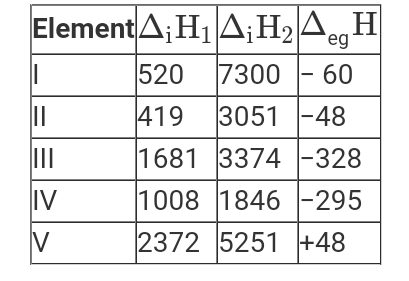
The first `(Delta_(i)H_(1))` and second `(Delta_(i)H_(2))` ionization enthalpies `("in kJ mol"^(-1))` and the electron gain enthalpy `(Delta_(eg)H)("in kJ mol"^(-1))` of the elements I, II, III, IV and V are given below

the least reactive non - metal and the most reactive metal of these are respectively

A

IV and V

B

II and V

C

V and III

D

V and II

Text Solution

Verified by Experts

The correct Answer is:

D
Promotional Banner

Topper's Solved these Questions

  • NTA JEE MOCK TEST 108

    NTA MOCK TESTS|Exercise CHEMISTRY|25 Videos
  • NTA JEE MOCK TEST 19

    NTA MOCK TESTS|Exercise CHEMISTRY|25 Videos

Similar Questions

Explore conceptually related problems

The first (DeltaH_(1)) and second (DeltaH_(2)) ionisation enthalpies (in kJ mol^(-1)) and the (DeltaH_(eg)) electron gain enthalpy (in kJ mol^(-1)) of a elements are given below: Based on the above information match the following columns.

Ionisation enthalpy (Delta_(i)"H kJ mol"^(-1)) for the elements of group 13 follows the order.

Ionisation enthalpy (Delta_(t)H_(l) "in" kJ mol^(-1)) for the elements of group-13 follows the order

The first (Delta_(i)H_(1)) and second (Delta_(i)H_(2)) ionisation enthalpies ("in" kJ mol^(-1)) and the (Delta_(eg)H^(ө)) electron gain enthalpy ("in" kJ mol^(-1)) of a few elements are given below: {:("Elements",(Delta_(i)H_(1)),(Delta_(i)H_(2)),Delta_(eg)H^(ө)),(I,520,7300,-60),(II,419,3051,-48),(III,1681,3374,-328),(IV,1008,1846,-295),(V,2372,5251,+48),(VI,738,1451,-40):} Which of the above elements is likely to be a. the least reactive element. b. the most reactive metal. c. the most reactive non-metal. d. the least reactive non-metal. e. the metal which can form a stable binary halide of the formula MX (X=halogen). f. the metal which can form a predominantly stable covalent halide of the formula MX(X=halogen).

The second electron gain enthalpies (in kJ mol^(-1) ) of oxygen and sulphur respectively are:

Why do halogens have high electron gain enthalpies (i.e. -Delta_(eg)H^(o.)) ?

NTA MOCK TESTS-NTA JEE MOCK TEST 109-CHEMISTRY
  1. N(2) and O(2) are converted into monocations, N(2)^(+) and O(2)^(+) r...

    Text Solution

    |

  2. Consider the following reactions in which all the reactants and the pr...

    Text Solution

    |

  3. The first (Delta(i)H(1)) and second (Delta(i)H(2)) ionization enthalpi...

    Text Solution

    |

  4. Equal volumes of 0.1 M NaCl and 0.06 M CaCl(2) solutions are separated...

    Text Solution

    |

  5. The correct match between Item I and Item II is

    Text Solution

    |

  6. The increasing order of the pK(a) value of the following compounds is

    Text Solution

    |

  7. AgCl dissolved in excess of NH(3), KCN and Na(2)S(2)O(3) solutions the...

    Text Solution

    |

  8. Considered the following statements : 1. Zeolites are aluminosilicat...

    Text Solution

    |

  9. Identify the final product 'E' in the given sequence of reactions here

    Text Solution

    |

  10. The flocculating power of the given ions for the specified colloidal s...

    Text Solution

    |

  11. Among (a) -(d) the complexes that can display geometical isomerism ar...

    Text Solution

    |

  12. The correct match between Item 'I' and Item 'II' is

    Text Solution

    |

  13. Mark the correct statements(s) (1) Manganeses exhibits +7 oxidation ...

    Text Solution

    |

  14. Arrange following compounds in decreasing order of rate of electrophil...

    Text Solution

    |

  15. The given plots represent the variation of the concentration of a reac...

    Text Solution

    |

  16. Chlorine reacts with hot and concentrated NaOH and produces compounds ...

    Text Solution

    |

  17. In the Kjeldahl's method for estimation of nitrogen present in a soil ...

    Text Solution

    |

  18. pH of saturated solution of Ba(OH)(2) is 12. The value of solubility p...

    Text Solution

    |

  19. The number of stereo isomers possible for a compound of the molecular ...

    Text Solution

    |

  20. The percentage of p-character in the orbitals forming p-p bonds in P4 ...

    Text Solution

    |
