

Home
Class 11
PHYSICS
The masses m(1) m(2) and m(3) of the thr...

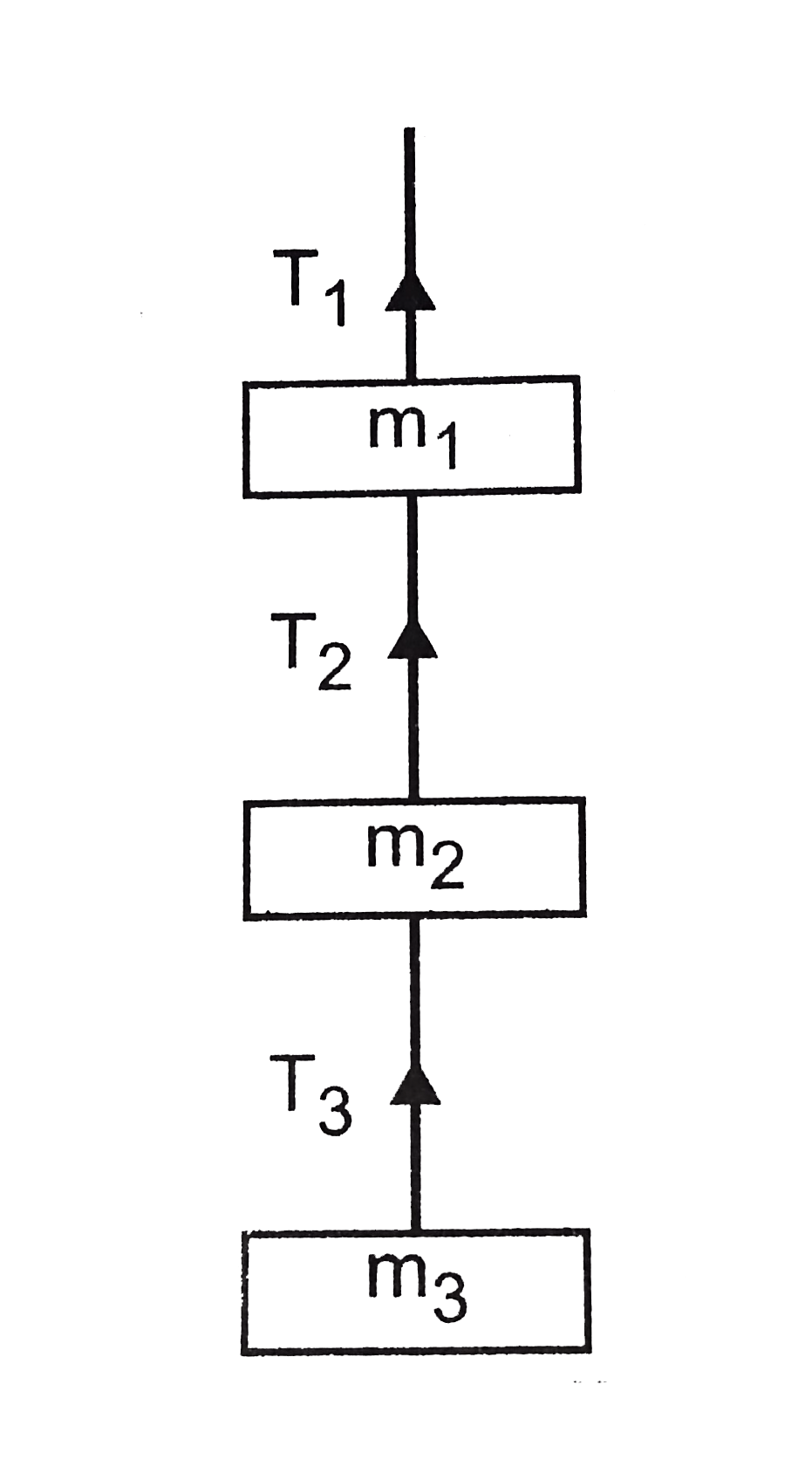
The masses `m_(1) m_(2)` and `m_(3)` of the three bodies shown in fig . Are 5 , 2 and 3 kg respectively Calculate the valuse of tension `T_(1) T_(2)` and `T_(3)` when (i) the whole system is going upward with an acceleration of `2 m//s^(2)` (ii) the whole system is stationary ` (g=9.8 m//s^(2))` .
.

Promotional Banner

Similar Questions

Explore conceptually related problems

Two masses of 5 kg and 3 kg are suspended with help of massless inextensible strings as shown in figure. Calculate T_(1) and T_(2) when whole system is going upwards with acceleration = 2 m/s^(2) 2 (use g = 9.8 ms^(-2) ).

Two masses of 5kg and 3kg are suspended with help of massless inextensible strings as shown in figure. Calculate T_(1) and T_(2) when whole system is going upwards with acceleration =2m//s^(2) (use g = 9.8 ms^(-2)) .

Two masses of 5kg and 3kg are suspended with help of massless inextensible strings as shown in figure. Calculate T_(1) and T_(2) when whole system is going upwards with acceleration =2m//s^(2) (use g = 9.8 ms^(-2)) .

A lift of mass 200 kg is moving upward with an acceleration of 3m//s^(2) . If g=10 m//s^(2) then the tension of string of the lift will be :

The masses M_(1), M_(2) and M_(3) are 5, 2 and 3 kg respectively. These have been joined using massless, inextensible pieces of strings as shown in the figure. If the whole system is going upward with an acceleration of 2ms^(-2) , then the value of tensions T_(1), T_(2) and T_(3) respectively are ["take "g=9.8ms^(-2)]

The masses M_(1), M_(2) and M_(3) are 5, 2 and 3 kg respectively. These have been joined using massless, inextensible pieces of strings as shown in the figure. If the whole system is going upward with an acceleration of 2ms^(-2) , then the value of tensions T_(1), T_(2) and T_(3) respectively are ["take "g=9.8ms^(-2)]

Two masses of 5 kg and 3 kg are suspended with the help of massless inextensible strings as shown in figure. The whole system is going upwards with an acceleration of 2m s^(-2) . The tensions T_(1) and T(2) are respectively ("Take g"=10ms^(-2))

Two objects A and B of masses m_(A) and m_(B) are attached by strings as shown in fig. If they are given upward acceleration then the rato of tension T_(1) : T_(2) is-