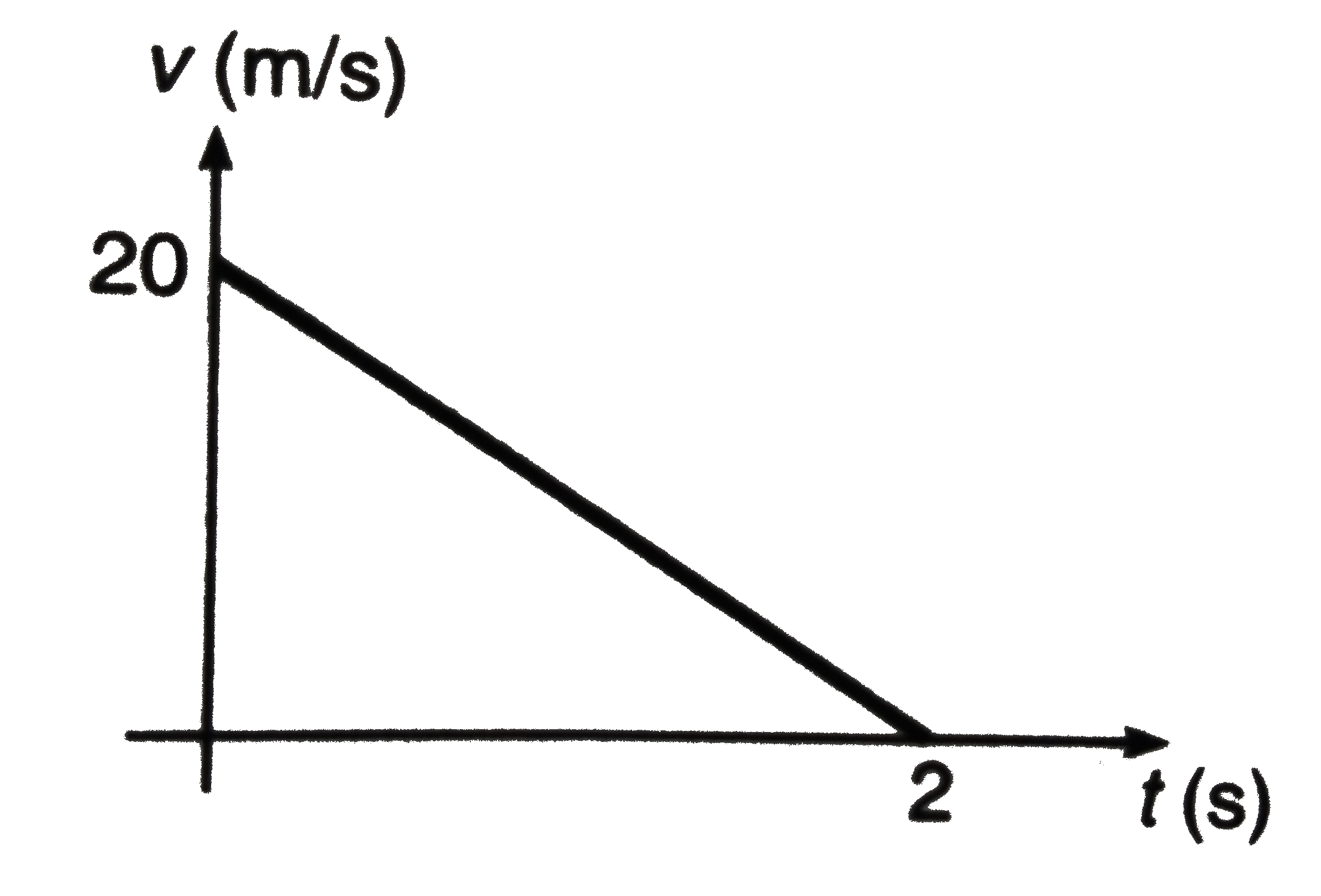
 .
. A
B
C
D
Text Solution
Verified by Experts
The correct Answer is:



Topper's Solved these Questions
WORK , ENERGY & POWER
NARAYNA|Exercise EXERCISE -II (H.W)|75 VideosWORK , ENERGY & POWER
NARAYNA|Exercise EXERCISE -III|54 VideosWORK , ENERGY & POWER
NARAYNA|Exercise EXERCISE -1 (H.W)|60 VideosWAVES
NARAYNA|Exercise Exercise-IV|56 VideosWORK POWER AND ENERGY
NARAYNA|Exercise Level-VI (Integer)|12 Videos
Similar Questions
Explore conceptually related problems
NARAYNA-WORK , ENERGY & POWER -EXERCISE -II (C.W)
- A bead of mass 1/2 kg starts from rest from A to move in a vertical pl...
Text Solution
|
- An outfielder throws a cricket ball with an initial kinetic energy of ...
Text Solution
|
- Velocity-time graph of a particle of mass (2 kg) moving in a straight ...
Text Solution
|
- A block of mass 1 kg slides down a vertical curved track that is one q...
Text Solution
|
- A force F = Ay^(2)+By+C acts on a body at rest in the Y-direction. The...
Text Solution
|
- A block of mass m=1kg moving on a horizontal surface with speed v(i)=2...
Text Solution
|
- In the fig. The potential energy U of a particle plotted against its p...
Text Solution
|
- If F = 2x^(2) - 3x -2, then choose correct option:-
Text Solution
|
- The potential energy of a 1kg particle free to move along the x-axis i...
Text Solution
|
- A particle located in one dimensional potential field has potential en...
Text Solution
|
- A block of mass 30.0 kg is being brought down by a chain. If the block...
Text Solution
|
- A body of mass 2 kg is thrown vertically upwards with K.E of 245 J. Th...
Text Solution
|
- A 3kg model rocket is launched striaght up with sufficient initial spe...
Text Solution
|
- In the arrangement shown in figure, string is light and inextensible a...
Text Solution
|
- The bob of a pendulum is released from a horizontal position. If the l...
Text Solution
|
- System shown in figure is released from rest . Pulley and spring is ma...
Text Solution
|
- The potential energy of a particle of mass m is given by U = (1)/(2) ...
Text Solution
|
- Figure shows the vertical section of a frictionless surface. A block o...
Text Solution
|
- A body of mass m falls from a height h and collides with another body ...
Text Solution
|
- Power supplied to a particle of mass 4 kg varies with time as P=(3t^(2...
Text Solution
|