Home
Class 12
MATHS
If pa n dq are chosen randomly from the ...

If `pa n dq` are chosen randomly from the set `{1,2,3,4,5,6,7,8,9, 10}` with replacement, determine the probability that the roots of the equation `x^2+p x+q=0` are real.

Text Solution

Verified by Experts
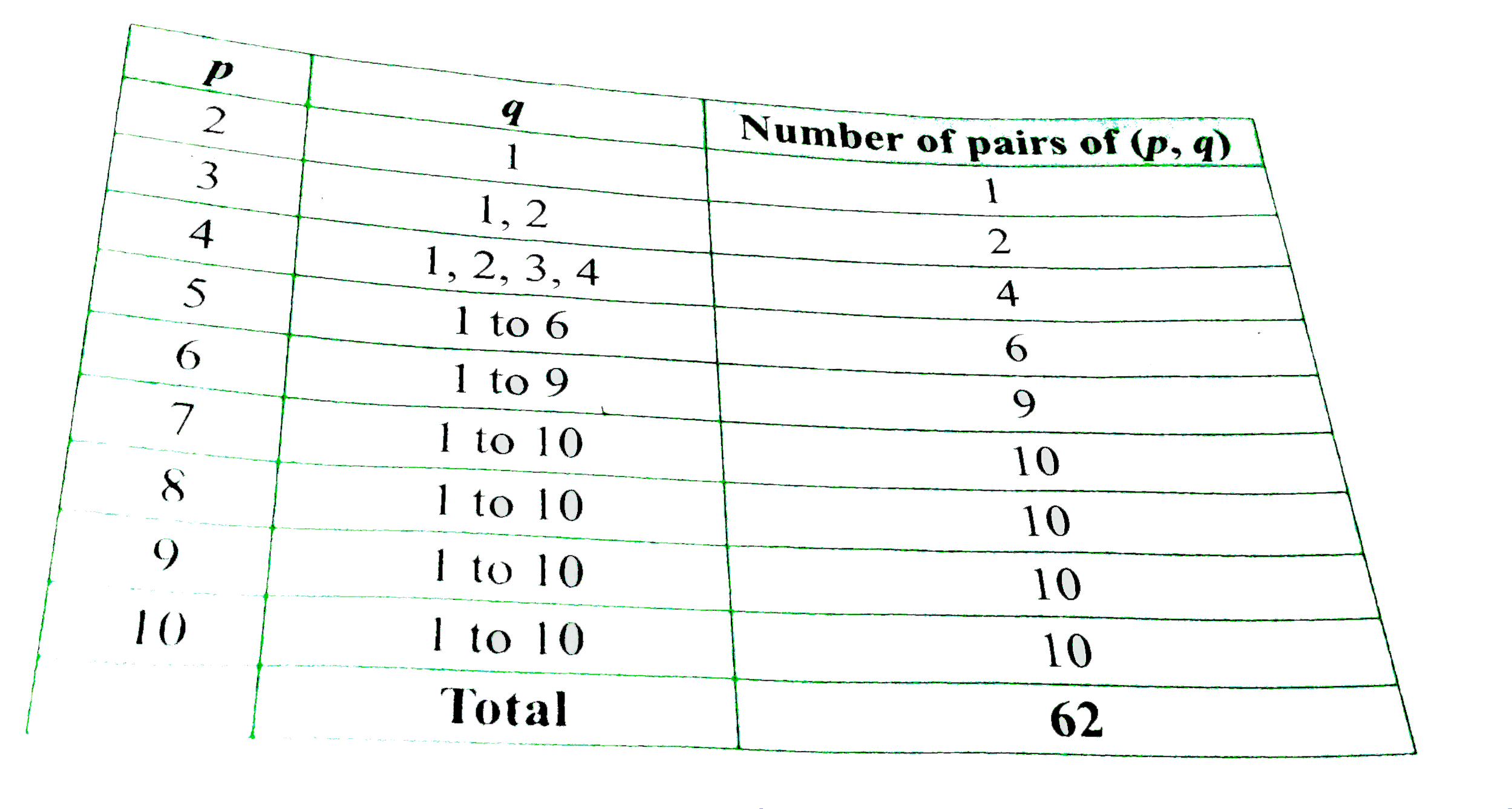
The roots of `x^(2) + px + q = 0` will be real if `p^(2) - 4q ge 0` or `p^(2) ge 4q`.
The possible values of p and q are given in the following table:

Also, the total number of possible pairs (p,q) = 10 `xx` 10 = 100
`therefore` Required probability = `(62)/(100) = 0.62`
Promotional Banner

Topper's Solved these Questions

  • PROBABILITY I

    CENGAGE|Exercise Exercise 9.1|6 Videos
  • PROBABILITY I

    CENGAGE|Exercise Exercise 9.2|19 Videos
  • PROBABILITY AND STATISTICS

    CENGAGE|Exercise Question Bank|37 Videos
  • PROBABILITY II

    CENGAGE|Exercise NUMARICAL VALUE TYPE|2 Videos

Similar Questions

Explore conceptually related problems

If p and q are chosen randomly from the set {1,2,3,4,5,6,7,8,9,10} with replacement, determine the probability that the roots of the equation x^(2)+px+q=0 are real.

If two numbers p and q are choosen randomly from the set {1, 2, 3, 4} with replacement, then the probability that p^(2)ge4q is equal to

If two numbers p and q are choosen randomly from the set {1, 2, 3, 4} with replacement, then the probability that p^(2)ge4q is equal to

If two numbers p and q are choosen randomly from the set {1, 2, 3, 4} with replacement, then the probability that p^(2)ge4q is equal to

What is the probability that the roots of the equation x^(2) +x +n = 0 are real, where n in N and pi lt 4 ?

The number a,b are chosen from the set (1,2,3,4,5,6,7,8,9,10) with replacement. Probability that a devides b is lambda, then (4000 lambda)/(27) is:

Two numbers are chosen from {1, 2, 3, 4, 5, 6, 7, 8} one after another without replacement. Then the probability that

