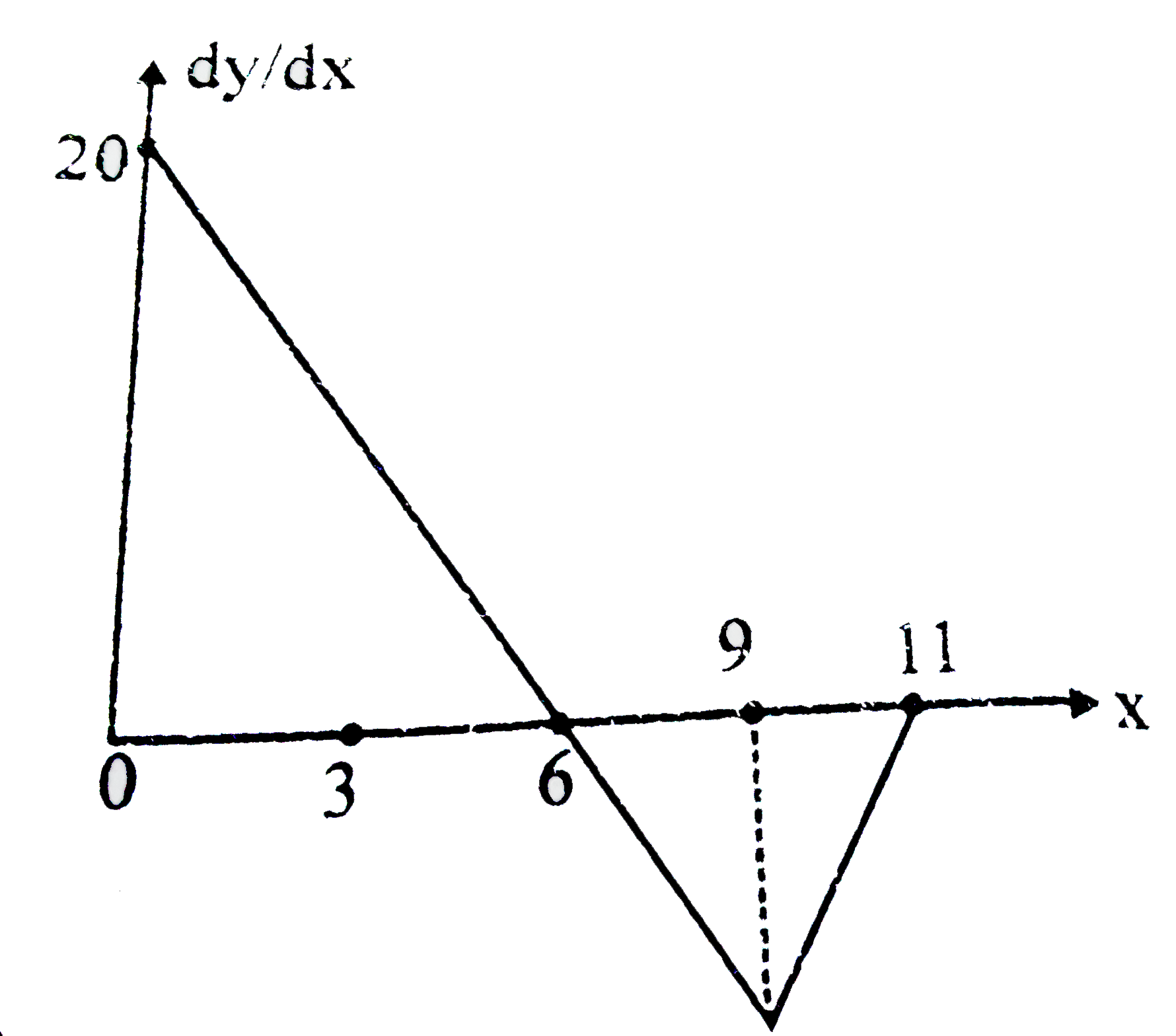
The following curve represent rate of change of a variable y w.r.t. x. The charge in the value of y when x changes from 0 to 11 is :
A
60
B
25
C
35
D
85
Text Solution
Verified by Experts
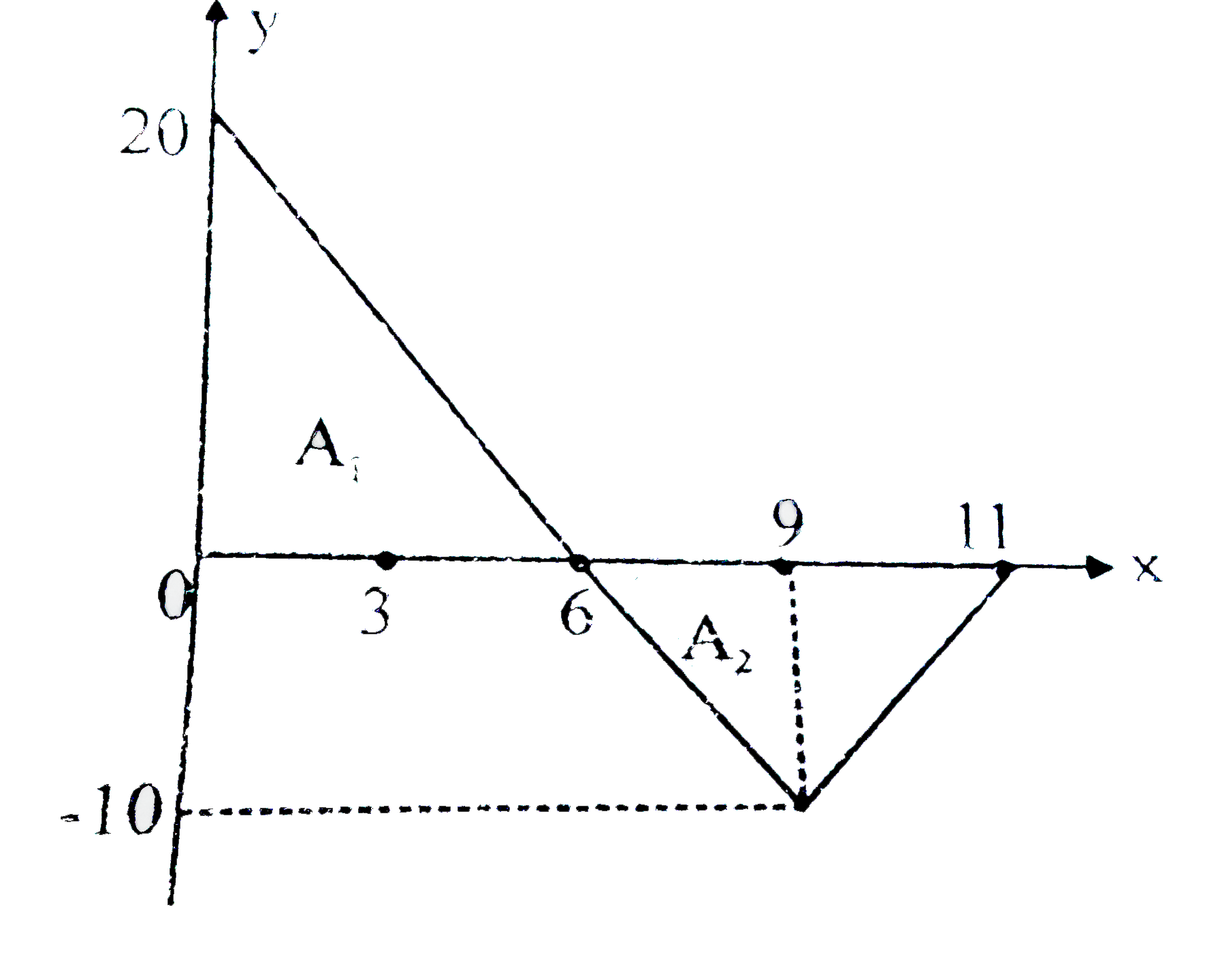
As `dy=((dy)/(dx))dx` So `Deltay=intdy=int_(0)^(11)((dy)/(dx))dx` Area under the curve `A_(1)=(1)/(2)xx6xx20=60` `A_(2)=-(1)/(2)xx(11-6)(10)=-25` `Deltay=A_(1)+A_(2)=60-25=35`
Topper's Solved these Questions
BASIC MATHS
ALLEN|Exercise EXERCISE-1|128 Videos
BASIC MATHS
ALLEN|Exercise EXERCISE-2|80 Videos
AIIMS 2019
ALLEN|Exercise PHYSICS|40 Videos
CIRCULAR MOTION
ALLEN|Exercise EXERCISE (J-A)|6 Videos
Similar Questions
Explore conceptually related problems
The following curve represent rate of change of a variable y w.r.t. x. The change in the value of y when x changes from 0 to 11 is:
The following curve represents a function y=f(x) . Find average value of y when x changes from 0 to 6
For curve y=(x^(2))/(2)-2x+5, the rate of change of y is twice the rate of change of x ,then value of x is
For curve y=(x^(2))/(2)-2x+5 the rate of change of y is twice the rate of change of x ,then value of x is
For curve y=(x^(2))/(2)-2x+5, the rate of change of y is twice the rate of change of x , then value of x is
What is the rate of change of sqrt(x^(2)+16) w.r.t. x^(2) at x=3 ?
Find the rate of change of y with respect to x, when x=1, given that y=x^(2)
Find the rate of change of y with respect to x, when x=1, given that y=x^(2)
If a spherical balloon has a variable diameter (3x+9//2) ., then the rate of change of its volume w. r. t x is
If x=(2)/(5)y+3, how does y change when x increases from 1 to 2 ?