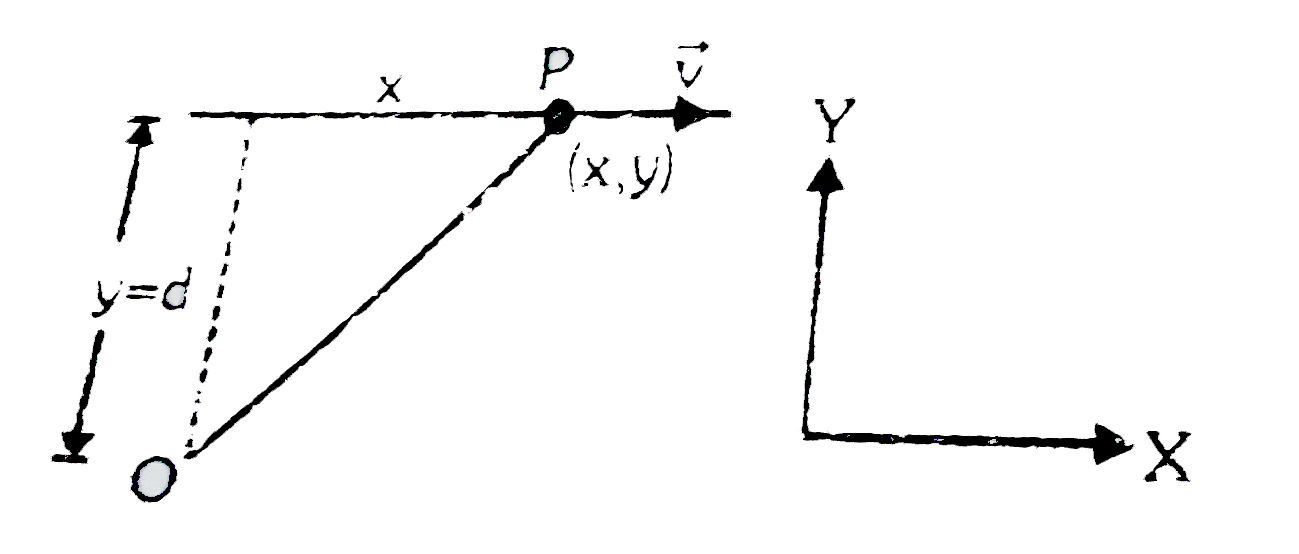
A particle moves on a given straight line with a constant speed v. At a certain time it is at a point P on its straight lline path.O is a fixed point. Show than `vec(OP)xxvec upsilon` is independent of the position P.?
Text Solution
Verified by Experts
Let `vecv=vhati & vecOP=xhati+yhatj=x hati+dhatj` so `vecOPxx vecv=(xhati+dhatj)xxvhati=-dvhatk` (d=is constant) which is independent of position.
Topper's Solved these Questions
BASIC MATHS
ALLEN|Exercise EXERCISE-1|128 Videos
BASIC MATHS
ALLEN|Exercise EXERCISE-2|80 Videos
AIIMS 2019
ALLEN|Exercise PHYSICS|40 Videos
CIRCULAR MOTION
ALLEN|Exercise EXERCISE (J-A)|6 Videos
Similar Questions
Explore conceptually related problems
A particle is moving along a straight line with increasing speed. Its angular momentum about a fixed point on this line :
A particle is moving with a constant speed along a straight line path. A force is not required to
A particle moves in a straight line in such a way that its velocity at any point is given by v^2=2-3x , where x is measured from a fixed point. The acceleration is
A particle moves in a straight line and its position x at time t is given by x^(2)=2+t . Its acceleration is given by :-
A particle moves in a straight line and its position x and time t are related as follows: x=(2+t)^(1//2) Acceleration of the particle is given by
A particle moves in a straight line, so that after t second, the distance x from a fixed point O on the line is given by x=(l-2)^(2)(t-5) . Then
A particle is moving in a straight line according to graph given below : (a is acceleration, v is velocity, x is position, t is time) :
 Let `vecv=vhati & vecOP=xhati+yhatj=x hati+dhatj`

