Home
Class 12
PHYSICS
Given that P=Q=R. if vecP+vecQ=vecR then...

Given that P=Q=R. if `vecP+vecQ=vecR` then the angle between `vecP & vecR` is `theta_(1)` then the angle between `vecP & vecR` is `theta_(2)`. What is the relation between `theta_(1)` and `theta_(2)`.

A

`theta_(1)=theta_(2)`

B

`theta_(1)=(theta_(1))/(2)`

C

`theta_(1)=2theta_(2)`

D

none of the above

Text Solution

Verified by Experts

The correct Answer is:
B

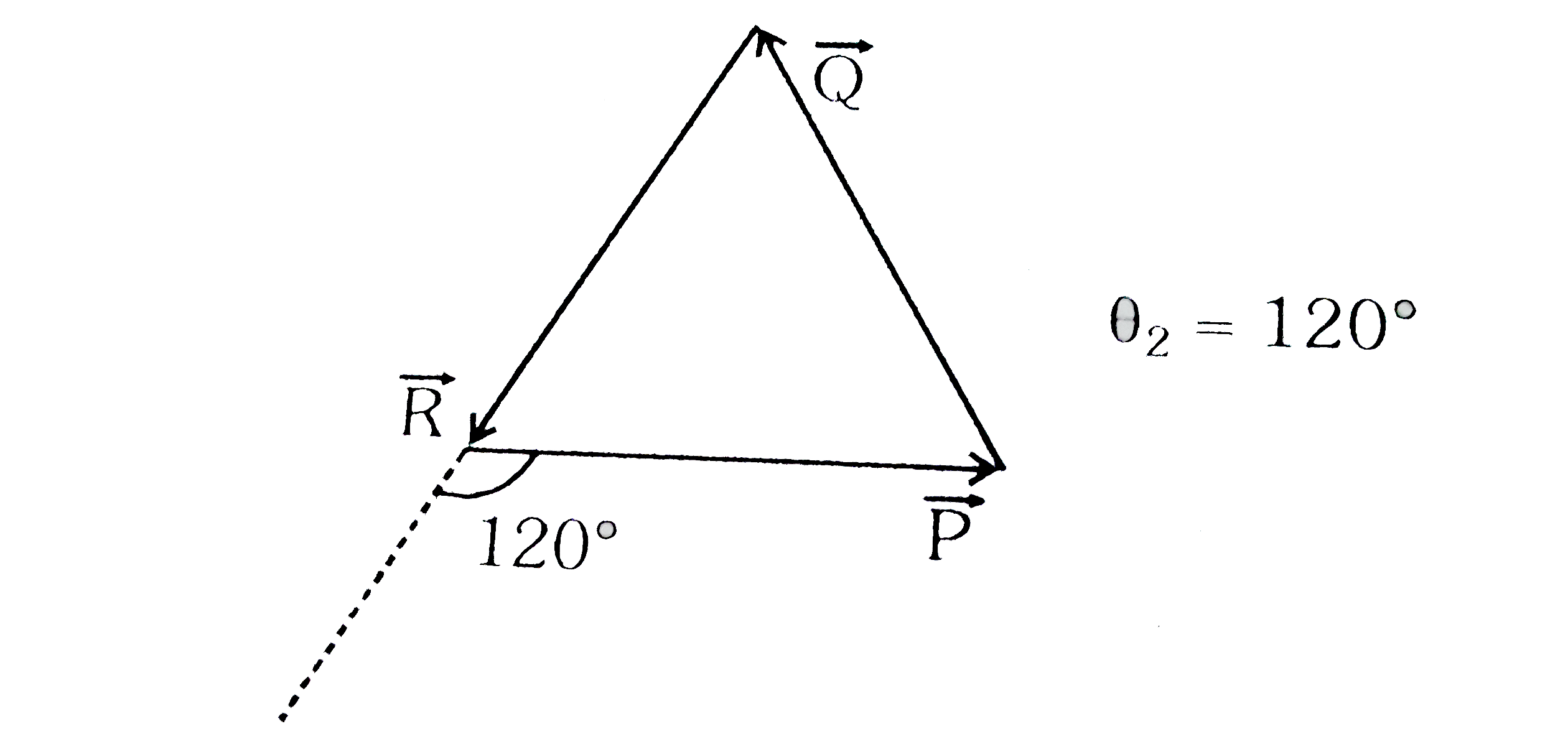
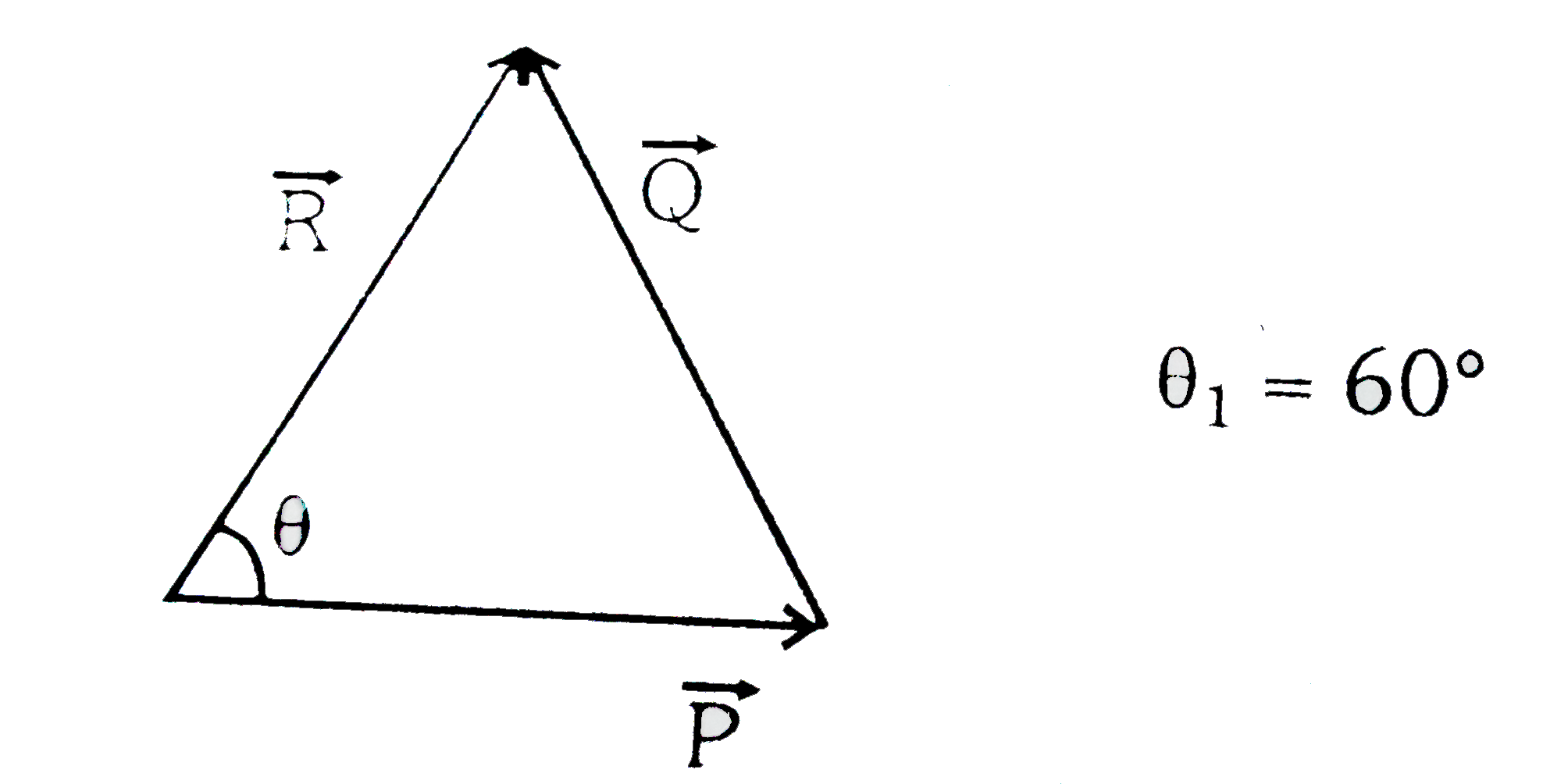
P=Q=R and `vecP+vecQ=vecR`
`theta_(1)=60^(@)`
If `P=Q=R` and `vecP+vecQ+vecR=0`
`theta_(2)=120^(@)`
Promotional Banner

Topper's Solved these Questions

Similar Questions

Explore conceptually related problems

Given that P= Q = R . If vecP + vecQ = vecR then the angle between vecP & vecR is theta_1 . If vecP + vecQ + vecR=vec0 then the angle between vecP& vecR is theta_2 . What is the relation between theta_1 and theta_2 ?

If vecP.vecQ=PQ then angle between vecP and vecQ is

If |vecP + vecQ| = |vecP -vecQ| the angle between vecP and vecQ is

Given that P=Q=R . If vec(P)+vec(Q)=vec(R) then the angle between vec(P) and vec(R) is theta_(1) . If vec(P)+vec(Q)+vec(R)=vec(0) then the angle between vec(P) and vec(R) is theta_(2) . The relation between theta_(1) and theta_(2) is :-

vecP,vecQ,vecR,vecS are vector of equal magnitude. If vecP+vecQ-vecR=0 angle between vecP and vecQ is theta_(1) .If vecP+vecQ-vecS=0 angle between vecP and vecS is theta_(2) .The ratio of theta_(1) to theta_(2) is

Let veca, vecb and vecc are three non - collinear vectors in a plane such that |veca|=2, |vecb|=5 and |vecc|=sqrt(29) . If the angle between veca and vecc is theta_(1) and the angle between vecb and vecc is theta_(1) the angle between vecb and vecc is theta_(2) , where theta_(1), theta_(2) in [(pi)/(2),pi] , then the value of theta_(1)+theta_(2) is equal to

If theta_(1)=(7)/(25)and theta_(2)=(24)/(25), " then find the relation between "theta_(1) and theta_(2) .

If |vecP + vecQ|= | vecP| -|vecQ| , the angle between the vectors vecP and vecQ is

if |vecP + vecQ| = |vecP| + |vecQ| , the angle between the vectors vecP and vecQ is

If vecP and vecQ denote the sides of parallelogram and its area is (1)/(2) PQ, then the angle between vecP and vecQ is

ALLEN-BASIC MATHS-EXERCISE-1
  1. The sum of magnitudes of two forces acting at a point is 16 N. If the ...

    Text Solution

    |

  2. At what angle must the two forces (x+y) and (x-y) act so that the resu...

    Text Solution

    |

  3. Given that P=Q=R. if vecP+vecQ=vecR then the angle between vecP & vecR...

    Text Solution

    |

  4. Given that vecA+vecB+vecC=0, out of three vectors two are equal in mag...

    Text Solution

    |

  5. The resultant of vecP and vecQ is perpendicular to vecP. What is the a...

    Text Solution

    |

  6. A vector of length l is turned through the angle theta about its tail....

    Text Solution

    |

  7. In the given figure, each box represents a function machine. A functio...

    Text Solution

    |

  8. The graph shows a linear relation between variable y and x. Consider t...

    Text Solution

    |

  9. Frequency f of a simple pendulum depends on its length l and accelerat...

    Text Solution

    |

  10. alpha and beta are the angle made by a vector from positive x & positi...

    Text Solution

    |

  11. If the force is given by F=at+bt^(2) with t is time. The dimensions of...

    Text Solution

    |

  12. The mechanical equivalent of heat J is

    Text Solution

    |

  13. Which of the following is not the unit of self inductance

    Text Solution

    |

  14. If energy (E), velcocity (V) and time (T) were chosen as fundamental p...

    Text Solution

    |

  15. If the energy, E = G^p h^q c^r, where G is the universal gravitational...

    Text Solution

    |

  16. Mathc list I with II and select the correct answer : {:((A)"spring c...

    Text Solution

    |

  17. Which of the following pairs does not have similar dimensions?

    Text Solution

    |

  18. Which of the following represents the dimensions of Farad

    Text Solution

    |

  19. The dimension of torque is:

    Text Solution

    |

  20. Using mass (M) , length (L) , time (T) , and electric current (A) as f...

    Text Solution

    |