Home
Class 12
PHYSICS
A siphon in use is demonstrated in the f...

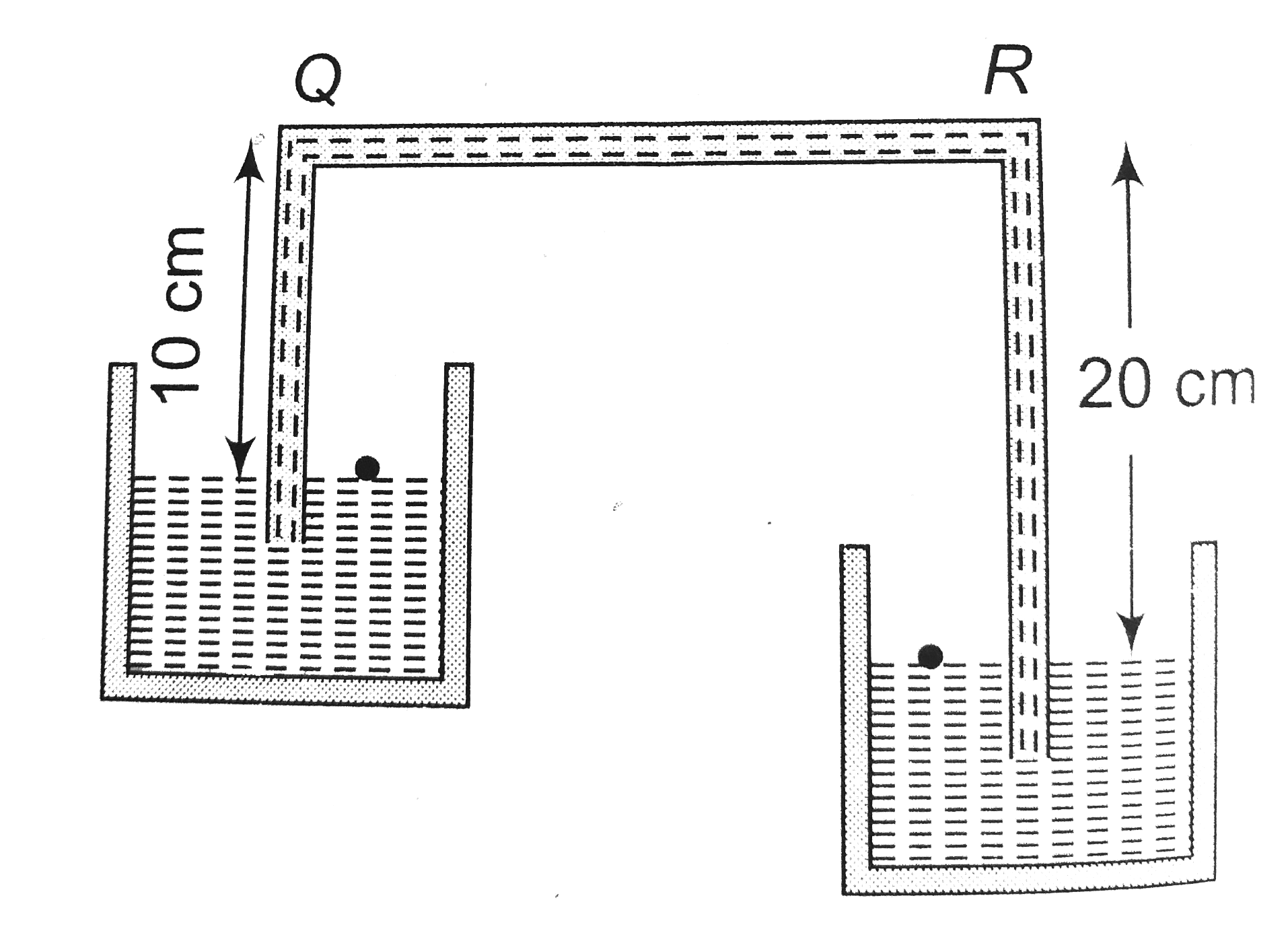
A siphon in use is demonstrated in the following in siphon is `1.5 gm//c c`. The pressure difference between the point `P` and `S` will be

A

`10^(5) N//m`

B

`2xx10^(5) N//m`

C

Zero

D

Infinity

Text Solution

Verified by Experts

The correct Answer is:

C

As the both points are at the surface of liquid and these points are in the open atmosphere. So both point possess similar pressure and equal to 1 atm. Hence the pressure difference will be zero.
Promotional Banner

Topper's Solved these Questions

  • FLUID MECHANICS

    BANSAL|Exercise EXERCISE # I|21 Videos
  • FLUID MECHANICS

    BANSAL|Exercise EXERCISE # II|18 Videos
  • MASTER PRACTICE PROBLEM

    BANSAL|Exercise Additional topic|70 Videos

Similar Questions

Explore conceptually related problems

A siphon in use is demostrated in the following in siphon is 1.5 gm//c c . The pressure differece between the point P and S will be

Figure shows a siphon. The liquid shown in water. The pressure difference P_B-P_A between the points A and B is

The difference between the value of C_p of H_2 and C_v of He will be

Four capacitors with capacitances C_(1) = 1 muF, C_(2) = 1.5 muF, C_(3) = 2.5 muF and C_(4) = 0.5 muF are connected as shown in Fig, to a 30 voltg source. The potentail difference between points a and b is

5 J of work is done in moving a positive charge of 0.5C between two points. What is the potential difference between these points ?

In Young's double slit intefrence experiment the wavelength of light used is 6000 Å . If the path difference between waves reaching a point P on the screen is 1.5 microns, then at that point P

Among two interfering sources, let S_1 be ahead of the phase by 90^@ relative to S_2 . If an observation point P is such that PS_1 - PS_2 = 1.5 lambda , the phase difference between the waves from S_1 and S_2 reaching P is

A tube of uniform cross section is used to siphon water from a vessel V as shown in the figure. The pressure over the open end of water in the vessel is atmospheric pressure (P_(0)) . The height of the tube above and below the water level in the vessel are h_(1) and h_(2) , respectively. If h_(1)=h_(2) = 3.0 m , the maximum value of h_(1) , for which the siphon will work will be

Calculate the molar mass of a compound in the Dumas method at 100^(@)C for which volume of experimental container was 452 ml and the pressure was 745.1 torr. The difference in mass between the empty container and the final measurement was 1.129 gm.
