Home
Class 12
PHYSICS
What is meant by a linearly polarised li...

What is meant by a linearly polarised light? Which type of waves can be polarised? Briefly explain a method for producing polarised light. Two polaroids are placed at `90^(@)` to each other and the intensity of transmitted light is zero. What will be the intensity of transmitted light when one more polariod is placed between these two bisecting the angle between them ? Take intensity of unpolarised light as `l_(0)`

Text Solution

Verified by Experts
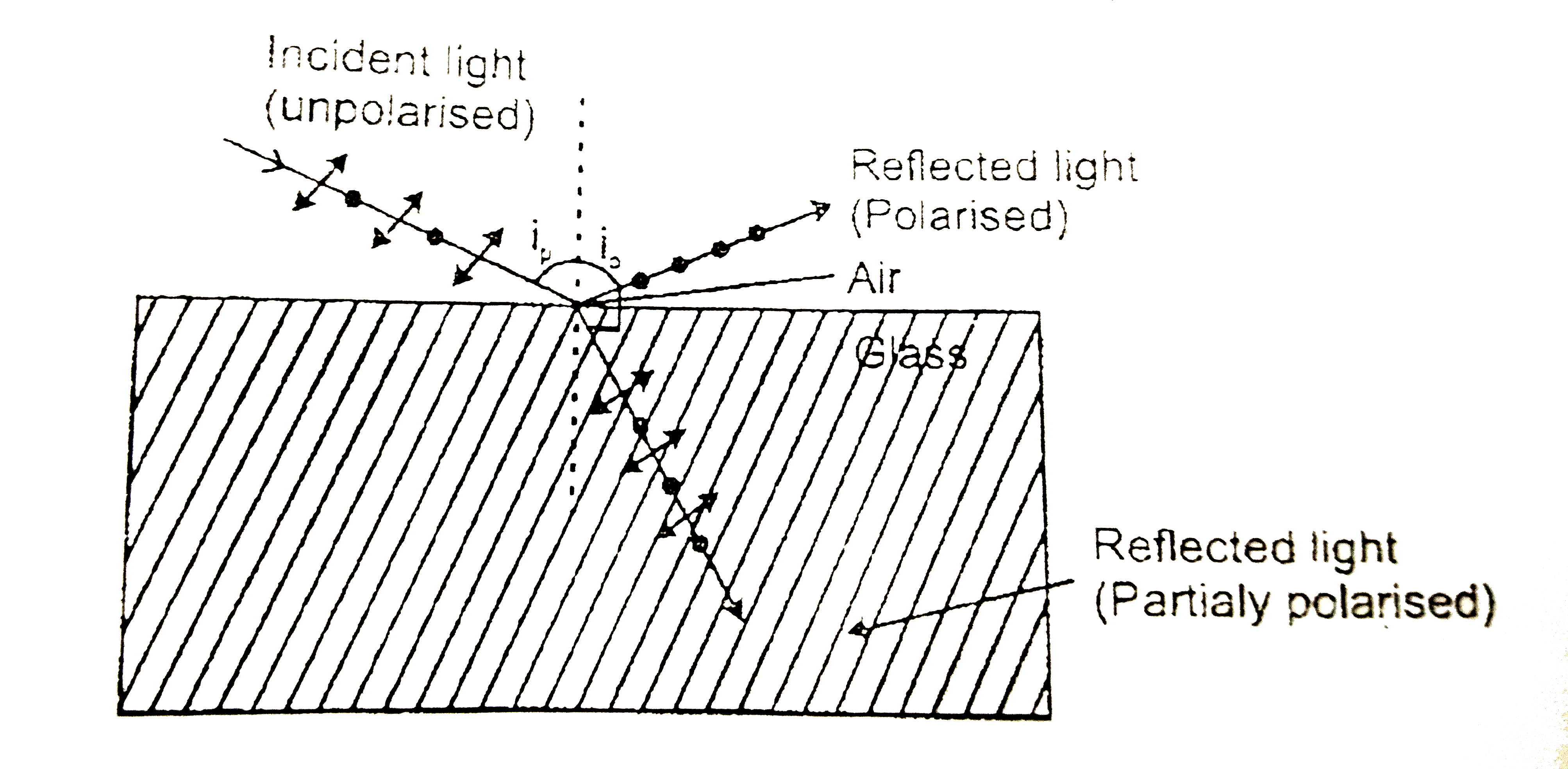
A light wave is said to be linearly polarised if its electric field vector vibrates just in one direction perpendicular to the direction of propagation. Only tranverse waves can be polarised. Light can be polarised by reflecting it from a transparent medium. The extent of polarisation depends on the angle of incident. At a particualr angle of incidence, called Brewster angle, the reflected light is completely polarised as shown below :

Numerical : `l=l_(0) cos^(2) theta=l_(0)xx((1)/(sqrt2))^(2)=(I_(0))/(2)`
Resultant intensity `l_(R)=l cos^(2) theta=l_(0)(I_(0))/(2)xx((1)/(sqrt2))^(2)=(I_(0))/(4)`
Promotional Banner

Topper's Solved these Questions

  • WAVE OPTICS

    RESONANCE|Exercise Advanced Level Problems|8 Videos
  • WAVE OPTICS

    RESONANCE|Exercise Exercise-3 (Part-2)|15 Videos
  • WAVE ON STRING

    RESONANCE|Exercise Exercise- 3 PART I|19 Videos

Similar Questions

Explore conceptually related problems

Two polaroids are placed at 90^(@) to eachother and the transmitted intensity is zero. What happens when one more polaroid is placed between these two, bisecuting the angle between them. How will the intensity of transmitted light vary on further rotating the third polaroid ?

Two poalroids are placed at 90^(@) to eachother and the transmitted intensity is zero. What happens when one more polaroid is placed between these two bisecting the angle between them ? What will be the diraction of polarization of outcoming beam ?

Two polaroids are placed at 90^(@) to each other and the transmitted intensity is zero. What happens when one more polarid is placed between these two bisecting two bisecting the angle between them?

Disuss the intensity of transmitted light when a polaroid sheet is rotated between two crossed polaroids ?

Unpolarised light of intensity I is incidnet of the polaroid. What will be the intensity of light transmitted by the polaroid?

Define the term 'linearly polarised light'. When does the intensity of transmitted light become maximum, when a polaroid sheet is rotated between two crossed polaroids ?

The polariser and analyser are inclined to each other at 60^(@) . The intensity of polarised light emerging from polariser is I. The intensity of the unpolarised light incident on the polariser is

RESONANCE-WAVE OPTICS-Exercise-3 (Part-3)
  1. State the essential condition for diffraction of light to take place. ...

    Text Solution

    |

  2. What is is plane polarised light ? Two polaroids are placed at 90^(@) ...

    Text Solution

    |

  3. What is meant by a linearly polarised light? Which type of waves can b...

    Text Solution

    |

  4. How is a wavefront defined ? Using Hygen's construction draw a figure ...

    Text Solution

    |

  5. (a) Light, from a sodium lamp, is passed through two polaroid sheets P...

    Text Solution

    |

  6. In a Young's double slit experiment , the slits are Kept 2mm apart and...

    Text Solution

    |

  7. In Young's double slit experiment ,momochromatic light of wavelength 6...

    Text Solution

    |

  8. In a single slit diffraction experiment when a tiny circular obstacle ...

    Text Solution

    |

  9. The diagram, given below, shows the refracton of a plane wavefront, in...

    Text Solution

    |

  10. How would the angular separation of interference fringes in Young's do...

    Text Solution

    |

  11. Two polaroid A and B are set in crossed positions. A third polaroid C ...

    Text Solution

    |

  12. In Young's double slit experiment , the two slits 0.20 mm apart are il...

    Text Solution

    |

  13. State Huygens' principle of diffraction of light.

    Text Solution

    |

  14. State the importance of coherent sources in the phenomenon of interfer...

    Text Solution

    |

  15. (a) What is a wave front?How does it propagate?Using Huygens' principl...

    Text Solution

    |

  16. (a) Define a wavefront. Use Huygen' principle to shown diagrammaticall...

    Text Solution

    |

  17. (a) Why are coherent sources necessary to produce a sustained interfer...

    Text Solution

    |

  18. (a) In Young's double slit experiment, derive the condition for (i) co...

    Text Solution

    |

  19. Which of the following waves can be polarized (i) Heat (ii) Sound wave...

    Text Solution

    |

  20. Two wavelength of sodium light 590 nm and 596 nm are used, in turn, to...

    Text Solution

    |

