Home
Class 12
PHYSICS
(a) Define a wavefront. Use Huygen' prin...

(a) Define a wavefront. Use Huygen' principle to shown diagrammatically the propagation of a plane wavefront from the intant `t_(1)=0` to later time `t_(2)`.
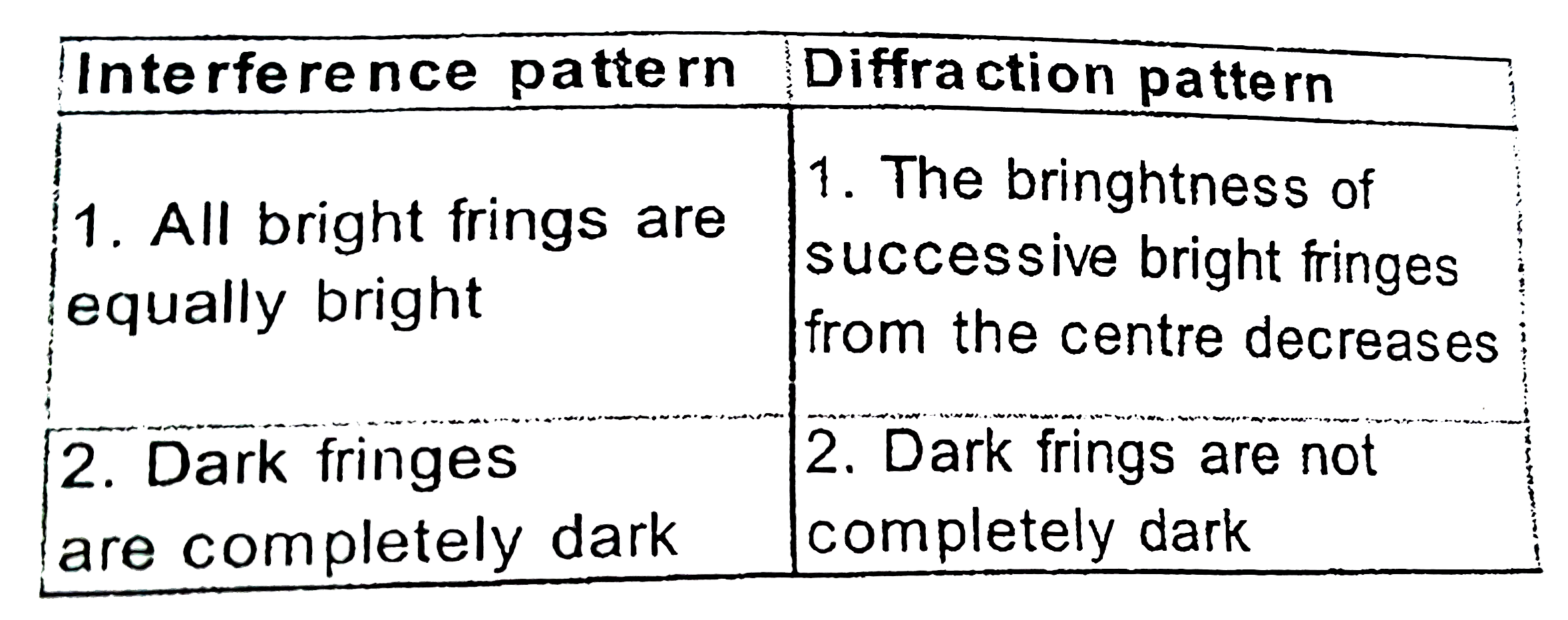
(b) State briefly two features which can distinguish the characteristic features of an interference pattern from those observed in the diffraction pattern due a single slit.

Text Solution

Verified by Experts
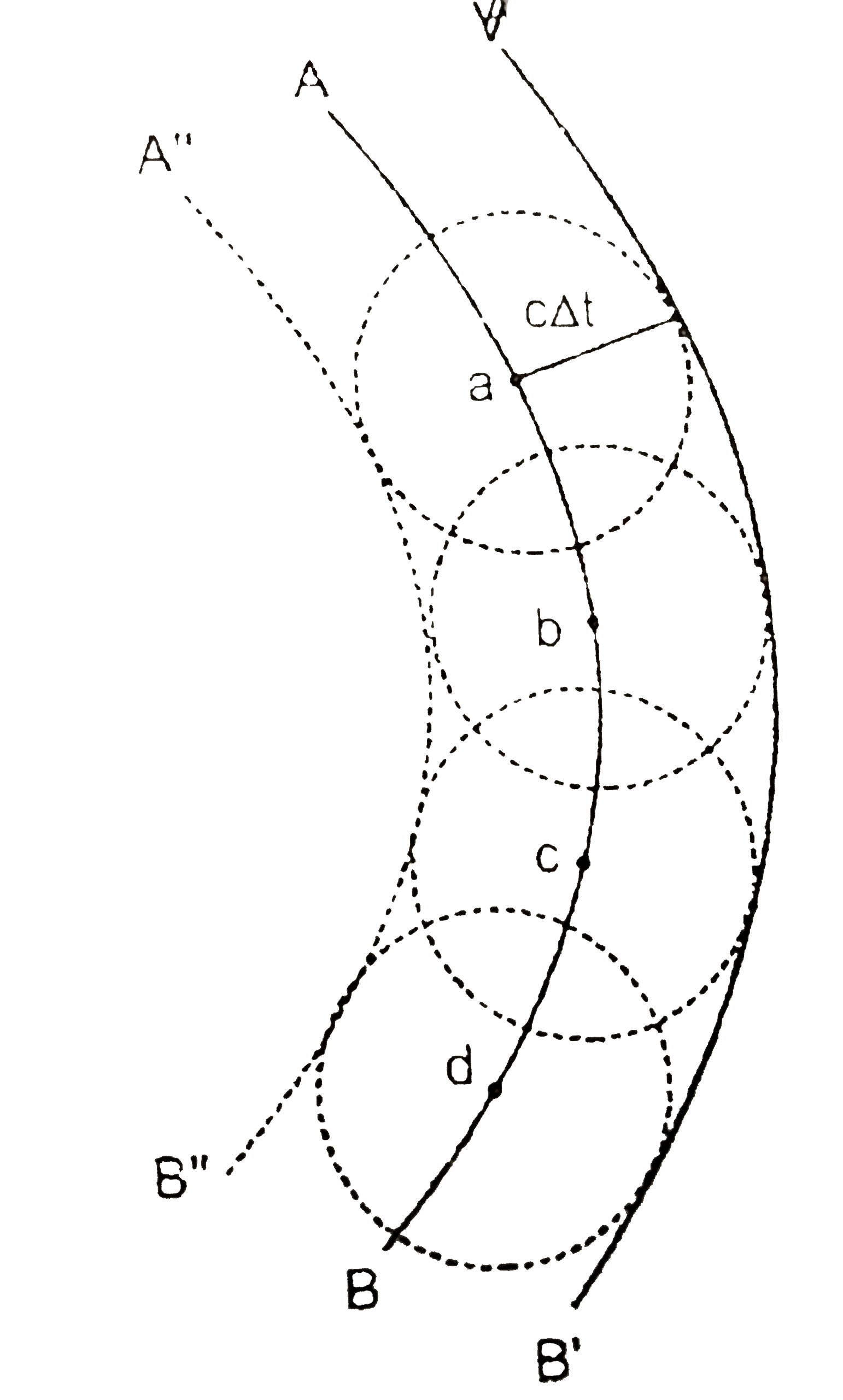
(a) Wavefront : The locus of all the particles of the medium, which at any instant are vibrating in the same phase, is called the wavefront.
Huygen's priciple is a geometrical constrution which is used to determine the new position of a wavefront at a later time its given position at any instant.

Consider a point source of light. Let `AB` be a section of primary spherical wavefront at any time `t,` The new position of wavefront at time `t+Deltat,` conside a number of points `a,b,c,d-` on the primary wavefront. The partition of the wavelet, which lies just on the back of the secondary wavefront, `O` is equal to `180^(@)` adn likewise the factor `(1)/(2)(1+costheta)` is equal to zero. Therefore, the forward secondary wavefront `A'B'` is the new position of the wavefront at time `t+Deltat`.
(b) Difference between Interference and Diffraction.
Promotional Banner

Topper's Solved these Questions

  • WAVE OPTICS

    RESONANCE|Exercise Advanced Level Problems|8 Videos
  • WAVE OPTICS

    RESONANCE|Exercise Exercise-3 (Part-2)|15 Videos
  • WAVE ON STRING

    RESONANCE|Exercise Exercise- 3 PART I|19 Videos

Similar Questions

Explore conceptually related problems

(a) Using Huygen's principle draw a diagram to whow propagation of a front originating from a monochrmatic source. (b) Desctibe diffraction of light due to a single slit. Explain formation of a pattern of fringes obtained on the screen and plot showing variation of intensity with angle theta in single slit diffraction.

(a) What is a wave front? How does it propagate? Using Huygens' principle, explain reflection of a plane wavefront from a surface and verify the laws of reflection. (b) A parallel beam of light of wavelength 500 nm falls on a narrow slit and the resulting diffraction pattern is obtained on a screen 1 m away. If the first minimum is formed at a distance of 2.5 mm from the centre of screen, find the (i) width of the slit, and (ii) distance of first secondary maximum from the centre of the screen.

(a) Derive the relation a sin theta=lambda for the first minimum of the diffraction pattern produced due to a single slit of width ‘a’ using light of wavelength lambda . (b) State with reason, how the linear width of central maximum will be affected if (i) monochromatic yellow light is replaced with red light, and (ii) distance between the slit and the screen is increased. (c) Using the monochromatic light of same wavelength in the experimental set-up of the diffraction pattern as well as in the interference pattern where the slit separation is 1 mm, 10 interference fringes are found to be within the central maximum of the diffraction pattern. Determine the width of the single slit, if the screen is kept at the same distance from the slit in the two cases.

(a) In what way is diffraction from each slit related to the interference pattern in a double slit experiment ? (b) Two wavelengths of sodium light 590 nm and 596 nm are used, in turn, to study the diffraction taking place at a single slit of aperture 2 xx 10^(-4)m. The distance between the slit and the screen is 1.5 m. Calculate the separation between the positions of the first maxima of the diffraction pattern obtained in the two cases.

(a) Write two characteristics features distinguishing the diffraction pattern from the interference fringes obtained in Young's double slit experiment. (b) Two wavelengths of sodium light 590 nm and 596 nm are used , in turn, to study the diffraction taking place due to a single slit of aperture 1xx10^(-4)m . The distance between the slit and the screen is 1.8m. Calculate the separation between the positions of the first maxima of the diffraction pattern obtained in the two cases.

RESONANCE-WAVE OPTICS-Exercise-3 (Part-3)
  1. What is is plane polarised light ? Two polaroids are placed at 90^(@) ...

    Text Solution

    |

  2. What is meant by a linearly polarised light? Which type of waves can b...

    Text Solution

    |

  3. How is a wavefront defined ? Using Hygen's construction draw a figure ...

    Text Solution

    |

  4. (a) Light, from a sodium lamp, is passed through two polaroid sheets P...

    Text Solution

    |

  5. In a Young's double slit experiment , the slits are Kept 2mm apart and...

    Text Solution

    |

  6. In Young's double slit experiment ,momochromatic light of wavelength 6...

    Text Solution

    |

  7. In a single slit diffraction experiment when a tiny circular obstacle ...

    Text Solution

    |

  8. The diagram, given below, shows the refracton of a plane wavefront, in...

    Text Solution

    |

  9. How would the angular separation of interference fringes in Young's do...

    Text Solution

    |

  10. Two polaroid A and B are set in crossed positions. A third polaroid C ...

    Text Solution

    |

  11. In Young's double slit experiment , the two slits 0.20 mm apart are il...

    Text Solution

    |

  12. State Huygens' principle of diffraction of light.

    Text Solution

    |

  13. State the importance of coherent sources in the phenomenon of interfer...

    Text Solution

    |

  14. (a) What is a wave front?How does it propagate?Using Huygens' principl...

    Text Solution

    |

  15. (a) Define a wavefront. Use Huygen' principle to shown diagrammaticall...

    Text Solution

    |

  16. (a) Why are coherent sources necessary to produce a sustained interfer...

    Text Solution

    |

  17. (a) In Young's double slit experiment, derive the condition for (i) co...

    Text Solution

    |

  18. Which of the following waves can be polarized (i) Heat (ii) Sound wave...

    Text Solution

    |

  19. Two wavelength of sodium light 590 nm and 596 nm are used, in turn, to...

    Text Solution

    |

  20. (a) In Young's double slit experiment, describe briefly how bright and...

    Text Solution

    |