Home
Class 12
CHEMISTRY
In a H-like sample, electrons make trans...

In a H-like sample, electrons make transition from `4^(th)` excited state upto `2^(nd)` state. Then ,

A

`10` different spectral lines are observed

B

`6` different spectral lines are observed

C

number of lines belonging to the balmer series is `3`

D

Number of lines belonging to paschen series is `2`

Text Solution

Verified by Experts

The correct Answer is:
B, C, D

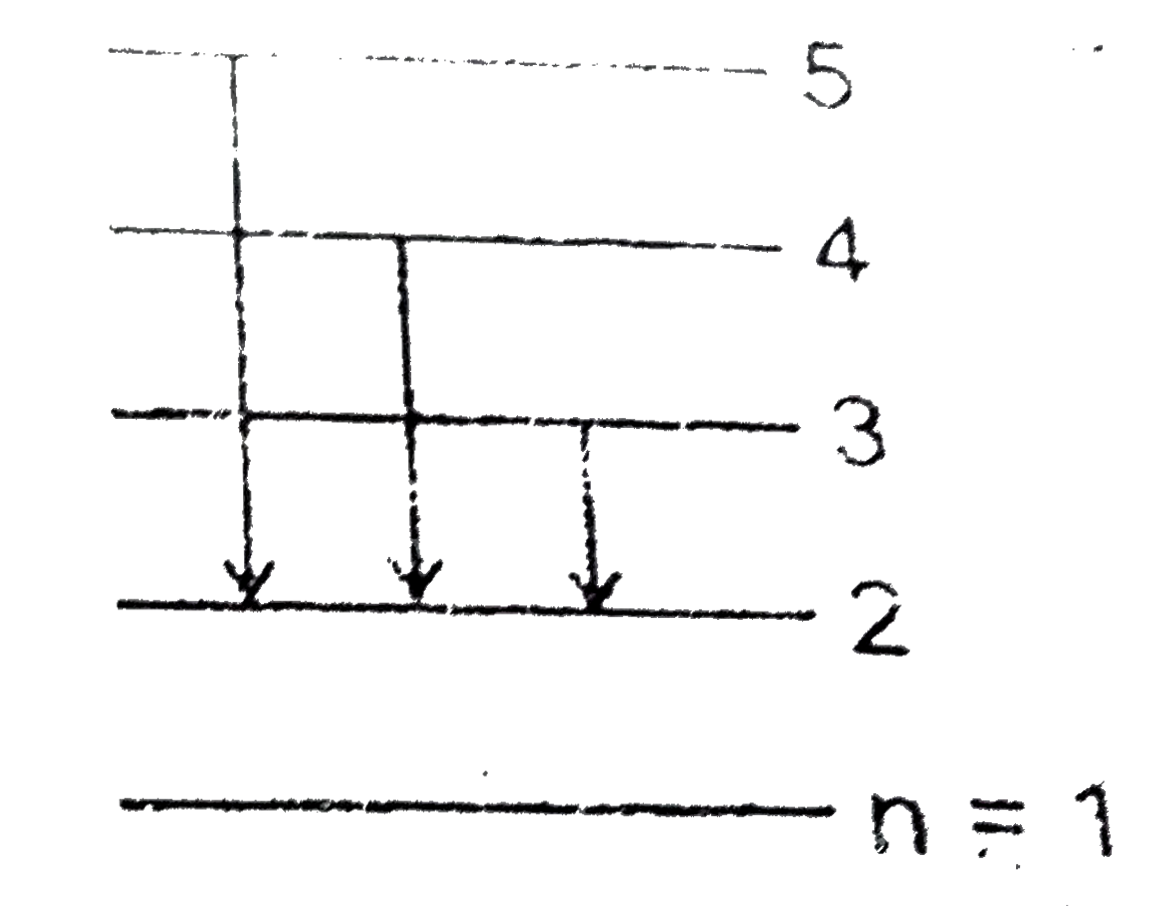
Transition is taking place from `5 rarr 2`
`rArr Deltan=3`
Hence maximum number of spectral line observed `=(3(3+1))/(2)=6`.

(C) number of lines belonging to the Balmer series `=3(5 rarr2, 4rarr2, 3 rarr 2)` as shown in figure.
Number of lines belonging to Paschen series `=2(5 rarr 3, 4 rarr 3)`.
Promotional Banner

Similar Questions

Explore conceptually related problems

In a H- like sample electron makes transition from 4th excited state of 2nd state then:

In a single isolated atom an electron make transition from 5th excited state to 2nd state then maximum number of different types of photons observed is

In a sample of H- atom electrons make transition from 5^(th) excited state to ground state, producing all possible types of photons, then number of lines in infrared region are

If electron make transition from 7^(th) excited state to 2^(nd) state in H atom sample find the max. number of spectral lines observed.

In a sample of H-atoms electrons are de-exicited from 4^(th) excited state to ground state. Which is/are correct statement ?

When an electron in a hydrogen atom makes a transition from 2^("nd") excited state to ground state. It emits a photon of frequency f.The frequency of photon emitted when an electron of Li^("++") makes a transition from 1^("st") excited state to ground state is :

The photon emitted due to electronic transition of 5^(th) excited state to 2^(nd) excited state in Li^(2+) , is used to excite He^+ already in first excited state. He^+ ion after absorbing the photon reaches in an orbit having total energy equal to :

An electron in a hydrogen in a hydrogen atom makes a transition from first excited state to ground state. The equivelent current due to circulating electron

