Home
Class 12
CHEMISTRY
The cell consists of three compartments ...

The cell consists of three compartments separated by porous barriers. The first contains a cobalt electrode in 5.00 L of 0.100 M cobalt (II) nitrate, the second contains 5.00 L of 0.100M `AgNO_(3)`. Assuming that the current within the cell is carried equally by the positive and negative ions, tabulate the concentrations of ions of each type in each compartment of the cell after the passage of 0.100 mole electrons.
given `Co^(2+)+2e^(-)toCo" "E^(0)=-0.28V`
`Ag^(+)+e^(-)toAg" "E^(0)=0.80V`
Spontaneous reaction is: `2Ag^(+)+CotoCo^(2+)+2Ag" "1.08V`

Text Solution

Verified by Experts
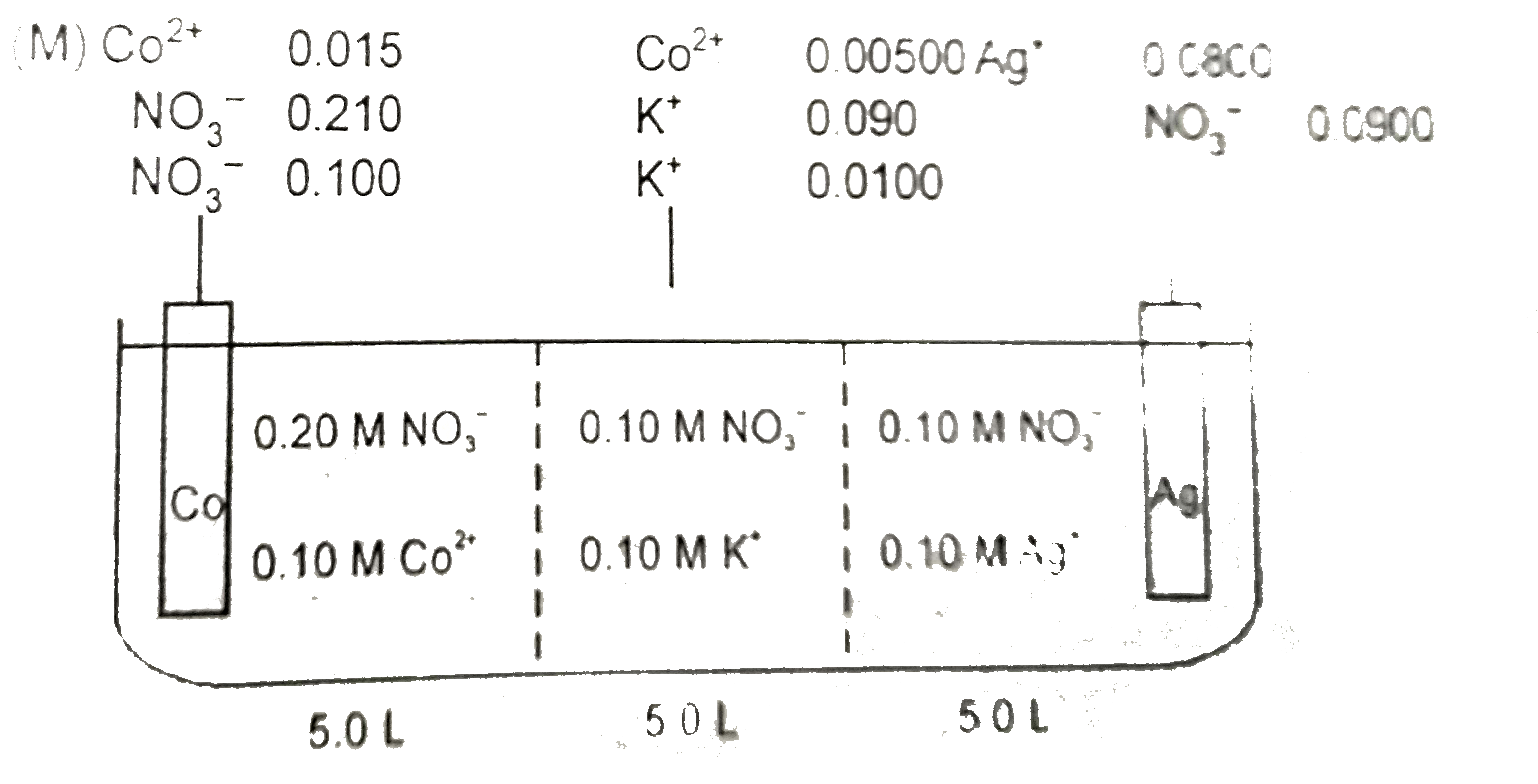
In the left compartment. Cobalt will be oxidized to cabalt (II) ion. In ht eright compartment, silver ion will be reduced to silver. The passage of 0.100 mol electrons will cause the following quantities of change.
effect of electrode positive ion movement `{:("Compoartment 1","Compartment 2","Copartment 3"),(+0.05000 mol CO^(3+),+0.0250 mol Co^(2+),-0.100molAg^(+)),(-0.0250molCo^(2+),-0.0500molK^(+),+0.0500molK^(+)):}`
Negative ion movement `+0.0500molNO_(3)^(-)`
Changing the numbers of mol to concentrators in 5.0 L compartment and adding or subtracting yields te following results:
Final concentrations (M) `Co^(2+)`

Promotional Banner

Topper's Solved these Questions

  • ELECTROCHEMISRY

    RESONANCE|Exercise Miscellaneous Solved Problems|9 Videos
  • ELECTROCHEMISRY

    RESONANCE|Exercise Board Level Exercise|20 Videos
  • ELECTRO CHEMISTRY

    RESONANCE|Exercise PHYSICAL CHEMITRY (ELECTROCHEMISTRY)|53 Videos
  • EQUIVALENT CONCEPT & TITRATIONS

    RESONANCE|Exercise Part -IV|22 Videos

Similar Questions

Explore conceptually related problems

A cell, as shown below, consists of there compartments separated by porous pots. The first contains a cobalt eletrode in 5.0L of 0.10M Co(NO_(3)), the second contains 5.0L of 0.10M KNO_(3), the third contains an Ag electrode in 5.0L of 0.10M AgNO_(3) . Assuming that current with in the cell iis carried equally by the negative and positive ions by passign 0.1F of electricity. Given : Co^(2+)+2e^(-) rarr Co" "E^(c-)=-0.28V Ag^(o+)+e^(-) rarr Ag" "E^(c-)=0.80V 2Ag^(o+)+Corarr Co^(2+)+2Ag" "E^(c-)._(cell)=1.08V The final concentration of Co^(2+) in I, II, and III compartment is

A cell, as shown below, consists of there compartments separated by porous pots. The first contains a cobalt eletrode in 5.0L of 0.10M Co(NO_(3)), the second contains 5.0L of 0.10M KNO_(3), the third contains an Ag electrode in 5.0L of 0.10M AgNO_(3) . Assuming that current with in the cell iis carried equally by the negative and positive ions by passign 0.1F of electricity. Given : Co^(2+)+2e^(-) rarr Co" "E^(c-)=-0.28V Ag^(o+)+e^(-) rarr Ag" "E^(c-)=0.80V 2Ag^(o+)+Corarr Co^(2+)+2Ag" "E^(c-)._(cell)=1.08V Finally, the I compartment contains I. Co^(2+)" "II. NO_(3)^(c-)" "III.K^(o+)" "IV.Ag^(o+)

A cell, as shown below, consists of there compartments separated by porous pots. The first contains a cobalt eletrode in 5.0L of 0.10M Co(NO_(3)), the second contains 5.0L of 0.10M KNO_(3), the third contains an Ag electrode in 5.0L of 0.10M AgNO_(3) . Assuming that current with in the cell iis carried equally by the negative and positive ions by passign 0.1F of electricity. Given : Co^(2+)+2e^(-) rarr Co" "E^(c-)=-0.28V Ag^(o+)+e^(-) rarr Ag" "E^(c-)=0.80V 2Ag^(o+)+Corarr Co^(2+)+2Ag" "E^(c-)._(cell)=1.08V Finally the II compartment contains

A cell, as shown below, consists of there compartments separated by porous pots. The first contains a cobalt eletrode in 5.0L of 0.10M Co(NO_(3)), the second contains 5.0L of 0.10M KNO_(3), the third contains an Ag electrode in 5.0L of 0.10M AgNO_(3) . Assuming that current with in the cell iis carried equally by the negative and positive ions by passign 0.1F of electricity. Given : Co^(2+)+2e^(-) rarr Co" "E^(c-)=-0.28V Ag^(o+)+e^(-) rarr Ag" "E^(c-)=0.80V 2Ag^(o+)+Corarr Co^(2+)+2Ag" "E^(c-)._(cell)=1.08V Finally, the II compartment contains

A cell, as shown below, consists of there compartments separated by porous pots. The first contains a cobalt eletrode in 5.0L of 0.10M Co(NO_(3)), the second contains 5.0L of 0.10M KNO_(3), the third contains an Ag electrode in 5.0L of 0.10M AgNO_(3) . Assuming that current with in the cell iis carried equally by the negative and positive ions by passign 0.1F of electricity. Given : Co^(2+)+2e^(-) rarr Co" "E^(c-)=-0.28V Ag^(o+)+e^(-) rarr Ag" "E^(c-)=0.80V 2Ag^(o+)+Corarr Co^(2+)+2Ag" "E^(c-)._(cell)=1.08V The final concentration of NO_(3)^(c-) in I,II, and III compartment is

A cell, as shown below, consists of there compartments separated by porous pots. The first contains a cobalt eletrode in 5.0L of 0.10M Co(NO_(3)), the second contains 5.0L of 0.10M KNO_(3), the third contains an Ag electrode in 5.0L of 0.10M AgNO_(3) . Assuming that current with in the cell iis carried equally by the negative and positive ions by passign 0.1F of electricity. Given : Co^(2+)+2e^(-) rarr Co" "E^(c-)=-0.28V Ag^(o+)+e^(-) rarr Ag" "E^(c-)=0.80V 2Ag^(o+)+Corarr Co^(2+)+2Ag" "E^(c-)._(cell)=1.08V The final concentration of K^(o+) in I,II, and III compartment is

A cell, as shown below, consists of there compartments separated by porous pots. The first contains a cobalt eletrode in 5.0L of 0.10M Co(NO_(3)), the second contains 5.0L of 0.10M KNO_(3), the third contains an Ag electrode in 5.0L of 0.10M AgNO_(3) . Assuming that current with in the cell iis carried equally by the negative and positive ions by passign 0.1F of electricity. Given : Co^(2+)+2e^(-) rarr Co" "E^(c-)=-0.28V Ag^(o+)+e^(-) rarr Ag" "E^(c-)=0.80V 2Ag^(o+)+Corarr Co^(2+)+2Ag" "E^(c-)._(cell)=1.08V The final concentration of Ag^(o+) in I,II, and III compartment is

Consider the following Galvanic cell:- By what value the cell voltage when concentration of ions in anodic and cathodic compartments both increased by factor of 10 at 298K:

RESONANCE-ELECTROCHEMISRY-Advanced Level Problems
  1. The cell consists of three compartments separated by porous barriers. ...

    Text Solution

    |

  2. How much will the reduction potential of a hydrogen electrode change w...

    Text Solution

    |

  3. The standard electrode potentials (reduction) of Pt//Fe^(3+),Fe^(+2) a...

    Text Solution

    |

  4. An acidic solution of copper (II) sulphate containing some contaiminat...

    Text Solution

    |

  5. Acetic acid is titrated with NaOH solution. Which of the following sta...

    Text Solution

    |

  6. Which statement is correct?

    Text Solution

    |

  7. During the electrolysis of 0.1 M CuSO(4) solution using coppepr electr...

    Text Solution

    |

  8. Consider the following Galvanic cell:- By what value the cell vol...

    Text Solution

    |

  9. Pt|Cl(2)(P(1)atm)|HCl(0.1M)|Cl(2)(P(2)atm)|Pt, cell reaction will be s...

    Text Solution

    |

  10. Pt |{:((H(2))),(1atm):}:| pH = 2:|:|:pH =3 |:{:((H(2))Pt),(1atm):}:|. ...

    Text Solution

    |

  11. In the given figure the electrolytic cell contains 1L of an aqueous 1M...

    Text Solution

    |

  12. By how much will the potential of half-cell Cu^(2+)|Cu change if the s...

    Text Solution

    |

  13. Which of the following facts is not truegt

    Text Solution

    |

  14. Equivalent conductance of 1M CH(3)COOH is 10ohm^(-1) cm^(2) "equiv"^(-...

    Text Solution

    |

  15. Adding powdered Pb and Fe to a solution containing 1.0 M each of Pb^(2...

    Text Solution

    |

  16. Cost of electricity for the production of X litre H(2) at STP at catho...

    Text Solution

    |

  17. The reaction : Zn(s) + 2AgCl(g) rightarrow ZnCl(2)(aq) + 2Ag(s) oc...

    Text Solution

    |

  18. If the pressure of hydrogen gas is increased from 1 atm. To 100 atm, k...

    Text Solution

    |

  19. The equilibrium Cu^(+2)(aq)+Cu(s) hArr2Cu^(+) established at 20^(@)C...

    Text Solution

    |

  20. The E^(@) in the given figure is

    Text Solution

    |

  21. What is the cell entropy change ( in J K ^(-1)) of the following cell...

    Text Solution

    |

