Home
Class 12
CHEMISTRY
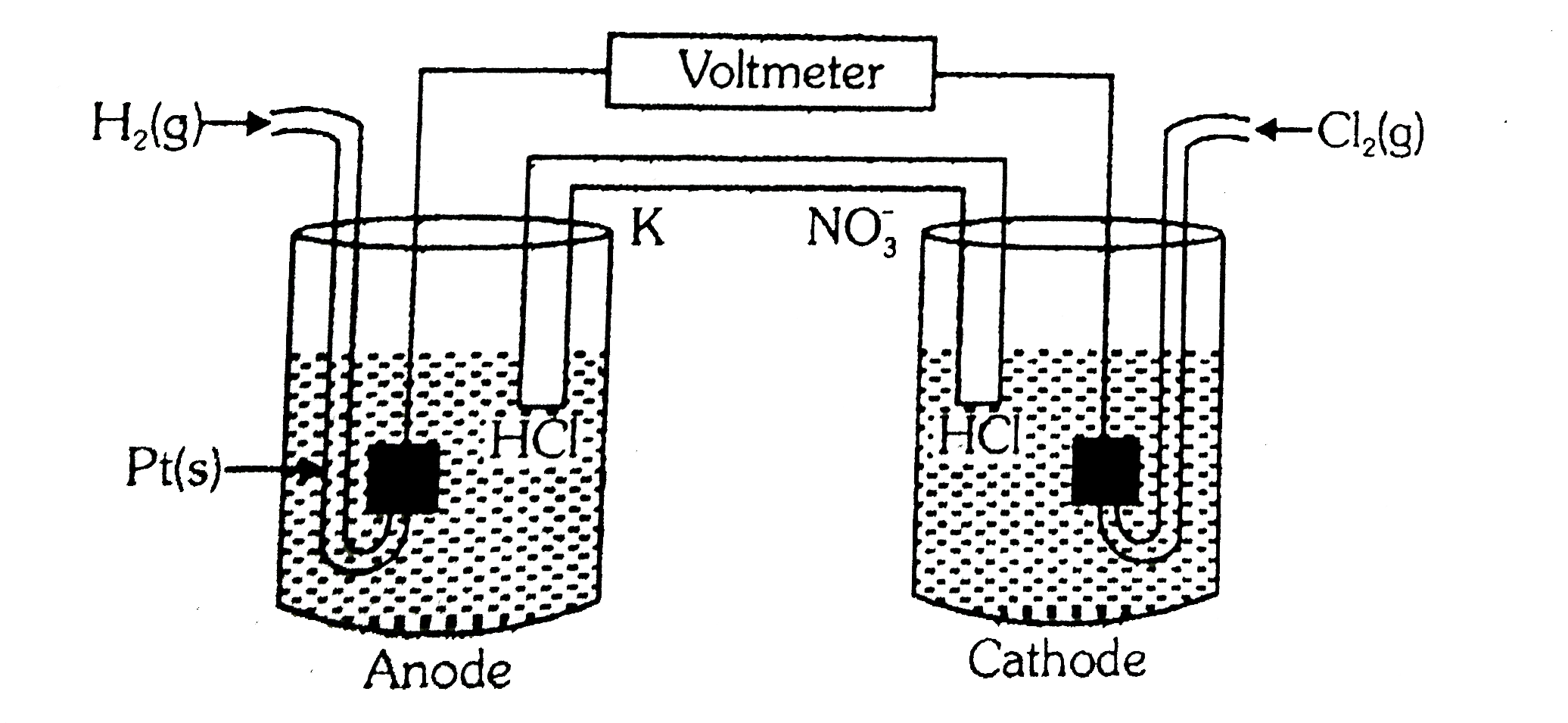
Consider the following Galvanic cell:- ...

Consider the following Galvanic cell:-

By what value the cell voltage when concentration of ions in anodic and cathodic compartments both increased by factor of 10 at 298K:

A

`+0591`

B

`-0.0591`

C

`-0.1182`

D

`0`

Text Solution

Verified by Experts

The correct Answer is:

C

`E_(cell)=-(0.0591)/(1)log_(10)[H^(+)][Cl^(-)]` and `E_(cell)^(')=E_(cell)^(0)-(0.0591)/(1)log_(10)100[H^(+)][Cl^(-)]`
`E_(cell)^(')-E_(cell)=-2xx0.0591=-0.1182`
Promotional Banner

Topper's Solved these Questions

  • ELECTROCHEMISRY

    RESONANCE|Exercise CBSE Problems|34 Videos
  • ELECTRO CHEMISTRY

    RESONANCE|Exercise PHYSICAL CHEMITRY (ELECTROCHEMISTRY)|53 Videos
  • EQUIVALENT CONCEPT & TITRATIONS

    RESONANCE|Exercise Part -IV|22 Videos

Similar Questions

Explore conceptually related problems

The Nernst equation: Consider the following galvanic cell Pb(s) | Pb^(2+)(aq.) || Ag^(2+)(aq.) | Ag(s) (a) What is the quantitative change in the cell voltage on increas-ing the ion concentrations in the anode compartment by a factor of 10 ? (b) What is the quantitative change in the cell voltage on increas-ing the ion concentration in the cathode compartment by a factor of 10 Strategy: The conventional notation of the cell tells us that lead is the anode while silve is the cathode. Therfore, the cell reaction is Pb(s) + 2Ag^(+)(aq.) rarr Pb^(2+)(aq.) + 2Ag(s) The cell potantial (at 25^(@)C ) is given by the Nernst equation, where n = 2 and Q = C_(Pb^(2+))//C_(Ag^(+)) : E_("cell") = E_("cell")^(@)-(0.0592 V)/(n) "logQ" E_("cell")^(@)-(0.0592 V)/(n) "logQ" C_(Pb^(2+))/C_(Ag^(+))^(2)

Write the Nernst equation for the cell reaction in the Daniel cell. How will the E_("cell") be affected when concentration of Zn^(+) ions is increased?

Consider the following relations for emf of a electrochemical cell (i) emf of cell = (Oxidation potential of anode)-(Reduction potential of cathode) (ii) emf of cell = (Oxidation potential of anode)+(Reduction potential of cathode) (iii) emf of cell = (Reduction potential of anode)+(Reduction potential of cathode) (iv) emf of cell = (Oxidation potential of anode)-(Oxidation potential of cathode) Which of the above realtions are correct?

RESONANCE-ELECTROCHEMISRY-Advanced Level Problems
  1. Which statement is correct?

    Text Solution

    |

  2. During the electrolysis of 0.1 M CuSO(4) solution using coppepr electr...

    Text Solution

    |

  3. Consider the following Galvanic cell:- By what value the cell vol...

    Text Solution

    |

  4. Pt|Cl(2)(P(1)atm)|HCl(0.1M)|Cl(2)(P(2)atm)|Pt, cell reaction will be s...

    Text Solution

    |

  5. Pt |{:((H(2))),(1atm):}:| pH = 2:|:|:pH =3 |:{:((H(2))Pt),(1atm):}:|. ...

    Text Solution

    |

  6. In the given figure the electrolytic cell contains 1L of an aqueous 1M...

    Text Solution

    |

  7. By how much will the potential of half-cell Cu^(2+)|Cu change if the s...

    Text Solution

    |

  8. Which of the following facts is not truegt

    Text Solution

    |

  9. Equivalent conductance of 1M CH(3)COOH is 10ohm^(-1) cm^(2) "equiv"^(-...

    Text Solution

    |

  10. Adding powdered Pb and Fe to a solution containing 1.0 M each of Pb^(2...

    Text Solution

    |

  11. Cost of electricity for the production of X litre H(2) at STP at catho...

    Text Solution

    |

  12. The reaction : Zn(s) + 2AgCl(g) rightarrow ZnCl(2)(aq) + 2Ag(s) oc...

    Text Solution

    |

  13. If the pressure of hydrogen gas is increased from 1 atm. To 100 atm, k...

    Text Solution

    |

  14. The equilibrium Cu^(+2)(aq)+Cu(s) hArr2Cu^(+) established at 20^(@)C...

    Text Solution

    |

  15. The E^(@) in the given figure is

    Text Solution

    |

  16. What is the cell entropy change ( in J K ^(-1)) of the following cell...

    Text Solution

    |

  17. Na- amalgam is prepared by electrolysis of NaCl solution using liquid...

    Text Solution

    |

  18. Zn amalgam is prepared by electrolysis of aqueous ZnCl(2) using Hg cat...

    Text Solution

    |

  19. A solution containing one mole per litre each of Cu(NO(3))(2),AgNO(3),...

    Text Solution

    |

  20. At 298 K the standard free energy of formation of H(2)O(l) is -237.20 ...

    Text Solution

    |
