Home
Class 12
CHEMISTRY
The expermental setup for a typical Zn-N...


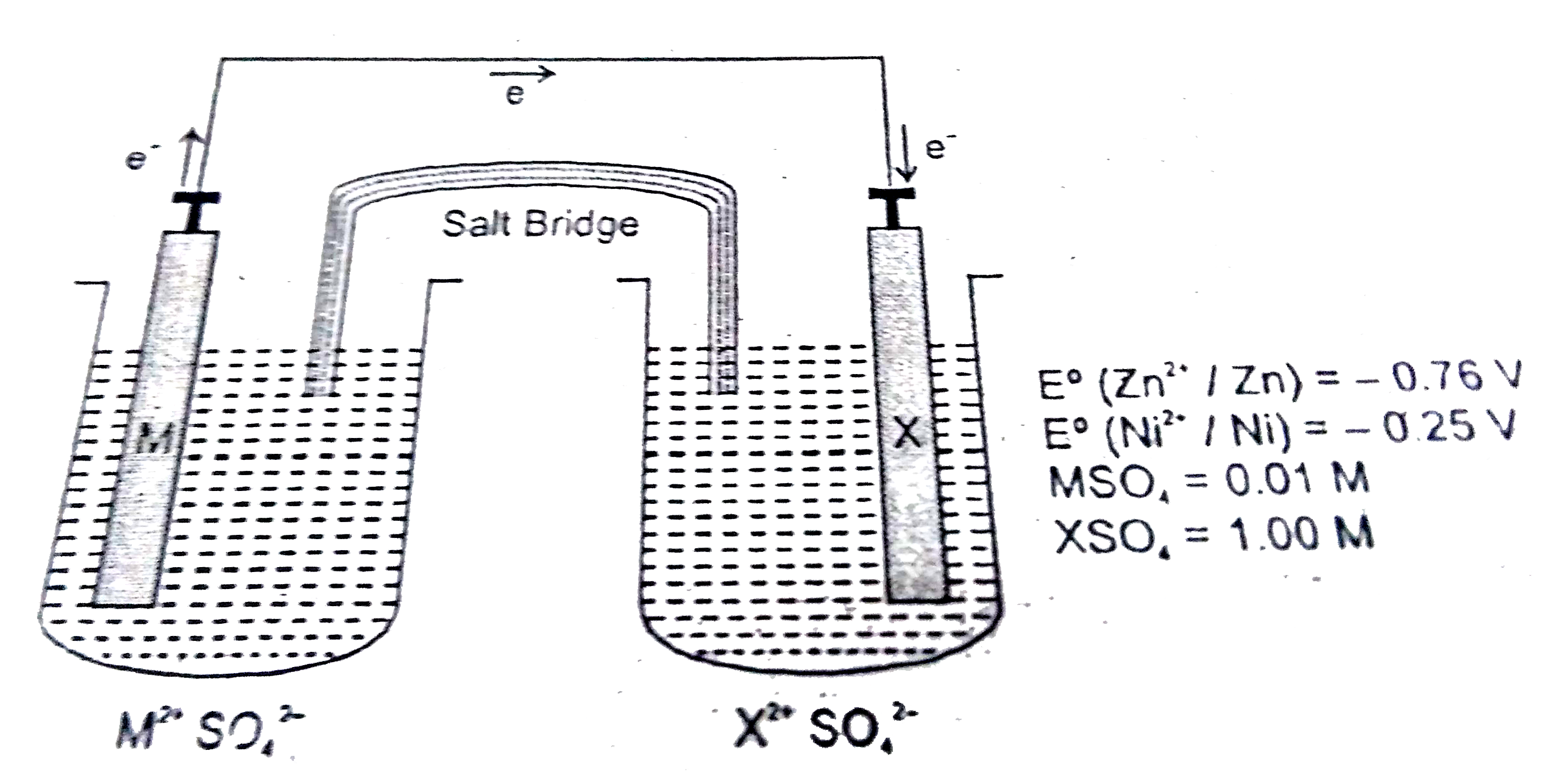
The expermental setup for a typical `Zn-Ni` galvanic cell as shown below in figure:
(a). Identify M and X and determine cell potential at `25^(@)C`
(b). If concentration of `M^(2+)` ion changes to 1.0 M during its usage, what would be the new cell voltage?
(c). Describe, what would happen to cell voltage if salt bridge was removed.

Text Solution

Verified by Experts

The correct Answer is:

(a). `MtoZn` and `XtoNi`
`E_(cell)=+0.569V`
(b). `E_(cell)=+0.451` V (note, equal volume of electrolytes have been considered in the two half-cells.)
(c). Cell voltage becomes zero.

(a). `M=Zn&X=Ni`
`E_(cell)^(@)=-0.25+0.76=0.51V`
`E_(cell)=-0.25-(0.059)/(2)log(([Zn^(2+)])/([Ni^(2+)]))=0.51-(0.059)/(2)log((0.01)/(1))=0.569V`
(b). `Zn^(2+)=1M`
initial conc. conc.after time. `undersetunderset(0.01)(1)(Ni^(2+))+Zn(s)hArrundersetunderset(1)(0.01)(Zn^(2+))(aq)+Ni(s)`

`E_(cell)=0.51-(0.059)/(2)log((1)/(0.01))=0.451"volt"`
(c). circuit is disconnected & cell voltage `=0`
Promotional Banner

Topper's Solved these Questions

  • ELECTROCHEMISRY

    RESONANCE|Exercise CBSE Problems|34 Videos
  • ELECTRO CHEMISTRY

    RESONANCE|Exercise PHYSICAL CHEMITRY (ELECTROCHEMISTRY)|53 Videos
  • EQUIVALENT CONCEPT & TITRATIONS

    RESONANCE|Exercise Part -IV|22 Videos

Similar Questions

Explore conceptually related problems

When a cell is placed in 0.25 M concentrated suger solution, there is no change in it. The concentration of cell sap would be

A voltaic cell is set up at 25^(@)C with following half cells : Ag^(+)(0.001 M)|Ag and Cu^(2+)(0.10 M)|Cu What would be the voltage of this cell ? (E_(cell)^(@)=0.45 V)

The Nernst equation: Consider the following galvanic cell Pb(s) | Pb^(2+)(aq.) || Ag^(2+)(aq.) | Ag(s) (a) What is the quantitative change in the cell voltage on increas-ing the ion concentrations in the anode compartment by a factor of 10 ? (b) What is the quantitative change in the cell voltage on increas-ing the ion concentration in the cathode compartment by a factor of 10 Strategy: The conventional notation of the cell tells us that lead is the anode while silve is the cathode. Therfore, the cell reaction is Pb(s) + 2Ag^(+)(aq.) rarr Pb^(2+)(aq.) + 2Ag(s) The cell potantial (at 25^(@)C ) is given by the Nernst equation, where n = 2 and Q = C_(Pb^(2+))//C_(Ag^(+)) : E_("cell") = E_("cell")^(@)-(0.0592 V)/(n) "logQ" E_("cell")^(@)-(0.0592 V)/(n) "logQ" C_(Pb^(2+))/C_(Ag^(+))^(2)

Consider figure from the above question and answer the questions (i) to (vi) given below. (i) Redraw the diagram to show the direction of electron flow. (ii) Is silver plate the anode or cathode? (iii) what will happen it salt bridge is removed? (iv) When will the cell stop functining? ( v) How will concentration of Zn^(2+) ions and Ag^(+) ions be affected when the cell function? (vi) How will the concentration of Zn^(2+) ions and Ag^(+) ions be affected after the cell becomes dead?

The measured e.m.f. at 25^(@)C for the cell reaction , Zn(S)+Cu^(2+)(1.0 M)to Cu(s) +Zn^(2+) (0.1 M) is 1.3 volt, Calculate E^(@) for the cell reaction.

RESONANCE-ELECTROCHEMISRY-Advanced Level Problems
  1. Calculate the e.m.f. of the cell Pt|H(2)(1.0atm)|CH(3)COOH (0.1M)||N...

    Text Solution

    |

  2. Calculate the equilibrium concentration of all ions in an ideal soluti...

    Text Solution

    |

  3. The expermental setup for a typical Zn-Ni galvanic cell as shown below...

    Text Solution

    |

  4. At 18^(@)C the mobilities of NH(4)^(+) and CIO(4)^(-) ions are 6.6 xx ...

    Text Solution

    |

  5. 10g fairly concentrated solution of CuSO(4) is electrolyzed using 0.01...

    Text Solution

    |

  6. An electric current is passed through electrolytic cells in series one...

    Text Solution

    |

  7. After electrolytes of NaCl solution with inert electrodes for a certai...

    Text Solution

    |

  8. Same quantity of charge is being used to liberate iodine (at anode) an...

    Text Solution

    |

  9. The resistance of two electrolytes X and Y ere found to be 45 and 100 ...

    Text Solution

    |

  10. For 0.0128 N solution fo acetic at 25^(@)C equivalent conductance of t...

    Text Solution

    |

  11. Specific conductance of pure water at 25^(@)C is 0.58 xx 10^(-7) mho c...

    Text Solution

    |

  12. The reduction potential diagram for Cu in acid solution is : Calc...

    Text Solution

    |

  13. For the cells in opposition, Zn(s) | ZnCl(2)(sol).|AgCl(s)|Ag|AgCl(s...

    Text Solution

    |

  14. At Tl^(+) |Tl couple was prepared by saturating 0.1 M KBr with TlBr an...

    Text Solution

    |

  15. The following two cells with initial concentration as given are connec...

    Text Solution

    |

  16. For the cell (at 1bar H(2) pressure) Pt|H(2)(g) HX(m(1), NaX(m(2), NaC...

    Text Solution

    |

  17. A positive potential implies that the species under study has reductio...

    Text Solution

    |

  18. In a galvanic cell, the half-cell having more standard potential serve...

    Text Solution

    |

  19. At 300 K specific conductivity of ethanol is 4xx10^(-10)mhocm^(-1). Th...

    Text Solution

    |

  20. Metallic sodium cannot be prepared from electrolysis of an aqueous sol...

    Text Solution

    |
