

Home
Class 11
PHYSICS
A cube is placed so that one corner is a...

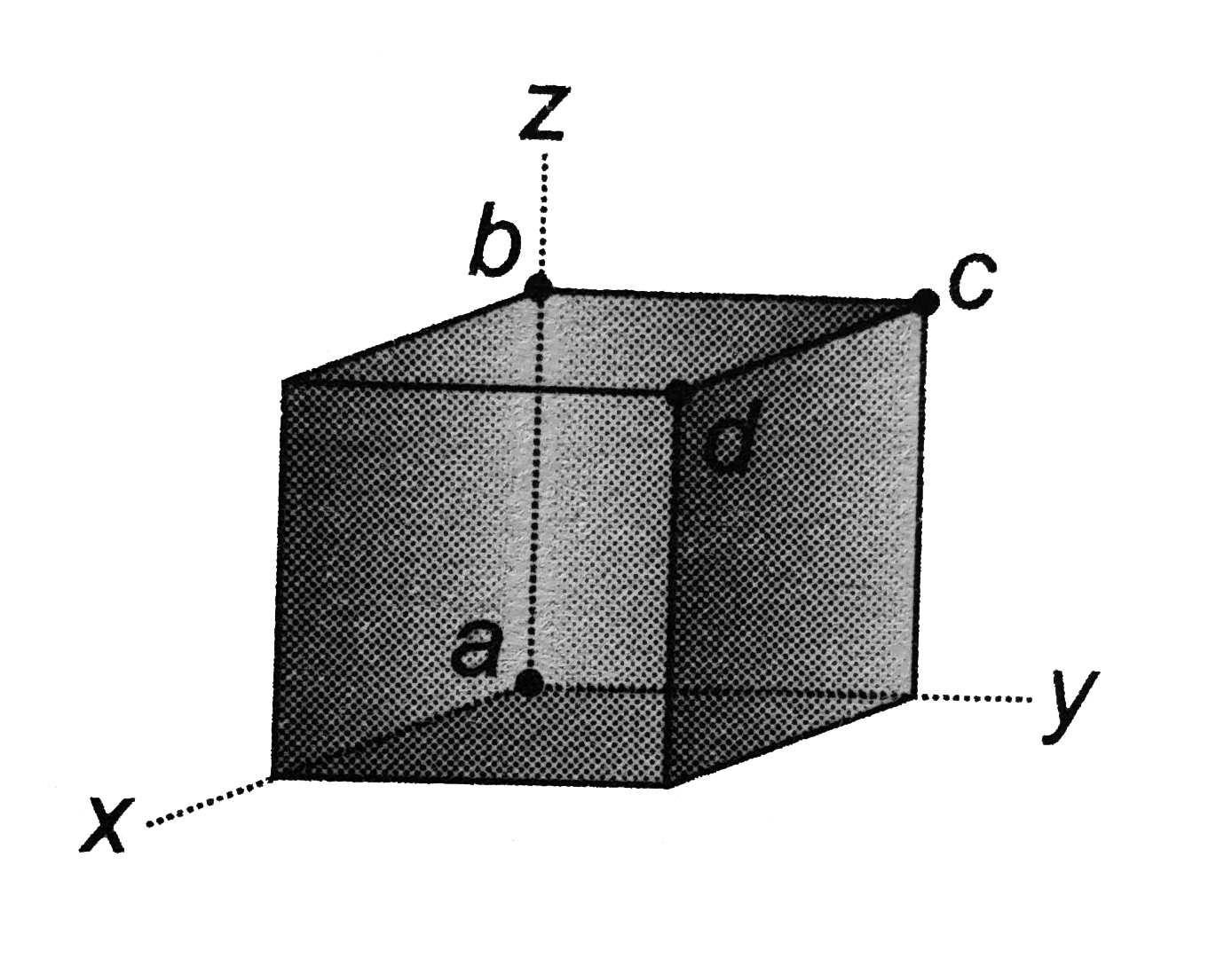
A cube is placed so that one corner is at the origin and three edges are along the x-,y-, and ,z-axes of a coordinate system (figure).Use vector to compute
a.The angle between the edge along the z-axis (line ab) and the diagonal from the origin to the opposite corner (line ad).
b. The angle between line ac (the diagonal of a face ) and line ad.

Promotional Banner

Similar Questions

Explore conceptually related problems

The direction rations of the diagonals of a cube which joins the origin to the opposite corner are (when the three concurrent edges of the cube are coordinate axes)

Find the equation of the straight line passing through the origin and bisecting the portion of the line a x+b y+c=0 intercepted between the coordinate axes.

One diagonal of a square is the intercept of the line x/a+y/b=1 between the axes. Find the coordinates of other two vertices

A charge +q is placed at the origin of X-Y axes as shown in the figure. The work done in taking a charge Q from A to B along the straight line AB is

Comprehesion-I Let k be the length of any edge of a regular tetrahedron (all edges are equal in length). The angle between a line and a plane is equal to the complement of the angle between the line and the normal to the plane whereas the angle between two plane is equal to the angle between the normals. Let O be the origin and A,B and C vertices with position vectors veca,vecb and vecc respectively of the regular tetrahedron. The angle between any edge and a face not containing the edge is

Comprehesion-I Let k be the length of any edge of a regular tetrahedron (all edges are equal in length). The angle between a line and a plane is equal to the complement of the angle between the line and the normal to the plane whereas the angle between two plane is equal to the angle between the normals. Let O be the origin and A,B and C vertices with position vectors veca,vecb and vecc respectively of the regular tetrahedron. The angle between any edge and a face not containing the edge is

The angle between the plane ax+by+cz+d=0 and the line (x-1)/(a)=(y-2)/(b)=(z-3 )/(c) is