

Home
Class 11
PHYSICS
A and B are two fixed points at ta dista...


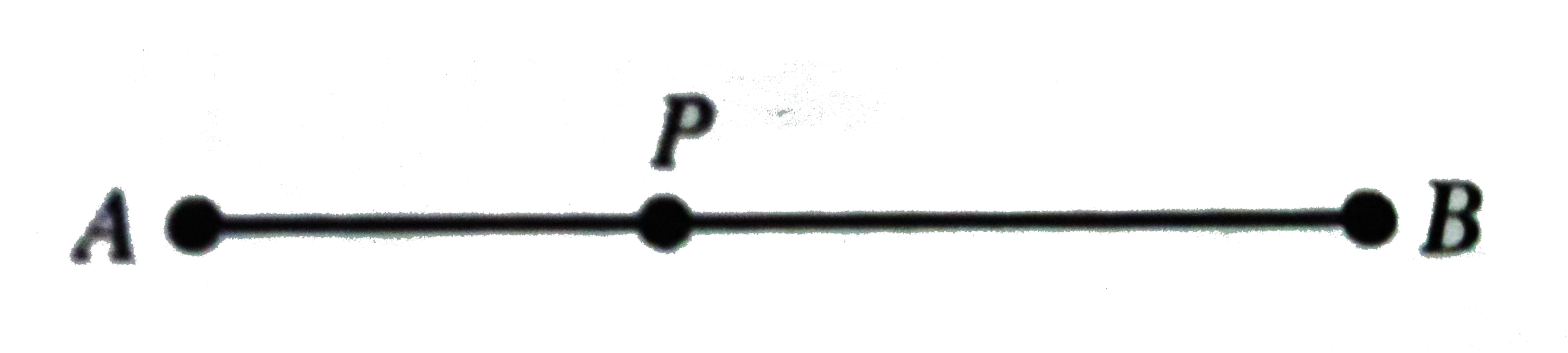
A and B are two fixed points at ta distance `3l` apart. A particle of mass `m` placed at a point `P` experiences the force `2((mg)/(l))vecPA` and the force `((mg)/(l))vecPB` sumultaneously. Initially at `t=0`, the particle is projected from A towards B with speed `3sqrt(gl)`.
Q. Tha particle moves simple harmonically with period `T` and amplitude `A`.

Promotional Banner

Similar Questions

Explore conceptually related problems

A and B are two fixed points at ta distance 3l apart. A particle of mass m placed at a point P experiences the force 2((mg)/(l))vecPA and the force ((mg)/(l))vecPB sumultaneously. Initially at t=0 , the particle is projected from A towards B with speed 3sqrt(gl) . Q. The velocity of the particle when it reaches B will be

A and B are two fixed points at ta distance 3l apart. A particle of mass m placed at a point P experiences the force 2((mg)/(l))vecPA and the force ((mg)/(l))vecPB sumultaneously. Initially at t=0 , the particle is projected from A towards B with speed 3sqrt(gl) . Q. The instant t at which the particle arrives at B in terms of the periodic time T will be

A particle of mass m is constrained to move along a straight line. A and B are two fixed points on the line at a separation of L. When the particle is at some point P, between A and B, it is acted upon by two forces vecF_(1)=((6mg)/(L))vecPA " and " vecF_(2)=((3mg)/(L))vecPB At time t=0, the particle is projected from A toward B with a speed of sqrt(gL) . At what time 't' will the particle reach at B for the first time ?

Two particles of equal mass m and charge t are placed at a distance 16 cm. They do no experience any force. The value of q/m is……..

A particle of mass 'm' moves on a horizont smooth line AB of length 'a' such that when particle is at any general point P on the line two force act on it. A force (mg(AP))/(a) towards A and another force (2mg(BP))/(a) towards B . If the force acting towards A stops acting when the particle is nearest to B then find the velocity with which it crosses point B.

A particle of mass 'm' moves on a horizont smooth line AB of length 'a' such that when particle is at any general point P on the line two force act on it. A force (mg(AP))/(a) towards A and another force (2mg(BP))/(a) towards B . If the force acting towards A stops acting when the particle is nearest to B then find the velocity with which it crosses point B.

A point particle is acted upon by a restoring force –kx3 . The time period of oscillation is T when the amplitude is A. The time period for an amplitude 2A will be :

A particle of mass 'm' moves on a horizont smooth line AB of length 'a' such that when particle is at any general point P on the line two force act on it. A force (mg(AP))/(a) towards A and another force (2mg(BP))/(a) towards B . Find the minimum distance of the particle from B during the motion.