Home
Class 12
CHEMISTRY
Formation of napthalene takes place in t...

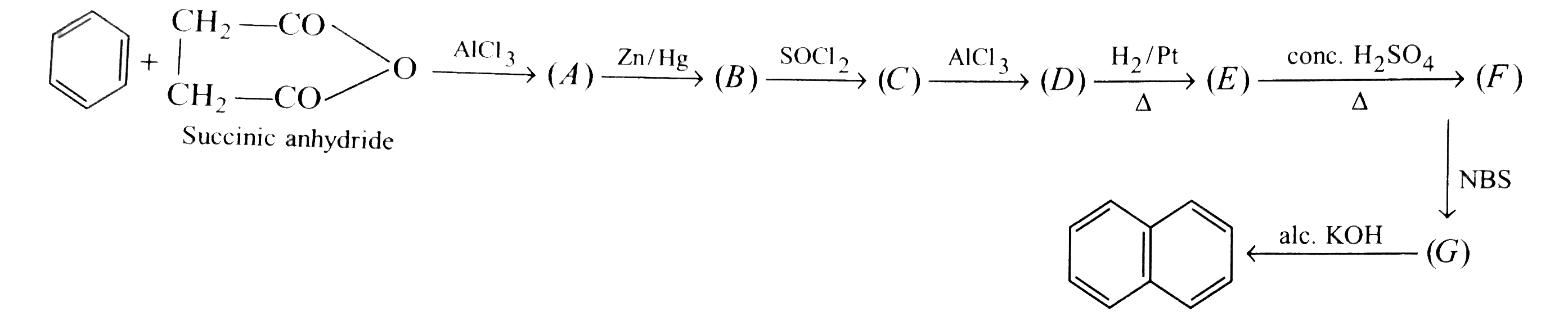
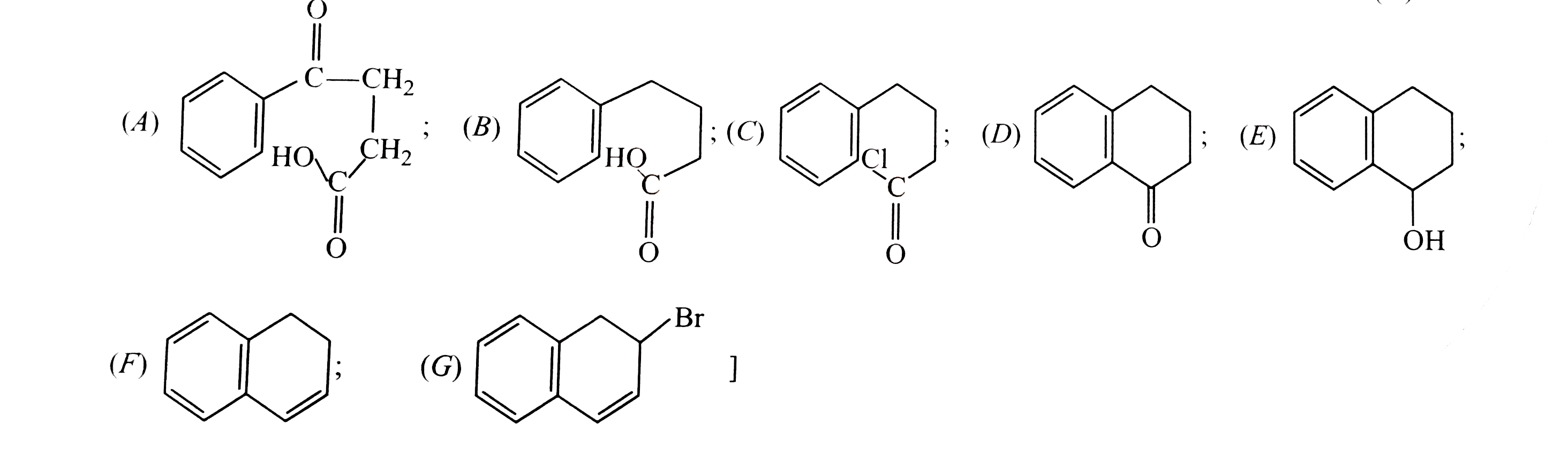
Formation of napthalene takes place in the following steps. What are (A),(B),(C ),(D),(E ),(F) and (G) formed in between?

Text Solution

Verified by Experts
Promotional Banner

Topper's Solved these Questions

  • CARBOXYLIC ACIDS AND THEIR DERIVATIVES

    OP TANDON|Exercise Objective questions|498 Videos
  • CARBOXYLIC ACIDS AND THEIR DERIVATIVES

    OP TANDON|Exercise Integer|4 Videos
  • CARBOXYLIC ACIDS AND THEIR DERIVATIVES

    OP TANDON|Exercise Problem based on structure and properties|26 Videos
  • BASIC PRINCIPLES OF ORGANIC COMPOUNDS (MECHANISM OF ORGANIC REACTIONS)

    OP TANDON|Exercise SINGLE INTEGER ANSWER TYPE QUESTIONS|4 Videos
  • CHEMICAL KINETICS

    OP TANDON|Exercise LINKED COMPRESHENSION TYPE QUESTIONS ( SECTION-VI)|4 Videos

Similar Questions

Explore conceptually related problems

Find the values of A,B,C,D,E,F,G in the following

See the following diagram and identify A,B,C,D,E,F and G

The formation of (C) and (E) takes place, respectivley, when :

The formation of (B) and (D) takes place, respectively, when :

Directions: Read the following information and answer the question that follow: I) Seven friends A, B, C, D, E, F and G are sitting in a circle facing towards centre. A, B, C, D, F and G are sitting at equal distances from each other. II) C is sitting two places right of F, who is sitting one place right of D. III) A forms an angle of 90@ (at centre) with E and angle of 120@ with B. IV) B is opposite G. V) G is sitting on the immediate left of E. If D and C interchange their positions, who will sit pn the immediate left of B? 1) D 2) C 3) F 4) A 5) None of these

Directions: Read the following information and answer the question that follow: I) Seven friends A, B, C, D, E, F and G are sitting in a circle facing towards centre. A, B, C, D, F and G are sitting at equal distances from each other. II) C is sitting two places right of F, who is sitting one place right of D. III) A forms an angle of 90@ (at centre) with E and angle of 120@ with B. IV) B is opposite G. V) G is sitting on the immediate left of E. Who is sitting on the immediate left of D? 1)F 2) G 3) B 4) E 5) None of these

Directions: Read the following information and answer the question that follow: I) Seven friends A, B, C, D, E, F and G are sitting in a circle facing towards centre. A, B, C, D, F and G are sitting at equal distances from each other. II) C is sitting two places right of F, who is sitting one place right of D. III) A forms an angle of 90@ (at centre) with E and angle of 120@ with B. IV) B is opposite G. V) G is sitting on the immediate left of E.br> Who is sitting on the immediate right of C? 1) G 2) E 3) D 4) A 5) None of these

Directions: Read the following information and answer the question that follow: I) Seven friends A, B, C, D, E, F and G are sitting in a circle facing towards centre. A, B, C, D, F and G are sitting at equal distances from each other. II) C is sitting two places right of F, who is sitting one place right of D. III) A forms an angle of 90@ (at centre) with E and angle of 120@ with B. IV) B is opposite G. V) G is sitting on the immediate left of E. Who is sitting opposite F? 1) F 2) G 3) B 4) A 5) None of these

Identify the products and explain their formation. (a) (b) ( c) (d) ( e) (f) (g) (h) (i) .

OP TANDON-CARBOXYLIC ACIDS AND THEIR DERIVATIVES-Brain storming problems
  1. Complete the following reactions

    Text Solution

    |

  2. How can you achieve the following interconversions ?

    Text Solution

    |

  3. Give the star mark to the hydrogen which is most acidic in the followi...

    Text Solution

    |

  4. What happens when malonic acid is heated with urea in presence of POCl...

    Text Solution

    |

  5. Complete the following reactions

    Text Solution

    |

  6. Complete the following reactions:

    Text Solution

    |

  7. What happens when benzene undergoes Friedel-Crafts acylation with succ...

    Text Solution

    |

  8. Complete the following Claisen condensation products. Indicate whether...

    Text Solution

    |

  9. Formation of napthalene takes place in the following steps. What are (...

    Text Solution

    |

  10. What are (X) and (Y) in the following reaction? Give the mechanism of ...

    Text Solution

    |

  11. What happens when ? (i) Lactic acid is heated (ii) Cyclic amide is...

    Text Solution

    |

  12. Complete the following reaction: 2C(2)H(5)MgCl+CdCl(2)to(A)+2MgCl(2)...

    Text Solution

    |

  13. Predict the products expexted of the following reactions:

    Text Solution

    |

  14. What happens when? (i) Urea is heated with acetoacetic ester, (ii)...

    Text Solution

    |

  15. Complete the following set of reactions: (i) Urea + NH(2)-NH(2)under...

    Text Solution

    |

  16. Complete the following reactions: CaCN(2)+H(2)SO(4)toCaSO(4)+(A) (...

    Text Solution

    |

  17. Complete the missing rectants (A) and (B) :

    Text Solution

    |

  18. What happens when in presence of sodium ethoxide: (i) Ethyl-3-methyl...

    Text Solution

    |

  19. Write down the products in the following reactions:

    Text Solution

    |

  20. Write down the major product in the following reaction with possible m...

    Text Solution

    |

