Text Solution
Verified by Experts



Topper's Solved these Questions
THEORY OF SUPPLY : LAW OF SUPPLY AND ELASTICITY OF SUPPLY
RADHA BHUGANA|Exercise EXERCISES(VSATQ)|19 VideosTHEORY OF SUPPLY : LAW OF SUPPLY AND ELASTICITY OF SUPPLY
RADHA BHUGANA|Exercise EXERCISES(SATQ)|23 VideosTHEORY OF SUPPLY : LAW OF SUPPLY AND ELASTICITY OF SUPPLY
RADHA BHUGANA|Exercise VALUE BASED QUESTIONS|3 VideosTHEORY OF DEMAND
RADHA BHUGANA|Exercise UNSOLVED NUMERICALS|7 Videos
Similar Questions
Explore conceptually related problems
RADHA BHUGANA-THEORY OF SUPPLY : LAW OF SUPPLY AND ELASTICITY OF SUPPLY-GUIDELINES TO NECRT QUESTIONS
- How does technological progress affect the supply curve of a firm?
Text Solution
|
- How does an increase in the price of an input affect the supply curve ...
Text Solution
|
- How does an increase in number of firms in a market affect the market ...
Text Solution
|
- What does price elasticity of supply mean ? How do we measure it ?
Text Solution
|
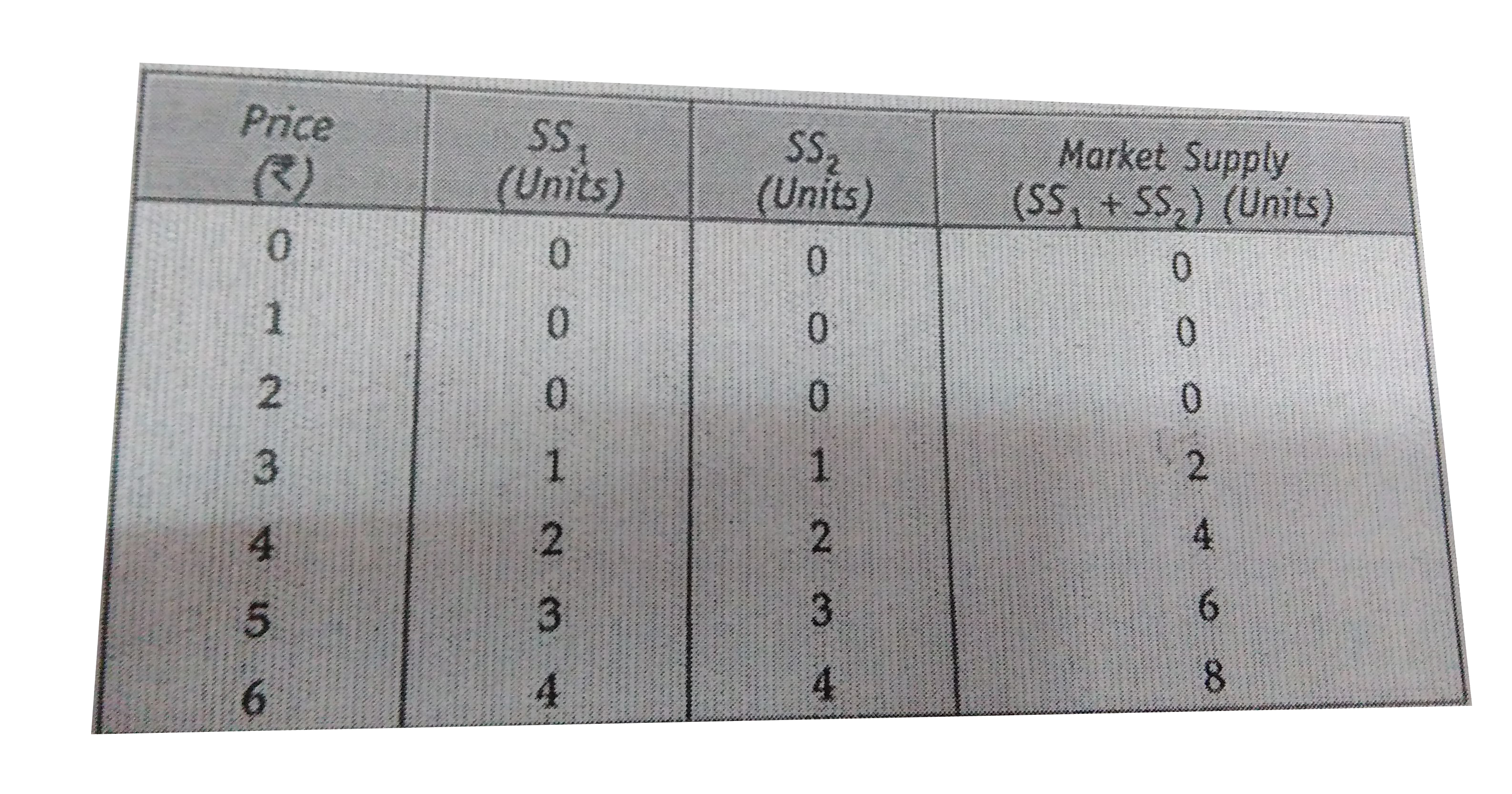
- Condiser a market with two firms. The following table shows schedules ...
Text Solution
|
- Compute market supply schedule. In the following table, columns labell...
Text Solution
|
- There are three identical firms in a market. The following table shows...
Text Solution
|
- A firm earns a revenue of Rs.50 at the market price of a good at Rs.10...
Text Solution
|
- The market price changes from Rs.5 to Rs.20. As a result, the quantity...
Text Solution
|
- At the market price of Rs.10, a firm supplied 4 untis of output. The m...
Text Solution
|