

Home
Class 11
PHYSICS
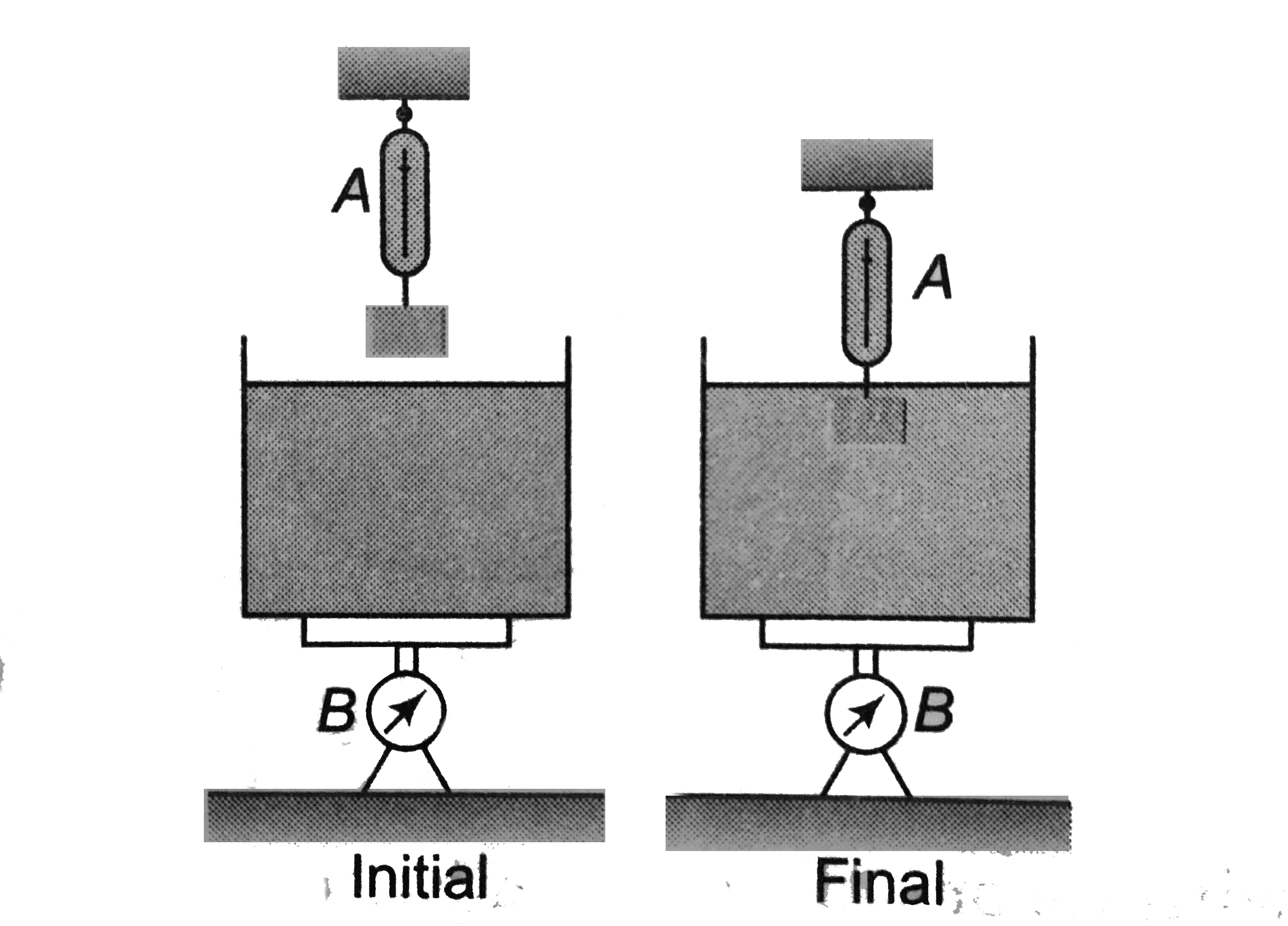
for the arrangement shown in figure, ini...

for the arrangement shown in figure, initially the balance `A`and `B` reads `F_(1)` and `F_(2)` respectively and `F_(1)gtF_(2)`. Finally when the block is immersed in the liquid then the readings of balance `A` and `B` are `f_(1)` and `f_(2)` respectively. Indentify the statement which is not always (where, F is some force ) correct statement.
.

Promotional Banner

Similar Questions

Explore conceptually related problems

For the following table, the values of f_(1) , f_(0) and f_(2) are respectively______.

For the following table, the values of f_(1) , f_(0) and f_(2) are respectively______.

A block pulley arrangement is shown in the figure. If f_(1) and f_(2) represents frictional force acting on the block A and B respectively then choose the correct statement. (given g=10m//s^(2) )

A block pulley arrangement is shown in the figure. If f_(1) and f_(2) represents frictional force acting on the block A and B respectively then choose the correct statement. (given g=10m//s^(2) )

On a smooth horizontal tanle, a sphere is pressed by blocks A and B by forces F_(1) and F_(2) respectively (F_(1)gtF_(2)) exactely normal to the tangent at the point of contact of blocks and sphere. A force F is applied on the sphere diameter OP , which is line of action of forces F_(1) and F_(2) . the sphere moves out of blocks A and B . find minimum value of F . the coefficient of friction is mu at all contancts.

In the figure, the blocks A,B and C of mass m each have accelerations a_(1),a_(2) and a_(3) respectively. F_(1) and F_(2) are external forces of magnitude 2mg and mg respectively.

In the diagram shown the ground is amooth and F_(1) & F_(2) are both horizontal forces. The mass of the upper block is 10 kg while that of lower block is 15 kg . The correct statement is :

In the figure the block A,B and C of mass m each, have acceleration a_(1),a_(2) & a_(3) respectively. F_(1) & F_(2) are external forces of magnitude 2 mg and mg respectively :

There are four forces acting at a point P produced by strings as shown in , which at rest . The forces F_(1) and F_(2) respectively: