

Home
Class 11
PHYSICS
Two immiscible liquids of densities rho ...

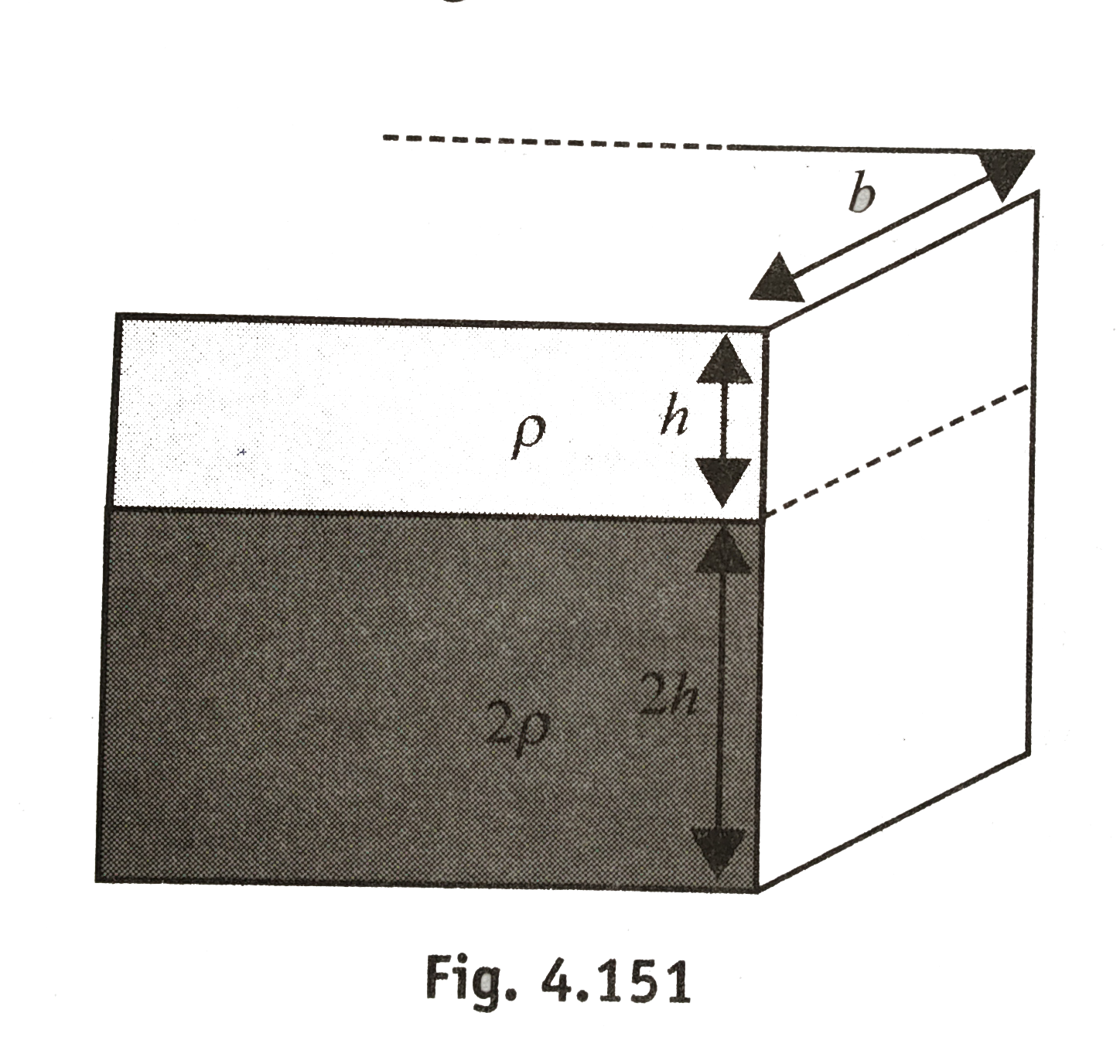
Two immiscible liquids of densities `rho` and `2rho` and thickness (heights) `h` and `2h`, respectively, push a vertical plate. Find the total side thrust given by the liquids on the vertical plate.

Promotional Banner

Similar Questions

Explore conceptually related problems

A thin triangular glass tube containing immiscible liquids A, B, C of densities rho, 2rho, 3rho is at rest in vertical plane. Find x.

A thin triangular glass tube containing immiscible liquids A, B, C of densities rho, 2rho, 3rho is at rest in vertical plane. Find x.

The pressure inside a liquid of density rho at a depth h is :

Two immiscible liquid of densities rho and 3rho are put in a container. The height of each liquid is h. A solid cylinder of length L and density d is put in this container. The cylinder floats completely inside liquids with its axis vertical and length L/3 in the denser liquid. The density d is equal to

A vertical pole of length l , density rho , area of cross section A floats in two immiscible liquids of densities rho_(1) and rho_(2) . In equuilibrium possition the bottom end is at the interface of the liquids. When the cylinder is displaced vertically, find the time period of oscillation.

A vertical pole of length l , density rho , area of cross section A floats in two immiscible liquids of densities rho_(1) and rho_(2) . In equuilibrium possition the bottom end is at the interface of the liquids. When the cylinder is displaced vertically, find the time period of oscillation.

A vertical pole of length l , density rho , area of cross section A , floats in two immiscible liquids of densities rho_(1) and rho_(2) . In equilibrium position the bottom end is at the interface of the liquids. When the cylinder is displaced vertically, the time period of oscillation is..........

Equal volume of two immiscible liquids of densities rho and 2rho are filled in a vessel as shown in the figure. Two small holes are punched at depths h//2 and 3h//2 from the surface of lighter liquid. If v_(1) and v_(2) are the velocities of efflux at these two holes, then v_(1)//v_(2) is