

Home
Class 12
PHYSICS
In the figure shown all the surface are ...

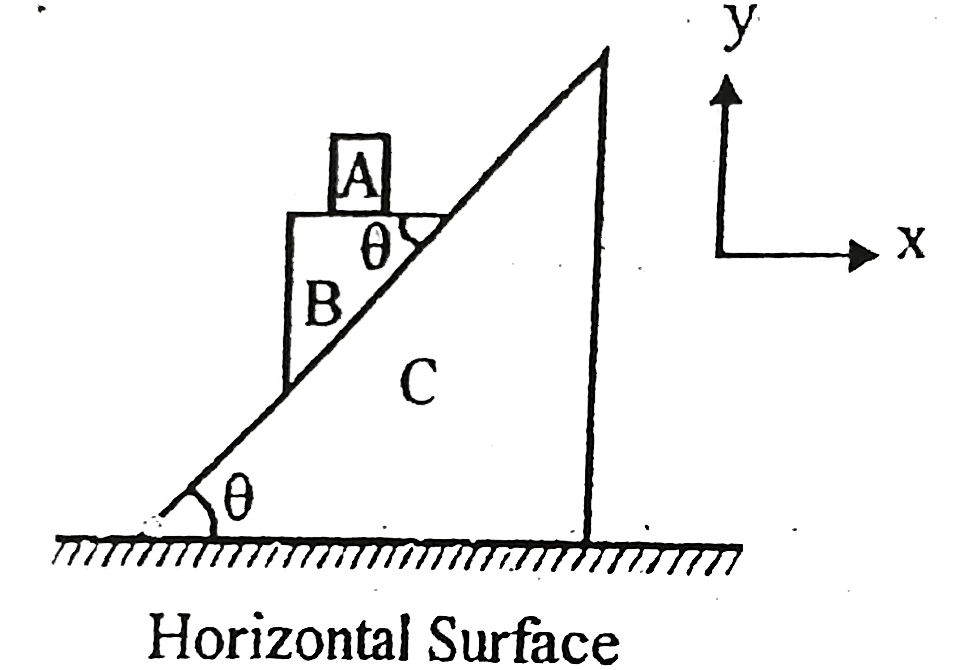
In the figure shown all the surface are smooth. All the blocks A, B and C are movable, x-axis is horizontal and y-axis verticle as shown. Just after the system is released from the position as shown.

Promotional Banner

Similar Questions

Explore conceptually related problems

In the figure shown all the surface are smooth. All the blocks A,B and C are movable x-axis is horizontal and y-axis vertical as shown. Just after the system is relased from the position as shown.

In the figure shown all the surface are smooth. All the blocks A,B and C are movable x-axis is horizontal and y-axis vertical as shown. Just after the system is relased from the position as shown.

In the figure shown all the surface are smooth. All the blocks A,B and C are movable x-axis is horizontal and y-axis vertical as shown. Just after the system is relased from the position as shown.

A rod and a block are of same mass. Initially rod is in horizontal position. What will be acceleration of tip of the rod just after the system is released from this position shown in figure.

In the figure shown A and B are free to move . All the surface are smooth. Mass of A is m . Then

In the figure shown A and B are free to move . All the surface are smooth. Mass of A is m . Then

In the following figure all surfaces are smooth. The system is released from rest , then :

In the system shown in the diagram all surfaces are smooth, pulley and strings are ideal. If vec( a_(A)) and vec( a_(B)) are the accelerations of the two blocks, then just after the system is released from rest, then choose correct statement(s) :

In the figure shown , all surface are smooth . Acceleration of mass '4m' , when the system Is released from rest will be

In the system shown in figure, all surfaces are smooth, pulley and strings are massless. Mass of both A and B are equal. The system is released from rest. (a) Find the veca_(A). veca_(B) immediately after the system is released. veca_(A) "and" veca_(B) are accelerations of block A and B respectively. (b) Find veca_(A) immediately after the system is released.