

Home
Class 11
CHEMISTRY
11 moles of N(2) and 12 moles of H(2) mi...

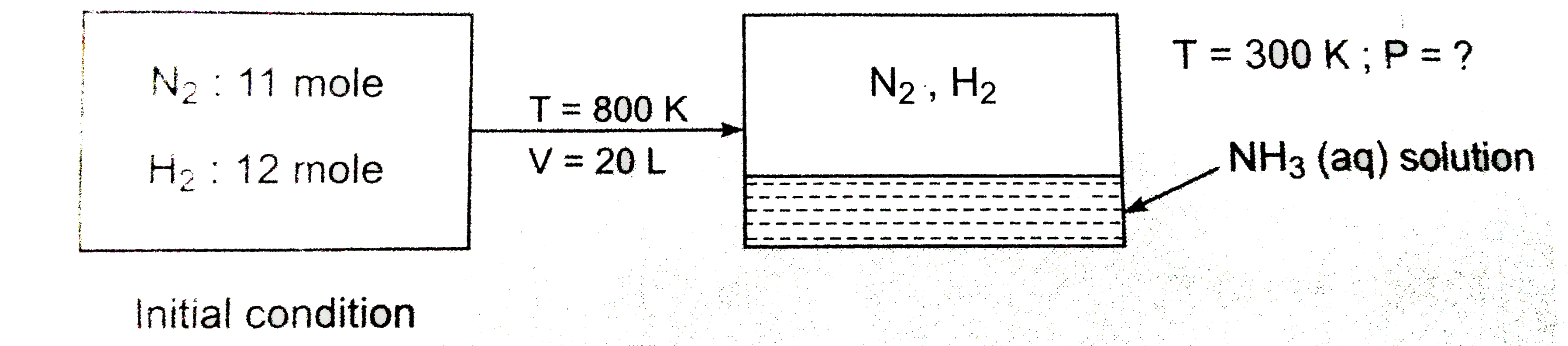
11 moles of `N_(2)` and 12 moles of `H_(2)` mixture reacted in 2.0 litre vessel at 800 K. After equilibrium was reached, 6 mole of `H_(2)` was present. 3.58 litre of liquid water is injected in equibrium mixture and resultant gaseous mixture suddenly cooled to 300K. What is the final pressure of gaseous mixture? Neglect vapour pressure of liquid solution. Assume (i) all `NH_(3)` dissolved in water (ii) no change in volume of liquid (iii) At 300 K no reaction takes place between `N_(2)` and `H_(2)`

Promotional Banner

Similar Questions

Explore conceptually related problems

A 100dm^(3) flask contains 10 mole each of N_(2) and H_(2) at 777 K . After equilibrium was reached, parital pressure of H_(2) was 1 atm . At this point 5 litre of H_(2)O_((l)) was injected and gas mixture was cooled to 298 K . Find out the pressure of gaseous mixture left.

A mixture of 2 moles of N_(2) and 8 moles of H_(2) are heated in a 2 lit vessel, till equilibrium is established. At equilibrium, 04 moles of N_(2) was present. The equilibrium concentration of H_(2) will be

A mixture of 2 moles of N_(2) and 8 moles of H_(2) are heated in a 2 lit vessel, till equilibrium is established. At equilibrium, 04 moles of N_(2) was present. The equilibrium concentration of H_(2) will be

A 100 dm^(3) flask contains 10 mol each of N_(2) and H_(2) at 700 K . After equilibrium was reached, partial pressure of H_(2) was 1 atm . At this point, 5 L of H_(2)O(l) was injected and gas mixture was cooled to 298 K . Find out the gas pressure.

A 100 dm^(3) flask contains 10 mol each of N_(2) and H_(2) at 700 K . After equilibrium was reached, partial pressure of H_(2) was 1 atm . At this point, 5 L of H_(2)O(l) was injected and gas mixture was cooled to 298 K . Find out the gas pressure.

A mixture of 1 mole of N_(2) and 3 moles of H_(2) is allowed to react at a constant pressure of 100 bar. At equilibrium, 0.6 mole of ammonia is formed. Calculate the equilibrium constant for the reaction N_(2)+3H_(2)hArr2NH_(3) .

28 g of N_(2) and 6 g of H_(2) were kept at 400^(@)C in 1 litre vessel, the equilibrium mixture contained 27.54 g of NH_(3) . The approximate value of K_(c) for the above reaction can be ("in mole"^(-2) "litre"^(2))