

Home
Class 11
PHYSICS
Figure shows a sphere moving in a steady...

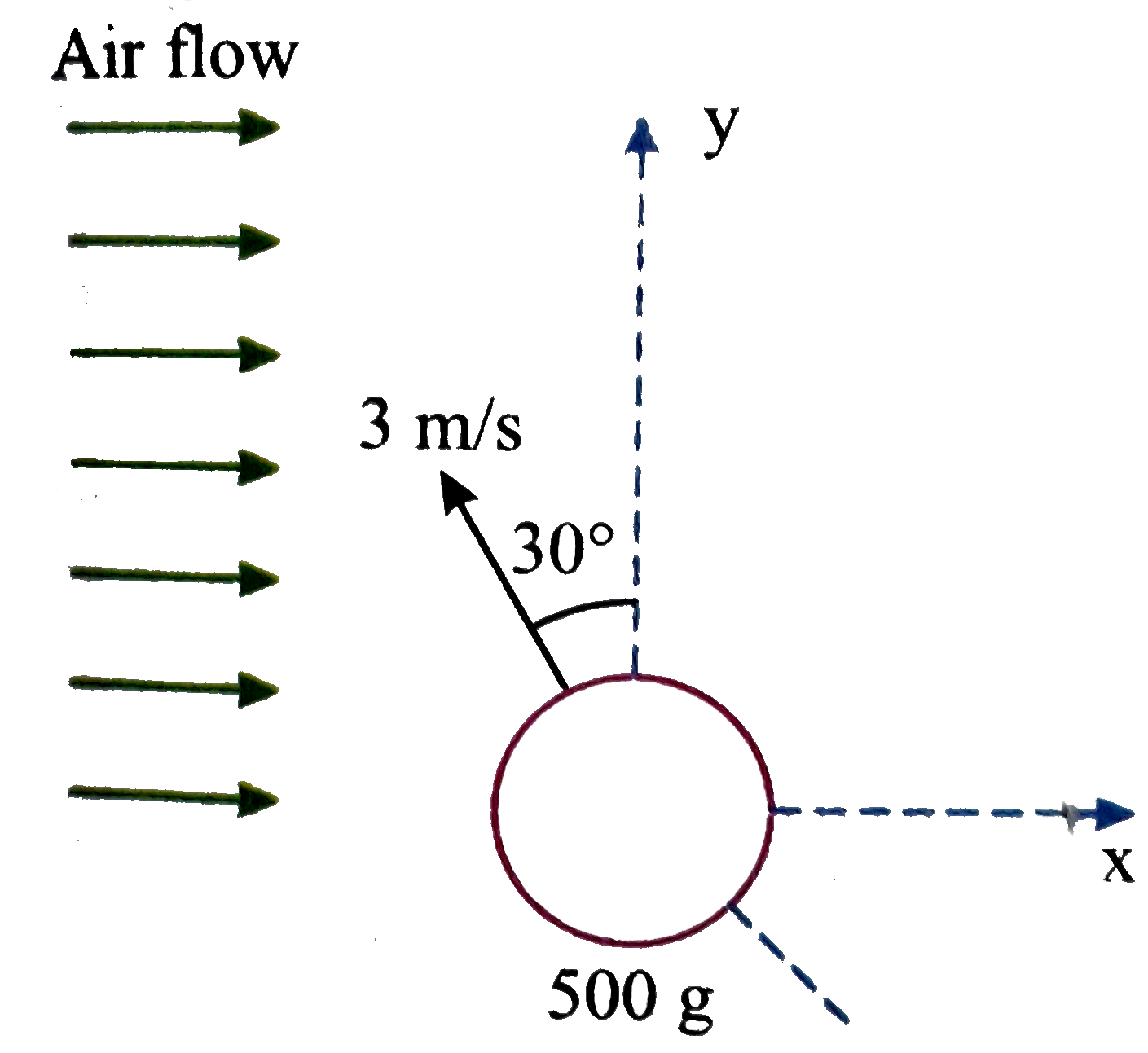
Figure shows a sphere moving in a steady flow of air in the `x`-direction on a horizontal plane.The air stream exerts an essentially constant acceleration `1.8 m//sec^(2)` on the sphere in the `x`-direction.If at `t=0` the sphere is moving as shown in figure, determine the time `t` required for the sphere to cross the `y`-axis again.

Promotional Banner

Similar Questions

Explore conceptually related problems

The figure shows a smooth inclined plane of inclination theta fixed in a car. A sphere is set in pure rolling on the incline. For what value of the acceleration of the car in the horizontal direction the sphere will continue pure rolling?

A particle of mass m is initially situated at point P inside a hemispherical surface of radius r as shown in the figure. A horizontal acceleration of magnitude a_o is suddenly produced acceleration on the particle in the horizontal direction. If gravitational acceleration is neglected, then time taken by the particle to touch the sphere again is

Figures shows a smooth inclined plane of inclination theta fixed ina car. A sphere is set in pure rolling on the incline. For what value of a (the acceleration of car in horizontal direction) the sphere will continue pure rolling ?

An object is moving in x-y plane its velocity and acceleration at t=0 are represented in figure. After how much time object crosses the y- axis:-

An object is moving in x-y plane its velocity and acceleration at t=0 are represented in figure. After how much time object crosses the y- axis:-

An object is moving in x-y plane its velocity and acceleration at t=0 are represented in figure. After how much time object crosses the y- axis:-

A plank of mass m_1 with a uniform sphere of mass m_2 placed on it rests on a smooth horizontal plane. A constant horizontal force F is applied to the plank. With what acceleration will the plank and the centre of the sphere move provided there is no sliding between the plank and the sphere?

Position-time graph for a particle moving along x- direction is as shown in the figure. Average speed of the particle from t = 0 to t = 4 is :