Home
Class 11
CHEMISTRY
In which of the following pairs of carba...

In which of the following pairs of carbanion the first one is more stable than correct.

A

`overset(o.)CF_(3),overset(o.)"CC"l_(3)`

B

`HC-=overset(" "o.)C,H_(2)C=overset(o.)CH`

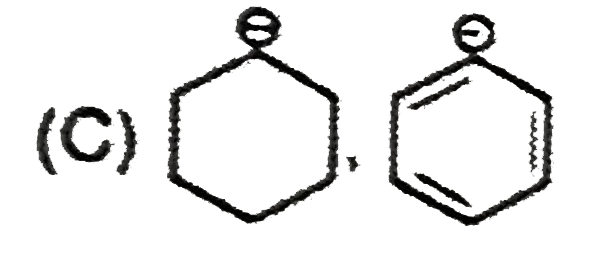
C

D

`(CH_(3)),overset(o.)C,H_(3)C-overset(o.)CH_(2)`

Text Solution

AI Generated Solution

The correct Answer is:

To determine which of the given pairs of carbanions has the first carbanion more stable than the second, we need to analyze the stability of each carbanion based on their structure and the effects of surrounding groups. Here’s a step-by-step solution: ### Step 1: Analyze the first pair (CF3- vs CCl3-) - **CF3-**: The carbon is bonded to three fluorine atoms. Fluorine is highly electronegative and has three lone pairs of electrons. This high electronegativity means that fluorine does not want to share electron density with the carbon, leading to increased electron density on carbon. - **CCl3-**: The carbon is bonded to three chlorine atoms. Chlorine, being larger and less electronegative than fluorine, can accept some electron density from the carbon due to its 3d orbitals, which allows for backbonding. This backbonding decreases the electron density on carbon, making it more stable. **Conclusion**: CCl3- is more stable than CF3-. Therefore, the first carbanion is not more stable in this pair. ### Step 2: Analyze the second pair (C≡C- vs C=C-) - **C≡C-**: The carbon bearing the negative charge is sp-hybridized, which means it has 50% s-character. Higher s-character indicates greater electronegativity, which stabilizes the negative charge. - **C=C-**: The carbon bearing the negative charge is sp2-hybridized, which means it has 33.3% s-character. This lower s-character means it is less electronegative and less stable than the sp-hybridized carbanion. **Conclusion**: C≡C- is more stable than C=C-. Thus, the first carbanion is more stable in this pair. ### Step 3: Analyze the third pair (C6H11- vs C6H5-) - **C6H11- (Cyclohexyl anion)**: The carbon with the negative charge is sp3-hybridized, which means it has 25% s-character. The negative charge is localized and not stabilized by resonance. - **C6H5- (Phenyl anion)**: The carbon with the negative charge is sp2-hybridized, which means it has 33.3% s-character. However, the negative charge can be delocalized over the aromatic ring, providing additional stability. **Conclusion**: C6H5- is more stable than C6H11-. Therefore, the first carbanion is not more stable in this pair. ### Step 4: Analyze the fourth pair (tert-butyl anion vs ethyl anion) - **tert-butyl anion**: The carbon with the negative charge is bonded to three methyl groups. Methyl groups are electron-donating due to the +I effect, which increases electron density on the negatively charged carbon, making it less stable. - **ethyl anion**: The carbon with the negative charge is bonded to only one methyl group and one hydrogen. The inductive effect is less pronounced here, leading to a more stable carbanion. **Conclusion**: The ethyl anion is more stable than the tert-butyl anion. Therefore, the first carbanion is not more stable in this pair. ### Final Answer: The only pair where the first carbanion is more stable than the second is the second pair (C≡C- vs C=C-).
Promotional Banner

Topper's Solved these Questions

  • GENERAL ORGANIC CHEMISTRY II

    RESONANCE|Exercise Part-III: Match the Column|2 Videos
  • GENERAL ORGANIC CHEMISTRY II

    RESONANCE|Exercise Part-I : Only One Option Correct Type|22 Videos
  • GENERAL ORGANIC CHEMISTRY II

    RESONANCE|Exercise Exercise-1|20 Videos
  • GASEOUS STATE

    RESONANCE|Exercise PHYSICAL CHMISTRY (Gaseous State)|47 Videos
  • GENERAL ORGANIC CHEMISTRY-I

    RESONANCE|Exercise PART-III : PRACTICE TEST-19|1 Videos

Similar Questions

Explore conceptually related problems

In each of the following pairs of ions in which I ion is more stable than II

In which of the following pairs the first one is the stronger base than second.

Which of the following is more stable?

In which of the following pairs, first species is more stable than second ?

In which of the following first resonating structure is more stable than the second?

In which of the following pairs A is more stable than B?

In which of the following pairs II is more stable than I

RESONANCE-GENERAL ORGANIC CHEMISTRY II-Part-II Only One Option Correct Type
  1. Which of the following is the least stable carbanion?

    Text Solution

    |

  2. The most stable anion is:

    Text Solution

    |

  3. In which of the following pairs of carbanion the first one is more sta...

    Text Solution

    |

  4. Arrange the following carbanions in decreasing order of stability:

    Text Solution

    |

  5. The most stable anion is:

    Text Solution

    |

  6. Arrange the following carbanions in increasing order of stability:

    Text Solution

    |

  7. Among the following, the paramagnetic species is:

    Text Solution

    |

  8. The stability of given free radicals in decreasing order is: (i) CH(...

    Text Solution

    |

  9. Which of the following is the correct order of stability of free radic...

    Text Solution

    |

  10. Most stable radical among the following is :

    Text Solution

    |

  11. Arrange the following radicals in decreasing order of their stability.

    Text Solution

    |

  12. Least stable radical among the following is :

    Text Solution

    |

  13. The most unstable carbocation is:

    Text Solution

    |

  14. The most stable carbocation is:

    Text Solution

    |

  15. Which of the following shows the correct order of decreasing stability...

    Text Solution

    |

  16. Which of the following is the arranged more stable carbocation of the ...

    Text Solution

    |

  17. Most stable rearranged form of given carbocations is:

    Text Solution

    |

  18. Which of the following in the rearranged in the rearranged more stable...

    Text Solution

    |

  19. The correct basic strength order of following anions is:

    Text Solution

    |

  20. Which of the following shows the correct order of decreasing basicity ...

    Text Solution

    |
