Home
Class 12
PHYSICS
Electrons are emitted by a hot filament ...

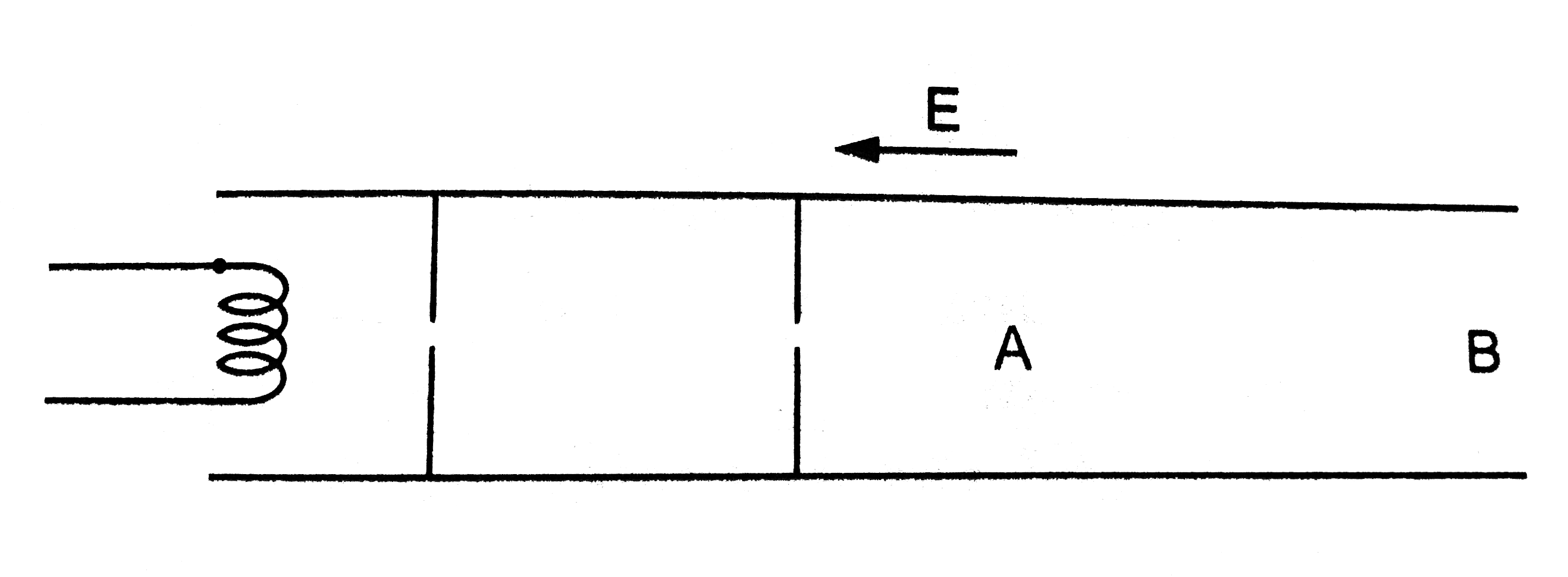
Electrons are emitted by a hot filament and are accelerated by an electric field as shown in figure .The two stops at the left ensure that the electron beam has a uniform cross-section.

A

Linear momentum of electron increases from A to B.

B

The electric current is from right to left

C

The magnitude of the current is same at A and B.

D

The current density is same at A and B.

Text Solution

Verified by Experts

The correct Answer is:

A, B, C, D
Promotional Banner

Topper's Solved these Questions

  • CURRENT ELECTRICITY

    RESONANCE|Exercise Exercise-2 (Part-4)|12 Videos
  • CURRENT ELECTRICITY

    RESONANCE|Exercise Exrcies-3(PART-1)|22 Videos
  • CURRENT ELECTRICITY

    RESONANCE|Exercise Exercise-2 (Part-2)|16 Videos
  • COMMUNICATION SYSTEMS

    RESONANCE|Exercise Exercise 3|13 Videos
  • DAILY PRACTICE PROBLEM

    RESONANCE|Exercise DPP.No.71|1 Videos

Similar Questions

Explore conceptually related problems

The de Broglie wavelength of an electron accelerated by an electric field of V volt is given by:

Electron are emited from an electron gun at almost zero velocity and are accelerated by an electric field E through a distance of 1.0m The electron are now scatteared by an atomic hydrogen sample in ground state what should be the minimum value of E so that red light of wavelength 656.5 nm may be emitted by the hydrogen?

A beam of electorn emitted from the electron gun G is accelerated by an electic field E . The area of cross-section of the beam remains constant. A the beam moves away from G

A proton and an electron are placed in a uniform electric field.

Following experiment was performed by J.J. Thomson in order to measure ratio of charge e and mass m of electron. Electrons emitted from a hot filament are accelerated by a potential difference V. As the electrons pass through deflecting plates, they encounter both electric and magnetic fields. the entire region in which electrons leave the plates they enters a field free region that extends to fluorescent screen. The entire region in which electrons travel is evacuated. Firstly, electric and magnetic fields were made zero and position of undeflected electron beam on the screen was noted. The electric field was turned on and resulting deflection was noted. Deflection is given by d_(1) = (eEL^(2))/(2mV^(2)) where L = length of deflecting plate and v = speed of electron. In second part of experiment, magnetic field was adjusted so as to exactly cancel the electric force leaving the electron beam undeflected. This gives eE = evB . Using expression for d_(1) we can find out (e)/(m) = (2d_(1)E)/(B^(2)L^(2)) A beam of electron with velocity 3 xx 10^(7) m s^(-1) is deflected 2 mm while passing through 10 cm in an electric field of 1800 V//m perpendicular to its path. e//m for electron is

Following experiment was performed by J.J. Thomson in order to measure ratio of charge e and mass m of electron. Electrons emitted from a hot filament are accelerated by a potential difference V. As the electrons pass through deflecting plates, they encounter both electric and magnetic fields. the entire region in which electrons leave the plates they enters a field free region that extends to fluorescent screen. The entire region in which electrons travel is evacuated. Firstly, electric and magnetic fields were made zero and position of undeflected electron beam on the screen was noted. The electric field was turned on and resulting deflection was noted. Deflection is given by d_(1) = (eEL^(2))/(2mV^(2)) where L = length of deflecting plate and v = speed of electron. In second part of experiment, magnetic field was adjusted so as to exactly cancel the electric force leaving the electron beam undeflected. This gives eE = evB. Using expression for d_(1) we can find out (e)/(m) = (2d_(1)E)/(B^(2)L^(2)) If the electron is deflected downward when only electric field is turned on, in what direction do the electric and magnetic fields point in second part of experiment

An electron beam enters a magnetic field right angles to it as shown in the Figure. The direction of force acting on the electron beam will be :

An electron and proton are placed inside a uniform electric field.

Knowledge Check

  • The de Broglie wavelength of an electron accelerated by an electric field of V volt is given by:

    A
    `lamda=(1.23)/(sqrt(m))`
    B
    `lamda=(1.23m)/(sqrt(h))`
    C
    `(1.23)/(sqrt(V))nm`
    D
    `lamda=(1.23)/(V)`.
  • A beam of electorn emitted from the electron gun G is accelerated by an electic field E . The area of cross-section of the beam remains constant. A the beam moves away from G

    A
    the speed of the electrons increases
    B
    the current constituted by the beam increases
    C
    the number of electrons per unit volume in the beam increases
    D
    the number of electrons per unit volume in the beam decreases
  • Following experiment was performed by J.J. Thomson in order to measure ratio of charge e and mass m of electron. Electrons emitted from a hot filament are accelerated by a potential difference V. As the electrons pass through deflecting plates, they encounter both electric and magnetic fields. the entire region in which electrons leave the plates they enters a field free region that extends to fluorescent screen. The entire region in which electrons travel is evacuated. Firstly, electric and magnetic fields were made zero and position of undeflected electron beam on the screen was noted. The electric field was turned on and resulting deflection was noted. Deflection is given by d_(1) = (eEL^(2))/(2mV^(2)) where L = length of deflecting plate and v = speed of electron. In second part of experiment, magnetic field was adjusted so as to exactly cancel the electric force leaving the electron beam undeflected. This gives eE = evB . Using expression for d_(1) we can find out (e)/(m) = (2d_(1)E)/(B^(2)L^(2)) A beam of electron with velocity 3 xx 10^(7) m s^(-1) is deflected 2 mm while passing through 10 cm in an electric field of 1800 V//m perpendicular to its path. e//m for electron is

    A
    `1.5 xx 10^(11)Ckg^(-1)`
    B
    `2 xx 10^(11)Ckg^(-1)`
    C
    `2.5 xx 10^(11)Ckg^(-1)`
    D
    `3 xx 10^(11)Ckg^(-1)`
  • RESONANCE-CURRENT ELECTRICITY-Exercise-2 (Part-3)
    1. Electrons are emitted by a hot filament and are accelerated by an elec...

      Text Solution

      |

    2. A current passes through a wire of nonuniform cross-section. Which of ...

      Text Solution

      |

    3. When no current is passed through a conductor,

      Text Solution

      |

    4. The current density in a wire is 10A//cm^(2) and the electric field in...

      Text Solution

      |

    5. A bulb is conneted to an ideal battery of emf 10 V so that the resulti...

      Text Solution

      |

    6. A cylindrical conductor has length l and area of cross section A. Its ...

      Text Solution

      |

    7. N cells each of e.m.f. E & internal resistance r are grouped into sets...

      Text Solution

      |

    8. In the circuit shown in fig. the cell has emf 10V and internal resista...

      Text Solution

      |

    9. In the network shown in fig. , points A, B, and C are at potentials of...

      Text Solution

      |

    10. In the circuit shown in figure

      Text Solution

      |

    11. A battery of emf E and internal resistance r is connected across a res...

      Text Solution

      |

    12. Potential difference across the terminal of a non ideal battery is

      Text Solution

      |

    13. A cell of emf epsilon and internal resistance r drives a current i thr...

      Text Solution

      |

    14. In the given figure, E=12V, R(1)=3Omega, R(2)=2Omega" and "r=1Omega. T...

      Text Solution

      |

    15. In a potentiometer wire experiment the emf of a battery in the primary...

      Text Solution

      |

    16. By mistake, a voltmeter is connected in series and an ammeter is conne...

      Text Solution

      |

    17. A microameter has a resistance of 100 omega and a full scale range of ...

      Text Solution

      |

    18. Two cells of unequal emfs epsi(1)" and "epsi(2), and internal resistan...

      Text Solution

      |

    19. Three voltmeeters, all having different resistances, are joined as sho...

      Text Solution

      |

    20. In the potentiometer arrangement shown, the driving cell D has emf eps...

      Text Solution

      |
