Home
Class 12
PHYSICS
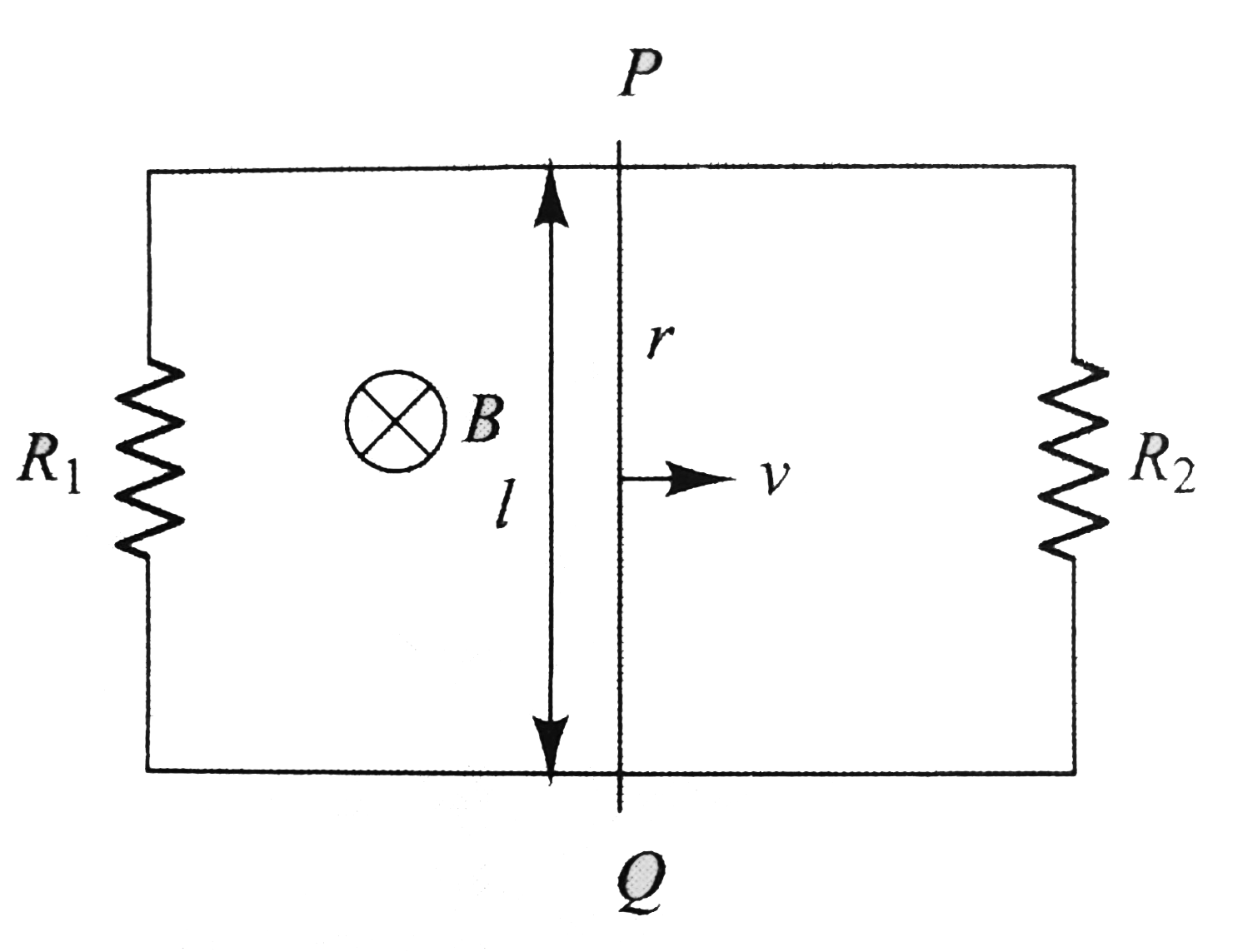
Shows rod PQ of mass m and resistance r ...

Shows rod `PQ` of mass `m` and resistance `r` moving on two fixed, resistanceless, smooth conducting rails (closed on both sides by resistances `R_(1) and R_(2)`). Find the current in the rod (at the instant its velocity is `v`).

Text Solution

Verified by Experts
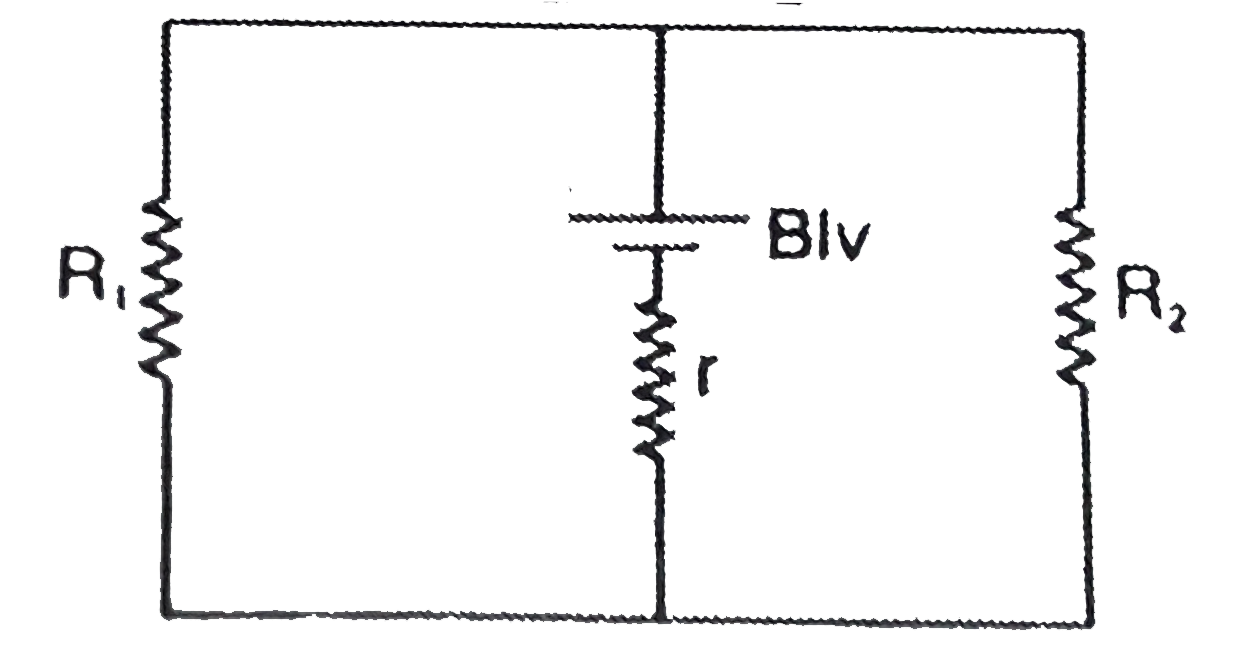
`i=(BlV)/(r+(R_(1)R_(2))/(R_(1)+R_(2)))`
this circuit is equivalent to the following diagram .
Promotional Banner

Similar Questions

Explore conceptually related problems

A rod of mass m and resistance r is placed on fixed, resistanceless, smooth conducting rails (closed by a resistance R ) and it is projected with an initial velocity u .Find its velocity as a function of time.

A conducting rod of mass m and length l is free to move without friction on two parallel long conducting rails, as shown below. There is a resistance R across the rails. In the entire space around, there is a uniform magnetic field B normal to the plane of the rod and rails. The rod is given an impulsive velocity v_(0) - Finally, the initial energy (1)/(2) mv_(0)^(2)

Two parallel vertical metallic bars X X^(1) and Y Y^(1) , of negligible resistance and separated by a length 'l' , are as shown in Fig. The ends of the bars are joined by resistance R_(1) and R_(2) . A uniform magnetic field of induction B exsits in space normal to the plane of the bars. A horizontal metallic rod PQ of mass m starts falling vertically, making contact with the bars. It is oberved that in the steady state the powers dissipated in the resistance R_(1) and R_(2) and the terminal velocity attained by the rod PQ .

Two ideal batteries of emf V_(1) and V_(2) and three resistance R_(1)R_(2) and R_(3) are connected The current in resistance R_(2) would be zero if

A rod having length l and resistance R is moving with velocity v on a pi shape conductor. Find the current in the rod.

Shows a rod of length l and resistance r moving on two rails shorted by a resistance R . A uniform magnetic field B is present normal to the plane of rod and rails. Show the electrical equivalence of each branch.

A rod of mass m and resistnce R sldes on frictionless and resistanceless rails a distance l a part thast innclude a source of emf E_0 (see figure). The rod is initially at rest. Find the expression for the a. Velocity of the rod v(t). b. current in the loop i(t).

A conducting rod PQ of mass m and length l is placed on two long parallel (smooth and conducting) rails connected to a capacitor as shown. The rod PQ is connected to a non conducting spring of spring constant k , which is initially in relaxed state. The entire arrangement is placed in a magnetic feild perpendicular to the plane of figure. Neglect the resistance of the rails and rod. Now, the rod is imparted a velocity v_(0) towards right, then acceleration of the rod as a function of its displacement x given by

