Home
Class 12
PHYSICS
Find the velocity of the moving rod at t...


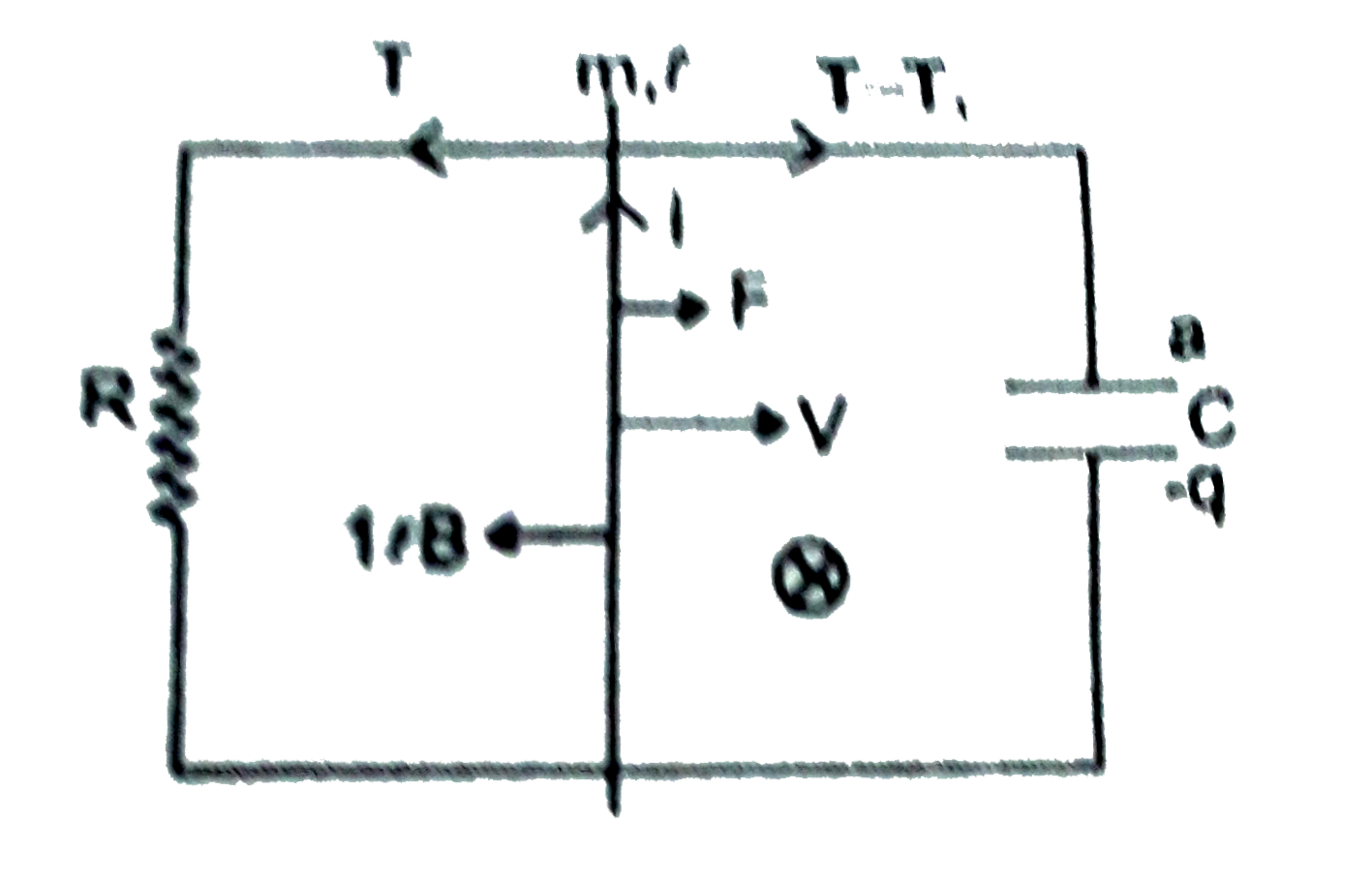
Find the velocity of the moving rod at time t if the initial velocity of the rod is v and a constant force F is applied on the rod. Neglect the resistance of the rod.

Text Solution

Verified by Experts

At any time , let the velocity of the rod be v .
Applying Newtons law: F-iIB=ma…..(1)
Also `Biv=i_(1)R=(q)/( c)`
Applying Kcl, `i=i_(1)+(dq)/(dt)=(BlV)/( R)+(D)/(Dt)(BIvC) or i=(B l V)/( R)+B l C a `
Putting the value of `i` in eq. (1), `F-(B^(2)l^(2)V)/( R)=(m+B^(2)l^(2)C)a=(m+B^(2)l^(2)C)(dv)/(dt)`
`(m+B^(2)l^(2)C)(v)/(F-(B^(2)I^(2)v)/( R))=dt`
Integrating both sides, and solving we get `v=(FR)/(B^(2)l^(2))(1-e^((tB^(2)l^(2))/(R(m+CB^(2)l^(2)))))`
Promotional Banner

Similar Questions

Explore conceptually related problems

Two long parallel horizontal rails a, a distance d aprt and each having a risistance lambda per unit length are joing at one end by a resistance R. A perfectly conduction rod MN of mass m is free to slide along the rails without friction (see figure). There is a uniform magnetic field of induction B normal to the plane of the paper and directed into the paper. A variable force F is applied to the rod MN such that, as the rod moves a constant current flows through R. (i) Find the velocity of the rod and the applied force F as function of the distance x of the rod from R. (ii) What fraction of the work done per second by F is converted into heat?

A uniform rod of mass m and length l is pivoted smoothly at O . A horizontal force acts at the bottom of the rod. a. Find the angular velocity of the rod as the function of angle of rotation theta. b.What is the maximum angular displacement of the rod?

A conducting circular loop of radius a and resistance per unit length R is moving with a constant velocity v_0 , parallel to an infinite conducting wire carrying current i_0 . A conducting rod of length 2a is approaching the centre of the loop with a constant velocity v_0/2 along the direction 2 of the current. At the instant t = 0 , the rod comes in contact with the loop at A and starts sliding on the loop with the constant velocity. Neglecting the resistance of the rod and the self-inductance of the circuit, find the following when the rod slides on the loop. (a) The current through the rod when it is at a distance of (a/2) from the point A of the loop. (b) Force required to maintain the velocity of the rod at that instant.

A uniform rod of mass m and length l is on the smooth horizontal surface. When a constant force F is applied at one end of the rod for a small time t as shown in the figure. Find the angular velocity of the rod about its centre of mass.

Figure shows a rigid rod of length 1.0 m. It is pivoted at O. For what value m, the rod will be in equilibrium ? Find the force (F) exerted on the rod by the pivot. Neglect the weight of the rod.

A uniform rod of length L lies on a smooth horizontal table. The rod has a mass M . A particle of mass m moving with speed v strikes the rod perpendicularly at one of the ends of the rod sticks to it after collision. Find the velocity of the centre of mass C and the angular, velocity of the system about the centre of mass after the collision.

Consider a rod of length l resting on a wall and the floor. If the velocity of the upper end of a rod A is v_(0) in downward direction, find the velocity of the lower end B at this iinstant, when the rod makes an angle theta with horizontal
