Home
Class 12
PHYSICS
Four point masses each of mass 'm' are p...

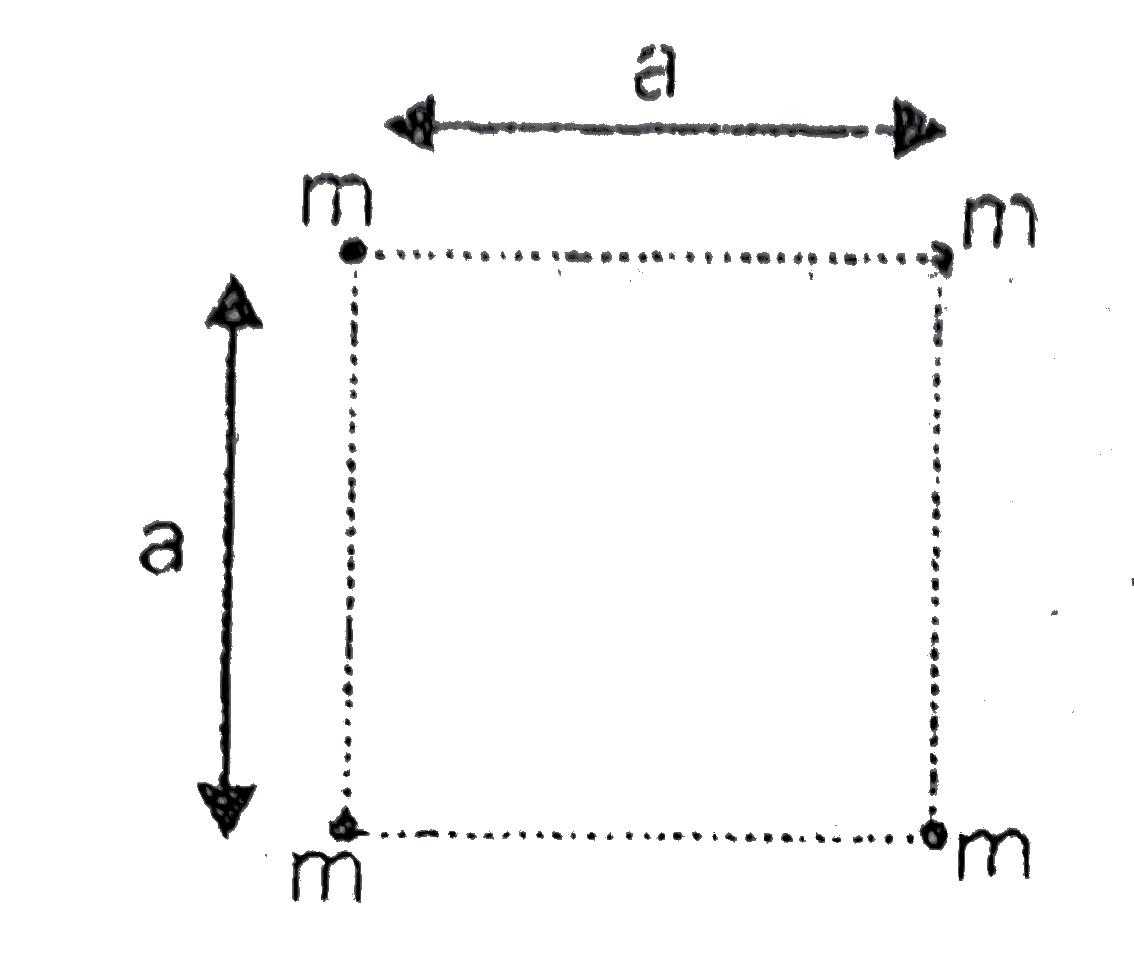
Four point masses each of mass 'm' are placed on the corner of square of side 'a' Calculate magnitude of gravitational force experienced each particle
.

Text Solution

Verified by Experts

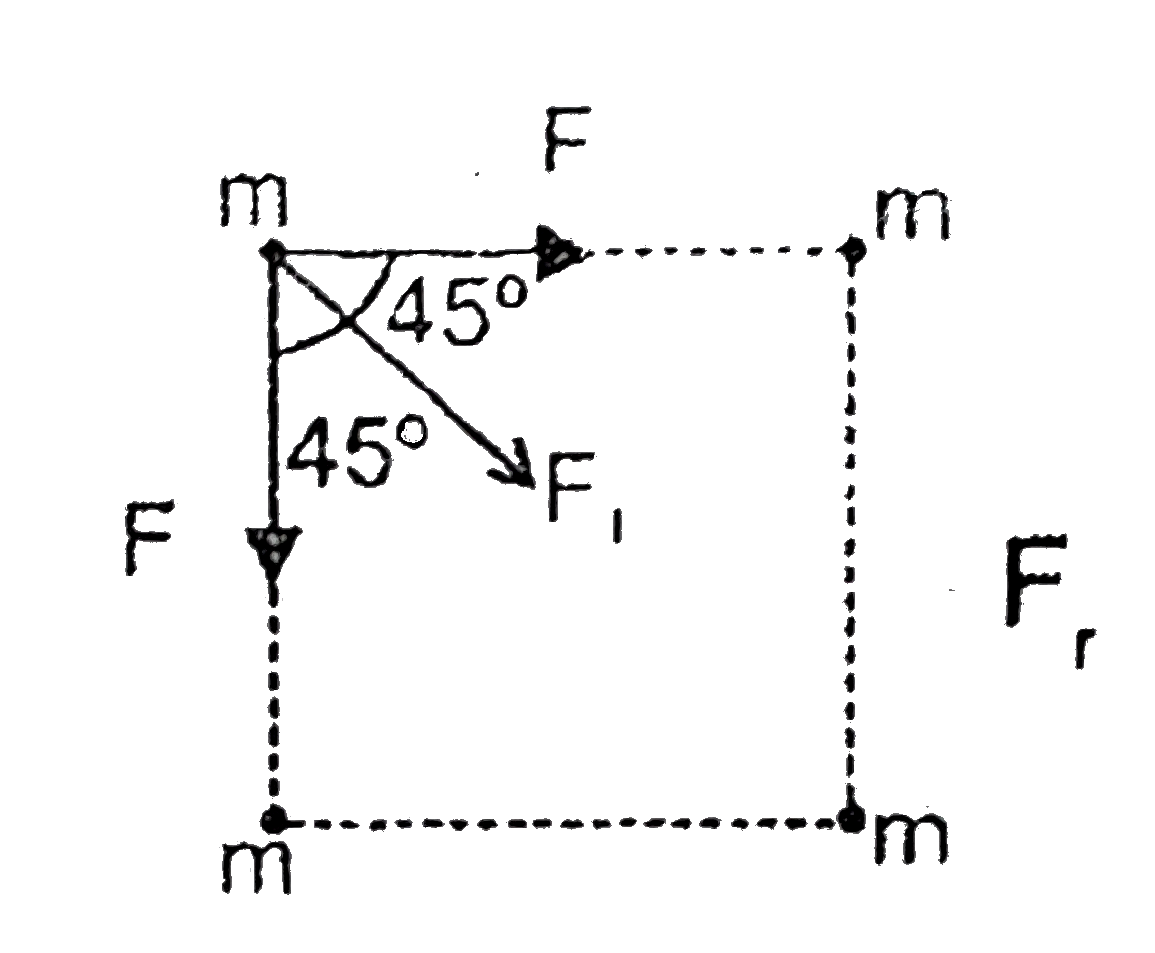
`F_(r) =` resultant force on each particle `=2F cos 45^(@) + F_(1)`
`=(2G.m^(2))/(a^(2)).(1)/(sqrt2)+(Gm^(2))/((sqrt(2a))2)= (G.m^(2))/(2a^(2))(2sqrt2+1)`
.
Promotional Banner

Topper's Solved these Questions

  • GRAVITATION

    RESONANCE|Exercise SOLVED MISCELLANEOUS PROBLEMS|5 Videos
  • GRAVITATION

    RESONANCE|Exercise EXAMPLE|2 Videos
  • GEOMATRICAL OPTICS

    RESONANCE|Exercise Advance level Problems|35 Videos
  • NUCLEAR PHYSICS

    RESONANCE|Exercise Advanced level solutions|16 Videos

Similar Questions

Explore conceptually related problems

Four equal point harges each 16 mu C are placed on the four corners of a square of side 0.2 m. Calculate the force on any one of the charges.

Four particles having masses, m, wm, 3m, and 4m are placed at the four corners of a square of edge a. Find the gravitational force acting on a particle of mass m placed at the centre.

Four equal masses (each of mass M) are placed at the corners of a square of side a. The escape velocity of a body from the centre O of the square is

Four particles each of mass m are placed at the vertices of a square of side l. the potential at the centre of square is

Four point charges of +1muc each are placed on the four corners of a square of side 1 m. Calculate the electric potential at the centre of the square.

Four particles each of mass m are placed at the corners of a square of side length l . The radius of gyration of the system the moment of inertia of four bodies about an axis passing through opposite corners of frame is

Four particles each of mass m are placed at the corners of a square of side length l . The radius of gyration of the system the moment of inertia of four bodies about an axis perpendicular to the plane of frame and passing through a corner is

Four particles each of mass m are placed at the corners of a square of side length l . The radius of gyration of the system the moment of inertia of four bodies about an axis passing through any side of frame is

Four particles each of mass m are placed at the corners of a square of side length l . The radius of gyration of the system about an axis perpendicular to the plane of square and passing through its centre is

RESONANCE-GRAVITATION-HIGH LEVEL PROBLEMS
  1. Four point masses each of mass 'm' are placed on the corner of square ...

    Text Solution

    |

  2. Let a star be much brighter than our sun but its mass is same as that ...

    Text Solution

    |

  3. Consider a spacecraft in an elliptical orbit around the earth At the l...

    Text Solution

    |

  4. A planet A moves along an elliptical orbit around the Sun. At the mome...

    Text Solution

    |

  5. A satellite is put into a circular orbit with the intention that it ov...

    Text Solution

    |

  6. What are (a) the speed and (b) the period of a 220kg satellite in an a...

    Text Solution

    |

  7. A planet of mass m moves along an ellipse around the sun so that its m...

    Text Solution

    |

  8. A solid shere of mass m and radius r is placed inside a hollow spheric...

    Text Solution

    |

  9. A sphere of density rho and radius a has a concentric of radius b as s...

    Text Solution

    |

  10. What is the escape speed for an object in the same orbit as that of Ea...

    Text Solution

    |

  11. A cosmic body A moves to the sun with velocity v(0)(when far from the ...

    Text Solution

    |

  12. Two stars of mass M(1) & M(2) are in circular orbits around their cent...

    Text Solution

    |

  13. A star can be considered as spherical ball of hot gas of radius R. Ins...

    Text Solution

    |

  14. A star can be considered as a shpherical ball of hot gas of radius R.I...

    Text Solution

    |

  15. A star can be considered as a shpherical ball of hot gas of radius R.I...

    Text Solution

    |

  16. A star can be considered as a shpherical ball of hot gas of radius R.I...

    Text Solution

    |

  17. A star can be considered as a shpherical ball of hot gas of radius R.I...

    Text Solution

    |