Home
Class 12
PHYSICS
In a double star, two stars (one of mass...

In a double star, two stars (one of mass `m` and the other of mass `2m`) distance `d` apart rotate about their common centre of mass., Deduce an expressioin for the period of revolution. Show that te ratio of their angular momenta about the centre of mass is the same as the ratio of their kinetic energies.

Text Solution

Verified by Experts
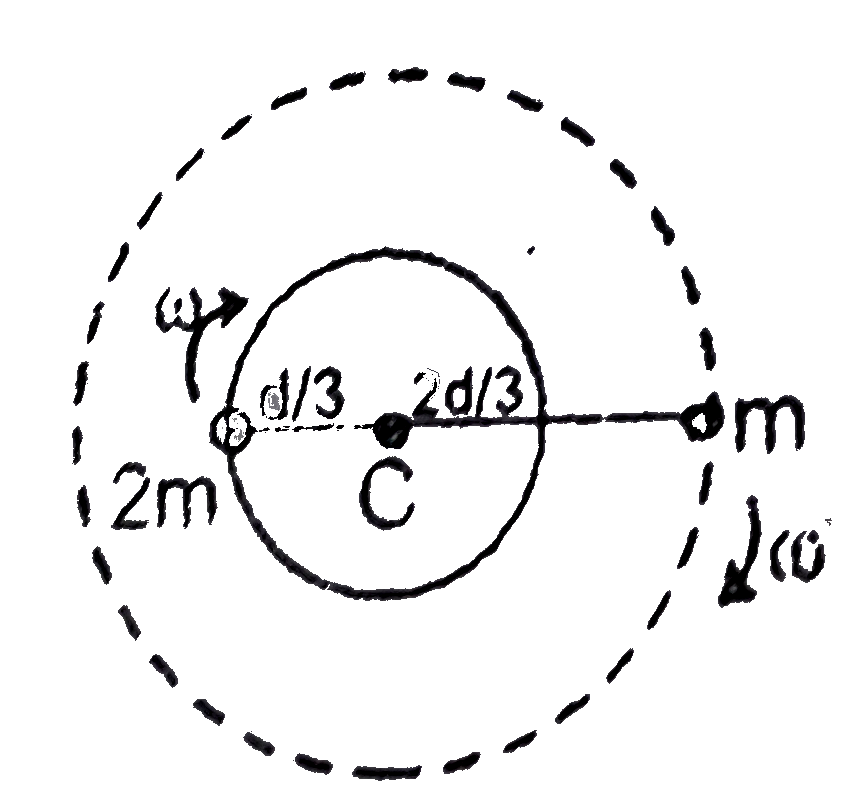
The centre of mass `C` will be at distances `d//3` and `2d//3` from the masses `2m` and m respectively Both the stars rotate round `C` in their respective orbits with the same angular velocity `omega` the gravitational force acting on each star due to the other supplies the necessary centripetal force The gravitational force on either star is `(G(2m)m)/(d^(2))` If we consider the rotation of the smaller star, the centripetal force `(m r omega^(2))is [m((2d)/(3))omega^(2)]` and for bigger star `[(2mdomega^(2))/(3)]` i.e same
`:. (G (2m)m)/(d^(2)) = m ((2d)/(3))omega^(2)` or `omega = sqrt((3gm)/(d^(3))`
Therefore, the period of revolution is given by `T = (2pi)/(omega) = 2pi sqrt(d^(3)/(3Gm))`
The ratio of the angular momentum is `(Iomega)_(big)/((iomega)_(small)) = (I_(big))/(I_(small)) = ((2m)((d)/(3))^(2))/(m((2d)/(3))^(2))=(1)/(2)`
since `omega` is same for both The ratio of their kinetic energygies is `((1)/(2)Iomega^(2))_(big)/(((1)/(2)Iomega^(2))_(small))=I_(big)/(I_(small))=(1)/(2)`
which is the same as the ratio of their angular momentum .
.
Promotional Banner

Topper's Solved these Questions

  • GRAVITATION

    RESONANCE|Exercise EXAMPLE|2 Videos
  • GRAVITATION

    RESONANCE|Exercise EXERCISE-1 PART-1|13 Videos
  • GRAVITATION

    RESONANCE|Exercise HIGH LEVEL PROBLEMS|16 Videos
  • GEOMATRICAL OPTICS

    RESONANCE|Exercise Advance level Problems|35 Videos
  • NUCLEAR PHYSICS

    RESONANCE|Exercise Advanced level solutions|16 Videos

Similar Questions

Explore conceptually related problems

In a double star, two stars one of mass m_(1) and another of mass m_(2) , with a separation d, rotate about their common centre of mass. Find (a) an expression for their time period of eavolution. (b) the ratio of rheir kintic energies. (c) the ratio of their angular momenta about the centre of mass. (d) the total angular momentum of the system. (e) the kinetic energy of the system.

Two stars of masses m and 2m at a distance d rotate about their common centre of mass in free space. The period of revolution is :

In a double star system, two stars of masses m_1 and m_2 separated by a distance x rotate about their centre of mass. Find the common angular velocity and Time period of revolution.

In a double star system one of mass m_(1) and another of mass m_(2) with a separation d rotate about their common centre of mass. Then rate of sweeps of area of star of mass m_(1) to star of mass m_(2) about their common centre of mass is

Two stars of masses m_(1) and m_(2) distance r apart, revolve about their centre of mass. The period of revolution is :

A pair of stars rotates about a common centre of mass. One of the stars has a mass M and the other m . Their centres are a distance d apart, d being large compared to the size of either star. Derive an expression for the period of revolution of the stars about their common centre of mass. Compare their angular momenta and kinetic energies.

Two bodies of masses m_1 and m_2 have the same linear momentum. What is the ratio of their kinetic energies?

Two objects of masses 1kg and 2kg separated by a distance of 1.2m are rotating about their centre of mass. Find the moment of inertia of the system

