Home
Class 12
CHEMISTRY
When benzene reacts with neopentyl bromi...

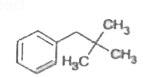
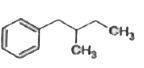
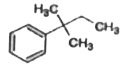
When benzene reacts with neopentyl bromide `CH_(3)-underset(CH_(3))underset(|)overset(CH_(3))overset(|)(C)-CH_(2)Br` in presence of `AlBr_(3)`, - is formed

A

B

C

D

all the three are formed

Text Solution

AI Generated Solution

The correct Answer is:

To solve the problem of what product is formed when benzene reacts with neopentyl bromide in the presence of AlBr3, we can follow these steps: ### Step 1: Understand the Reactants We have benzene (C6H6) and neopentyl bromide (C(CH3)3CH2Br). Neopentyl bromide is a primary alkyl halide, which means it can undergo a reaction to form a carbocation when treated with a Lewis acid like AlBr3. ### Step 2: Formation of the Carbocation When neopentyl bromide reacts with AlBr3, the bromine atom leaves, and a carbocation is formed. The reaction can be represented as follows: \[ \text{C(CH}_3)_3\text{CH}_2\text{Br} + \text{AlBr}_3 \rightarrow \text{C(CH}_3)_3\text{CH}_2^+ + \text{AlBr}_4^- \] Here, the AlBr3 acts as a Lewis acid, accepting the bromine and generating a carbocation. ### Step 3: Carbocation Rearrangement The initial carbocation formed is a primary carbocation, which is less stable. To stabilize it, a rearrangement occurs. The adjacent methyl group can shift to the carbocation center, leading to a more stable tertiary carbocation: \[ \text{C(CH}_3)_3\text{CH}_2^+ \rightarrow \text{C(CH}_3)_3^+\text{C(CH}_3) \] This results in a tertiary carbocation, which is more stable. ### Step 4: Electrophilic Attack on Benzene The stable tertiary carbocation now acts as an electrophile and attacks the benzene ring. The reaction can be represented as: \[ \text{C}_6\text{H}_6 + \text{C(CH}_3)_3^+ \rightarrow \text{C}_6\text{H}_5\text{C(CH}_3)_3 \] This forms a new carbon-carbon bond between the benzene ring and the carbocation. ### Step 5: Deprotonation The final step involves the loss of a proton (H+) from the carbon that was attacked, restoring the aromaticity of the benzene ring: \[ \text{C}_6\text{H}_5\text{C(CH}_3)_3 \rightarrow \text{C}_6\text{H}_5\text{C(CH}_3)_3 + \text{H}^+ \] The product formed is 1-tert-butylbenzene, where the tert-butyl group is attached to the benzene ring. ### Final Product The final product of the reaction is: \[ \text{C}_6\text{H}_5\text{C(CH}_3)_3 \] ### Summary of the Steps 1. **Identify reactants**: Benzene and neopentyl bromide. 2. **Carbocation formation**: Neopentyl bromide reacts with AlBr3 to form a carbocation. 3. **Rearrangement**: The primary carbocation rearranges to a tertiary carbocation for stability. 4. **Electrophilic attack**: The tertiary carbocation attacks the benzene ring. 5. **Deprotonation**: A proton is lost, restoring aromaticity.
Promotional Banner

Topper's Solved these Questions

  • GENERAL ORGANIC CHEMISTRY

    FIITJEE|Exercise MORE THAN ONE CORRECT CHOICES|24 Videos
  • GENERAL ORGANIC CHEMISTRY

    FIITJEE|Exercise COMPREHENSION TYPE|18 Videos
  • GENERAL ORGANIC CHEMISTRY

    FIITJEE|Exercise Section (I) [Jee mains]: With Single Correct Choice|100 Videos
  • GASEOUS STATE

    FIITJEE|Exercise MATCHING LIST TYPE QUESTION|1 Videos
  • HYDROCARBONS

    FIITJEE|Exercise SINGLE INTEGER ANSWER TYPE QUESTION|9 Videos

Similar Questions

Explore conceptually related problems

CH_(3)-Br+NaO-underset(CH_(3))underset(|)overset(CH_(3))overset(|)C-CH_(3)to ?

CH_(3)-underset(CH_(3))underset(|)overset(CH_(3))overset(|)C-CH=CH_(2)+HBr to A The structure of A is:

CH_(3)-underset(CH_(3))underset(|)overset(CH_(3))overset(|)(C)-CH_(2)-underset(O)underset(||)(C)-NHCH_(3)

Write the IUPAC name of CH_(3)-CH=CH-underset(CH_(3))underset(|)overset(CH_(3))overset(|)C-Br

CH_(3)-underset(CH_(3))underset(|)(CH)-CH=CH-CH_(2)-overset(O)overset(||)(C)-OH

Write the IUPAC name of CH_(3)CH=CH-underset(Br)underset(|)overset(CH_(3))overset(|)C—CH_(3) .

Write the IUPAC name of CH_(3)CH=CH-underset(Br)underset(|)overset(CH_(3))overset(|)C—CH_(3) .

CH_(3)-underset(CH_(3))underset(|)(C)=CH-underset(CH_(3))underset(|)overset(CH_(3))overset(|)C-CH_(3)

FIITJEE-GENERAL ORGANIC CHEMISTRY-Section (II) [Jee mains]: With Single Correct Choice
  1. Arrange the following in the decreasing order of reactivity towards el...

    Text Solution

    |

  2. Predict the product

    Text Solution

    |

  3. When benzene reacts with neopentyl bromide CH(3)-underset(CH(3))unders...

    Text Solution

    |

  4. For the reaction What is the product P?

    Text Solution

    |

  5. The above conversion can be done by

    Text Solution

    |

  6. When phenol is treated with CHCl(3) and NaOH, followed by acidificatio...

    Text Solution

    |

  7. Identify the final pr(Z) in the following sequence of reactions.

    Text Solution

    |

  8. An alcohol, on dehydration produces an alkene which on ozonolysis yiel...

    Text Solution

    |

  9. Eacof nucleophilic substitution among these compounds will be in the o...

    Text Solution

    |

  10. The cannizzaro reaction of PhCOCHO forms the product(s)

    Text Solution

    |

  11. Complete the following reaction

    Text Solution

    |

  12. CH(3)-CH=CH-CH=CH-overset(O)overset(||)(C)-H overset("dil. "OH^(-))to ...

    Text Solution

    |

  13. The carboxylic acid undergoing decarboxylation most readily is/are

    Text Solution

    |

  14. Identify the final product PhCH(3) underset(H(2)SO(4))overset(HNO(3)...

    Text Solution

    |

  15. The transformation Can be brought about by reducing the reactant ...

    Text Solution

    |

  16. What will be the major product?

    Text Solution

    |

  17. (I) Cl-underset(Cl)underset(|)overset(Cl)overset(|)(C^(3))-overset(2)(...

    Text Solution

    |

  18. H(3)C-CH(2)-underset(Br)underset(|)(C)H-CH(3) overset(NaNH(2))to Whi...

    Text Solution

    |

  19. H(3)C-underset(CH(3))underset(|)overset(CH(3))overset(|)(C)-underset(O...

    Text Solution

    |

  20. A will be

    Text Solution

    |
