Home
Class 12
CHEMISTRY
H(3)C-underset(CH(3))underset(|)overset(...

`H_(3)C-underset(CH_(3))underset(|)overset(CH_(3))overset(|)(C)-underset(OH)underset(|)(C)H-CH_(3) overset(HBr)to (A)` Product (A) is

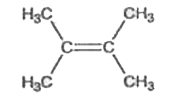
A

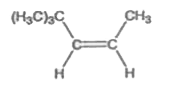
B

C

A & B both

D

none

Text Solution

AI Generated Solution

The correct Answer is:

To solve the problem, we will follow the steps of the reaction of the given compound with HBr and determine the product (A). ### Step-by-Step Solution: 1. **Identify the Structure**: The starting compound has a hydroxyl group (OH) on the second carbon and two methyl groups attached to the first and third carbons. The structure can be represented as: ``` CH3 | CH3-C-CH-CH3 | OH ``` 2. **Protonation of the Hydroxyl Group**: When the compound reacts with HBr, the hydroxyl group (OH) can be protonated to form a better leaving group (water). The lone pair on the oxygen atom attacks the H+ from HBr, resulting in: ``` CH3 | CH3-C-CH-CH3 | OH2^+ ``` 3. **Formation of Carbocation**: The protonated hydroxyl group (OH2+) leaves, forming a carbocation. The structure now has a positive charge on the carbon where the OH was initially attached: ``` CH3 | CH3-C^+-CH3 ``` 4. **Carbocation Rearrangement**: The carbocation formed is a secondary carbocation. To increase stability, a methyl group from the adjacent carbon can shift to the positively charged carbon, converting the secondary carbocation into a more stable tertiary carbocation: ``` CH3 | CH3-C-CH3 | CH3 ``` 5. **Nucleophilic Attack by Bromide Ion**: The Br- ion from HBr can now attack the carbocation. The Br- can abstract a proton from one of the adjacent carbons, leading to the formation of a double bond (alkene). The possible products are: - If Br- attacks the carbon with the methyl group, it will lead to one product. - If Br- attacks the carbon with the hydrogen, it will lead to another product. 6. **Determine the Major Product**: The stability of the alkene formed will depend on the number of alpha hydrogens. The product with the greater number of alpha hydrogens will be more stable. In this case, the product with more alpha hydrogens will be favored. 7. **Final Product**: The final product (A) will be the more stable alkene formed from the reaction, which can be represented as: ``` CH3 | CH3-C=CH-CH3 ``` ### Conclusion: The product (A) formed from the reaction of the given compound with HBr is a more stable alkene. ---
Promotional Banner

Topper's Solved these Questions

  • GENERAL ORGANIC CHEMISTRY

    FIITJEE|Exercise MORE THAN ONE CORRECT CHOICES|24 Videos
  • GENERAL ORGANIC CHEMISTRY

    FIITJEE|Exercise COMPREHENSION TYPE|18 Videos
  • GENERAL ORGANIC CHEMISTRY

    FIITJEE|Exercise Section (I) [Jee mains]: With Single Correct Choice|100 Videos
  • GASEOUS STATE

    FIITJEE|Exercise MATCHING LIST TYPE QUESTION|1 Videos
  • HYDROCARBONS

    FIITJEE|Exercise SINGLE INTEGER ANSWER TYPE QUESTION|9 Videos

Similar Questions

Explore conceptually related problems

CH_(3)-underset(CH_(3))underset(|)overset(CH_(3))overset(|)(C)-underset(OH)underset(|)(CH)-CH_(3)overset(HBr)rarrA (predominant) A is

CH_(3)underset(Br)underset(|)CH-overset(CH_(3))overset(|)underset(OH)underset(|)(C)-C-O-CH_(3)

Major product of the given reaction is CH_(3)-underset(CH_(3))underset(|)overset(CH_(3))overset(|)C-underset(CI)underset(|)(CH)-CH_(3)overset(C_(2)H_(5)O^-)rarr

CH_(3) - underset(H) underset(|)overset(OH)overset(|)(C ) - CN is

The major product of the following reaction is: CH_(3)-underset(H)underset(|)overset(CH_(3))overset(|)C-underset(Br)underset(|)(CHCH_(3)) overset(CH_(3)OH) to

CH_(3)-CH_(2)-underset(CH_(3))underset(|)overset(CH_(3))overset(|)C-underset(OH)underset(|)(CH)-CD_(3)underset(Delta)overset(H_(3)PO_(4))rarr Total no. of alkenes (X) underset(distilation)overset(Fractional)rarr No. of fractions obtained (Y) . X and Y are:

CH_(3)-underset(CH_3)underset(|)overset(CH_3)overset(|)(C )-underset(Br)underset(|)(C )H-CH_(3) underset(Delta)overset("El mechanism")(rarr) (A) Major product (A) is

Write the IUPAC name of the given compound: CH_(3)- underset(C_(2)H_(5))underset(|) overset(CH_(3)) overset(|)(C)-underset(OH)underset(|)(CH)-CH_(3)
