Home
Class 12
CHEMISTRY
CH(2)=CH-CH(2)-Cl overset(HOC l)to (X) i...

`CH_(2)=CH-CH_(2)-Cl overset(HOC l)to (X)` is

A

`H_(2)underset(Cl)underset(|)(C)-underset(OH)underset(|)(C)H-underset(Cl)underset(|)(C)H_(2)`

B

`H_(2)underset(OH)underset(|)(C)-underset(Cl)underset(|)(C)H-underset(Cl)underset(|)(C)H`

C

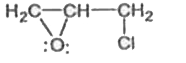
D

`H_(3)C-underset(Cl)underset(|)(C)H-CH_(3)`

Text Solution

AI Generated Solution

The correct Answer is:

To solve the question `CH₂=CH-CH₂-Cl + HOC l → (X)`, we will analyze the reaction step by step. ### Step 1: Identify the Reactants The reactant is an allylic halide, specifically 3-chloropropene (CH₂=CH-CH₂-Cl). The reaction is taking place with hydroxide ion (OH⁻) from HOC l. **Hint:** Identify the functional groups and the type of reaction involved. ### Step 2: Mechanism of Reaction The hydroxide ion (OH⁻) acts as a nucleophile and will attack the carbon atom involved in the double bond (C=C). This can occur through two possible mechanisms: 1. **Mechanism 1:** The nucleophile attacks the carbon atom that is part of the double bond, leading to the formation of a carbocation intermediate. 2. **Mechanism 2:** The double bond can break in such a way that the nucleophile attacks the carbon adjacent to the carbon with the chlorine atom. **Hint:** Consider how the double bond can react with the nucleophile and the stability of the resulting carbocation. ### Step 3: Formation of Carbocation In Mechanism 1, if the nucleophile attacks the terminal carbon of the double bond, a primary carbocation is formed. In Mechanism 2, if the nucleophile attacks the middle carbon, a more stable secondary carbocation is formed. - **Intermediate from Mechanism 1:** CH₂⁺-CH-CH₂-Cl (Primary carbocation) - **Intermediate from Mechanism 2:** CH₂-CH⁺-CH₂-Cl (Secondary carbocation) **Hint:** Determine which carbocation is more stable based on the inductive effect and the number of alkyl groups attached. ### Step 4: Stability of Carbocations The secondary carbocation (from Mechanism 2) is more stable than the primary carbocation (from Mechanism 1) due to the inductive effect of the neighboring carbon atoms. The chlorine atom (Cl) has a -I effect, which pulls electron density away, but since it is further away from the positively charged carbon in the secondary carbocation, it is less destabilizing. **Hint:** Compare the stability of the two carbocations formed. ### Step 5: Nucleophilic Attack Once the more stable secondary carbocation is formed, the hydroxide ion (OH⁻) will attack the positively charged carbon atom. This leads to the formation of the final product. **Final Product (X):** CH₂-CH(OH)-CH₂-Cl ### Step 6: Conclusion The product of the reaction is 3-chloro-1-propanol (X), where the hydroxyl group (OH) has replaced the chlorine atom (Cl) at the carbon adjacent to the double bond. **Final Answer:** (X) is CH₂-CH(OH)-CH₂-Cl (3-chloro-1-propanol). ---
Promotional Banner

Topper's Solved these Questions

  • GENERAL ORGANIC CHEMISTRY

    FIITJEE|Exercise MORE THAN ONE CORRECT CHOICES|24 Videos
  • GENERAL ORGANIC CHEMISTRY

    FIITJEE|Exercise COMPREHENSION TYPE|18 Videos
  • GENERAL ORGANIC CHEMISTRY

    FIITJEE|Exercise Section (I) [Jee mains]: With Single Correct Choice|100 Videos
  • GASEOUS STATE

    FIITJEE|Exercise MATCHING LIST TYPE QUESTION|1 Videos
  • HYDROCARBONS

    FIITJEE|Exercise SINGLE INTEGER ANSWER TYPE QUESTION|9 Videos

Similar Questions

Explore conceptually related problems

CH_(3)""^(.)CH_(2)CH_(2)Cl overset(aq. KOH)(to) CH_(3)CH_(2)CH_(2)OH The reaction is

In the given +CH_(5)-CH_(2)-CH_(2)-Cl overset (AlCl_(3))rarr" Product" the major product will be

Identify the final product CH_(2) = CH_(2) overset (Cl_(2)//H_(2)O)to X overset(-aq.KOH) to Y

CH_(3)CH_(2)CH=CH_(2) overset(NBs)to X overset(alc. KOH)to Y . The compound Y is

CH_(2)=CH-CH_(3)overset(Cl_(2),500^(@)C)toA ' the major product A is formed through

+ CH_3-CH_2-CH_2-CH_2 -Cl overset(AlCl_3) to Hydrocarbon (X) major product X is

Give the IUPAC name of the following compounds: (a) CH_(3)-CH_(2)-overset(CH_(3))overset(|)(CH)-CH_(2)-CH_(2)-CH_(2)-CH_(2)-CH_(2)-CH_(2)-CH_(2)-overset(CH_(3))overset(|)(CH)-CH_(3) (b) CH_(3)-CH_(2)-overset(OH)overset(|)(CH)-CH_(2)-CH_(2)-CH_(2)-CH_(2)-CH_(2)-CH_(2)-CH_(2)-CH_(2)-overset(CH_(3))overset(|)(CH)-CH_(3) {:(CH-CH_(2)-CH_(2)-underset(|)(CH_(2))-underset(|)(CH_(2))-CH_(3)),(" "CH_(3)-CH_(2)-CH-CH-CH_(3)):}

Which of the following is//are the chain termination step during photochloration of ethane? CH_(3)overset(.) (C)H_(2)+ overset(.)(C)l toCH_(3)-CH_(2)-Cl CH_(3)overset(.)(C)H_(2)+CH_(3)overset(.)(C)H_(2) to CH_(3)CH_(2)CH_(2)CH_(3) overset(.) (C)l+overset(.)(C)l to Cl_(2) overset(.)(C)l+overset(.)H to HCl
