Home
Class 12
CHEMISTRY
2-methyl-2-phenyl propanamide when react...

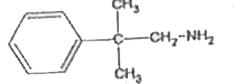
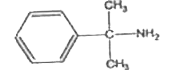
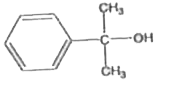
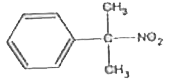
2-methyl-2-phenyl propanamide when reacted with bromine and NaOH forms.

A

B

C

D

Text Solution

AI Generated Solution

The correct Answer is:

To solve the problem of what product is formed when 2-methyl-2-phenylpropanamide reacts with bromine and NaOH, we can follow these steps: ### Step 1: Understand the Structure of 2-methyl-2-phenylpropanamide 2-methyl-2-phenylpropanamide has the following structure: - It contains a propanamide backbone, which means it has three carbon atoms (C-C-C) with an amide functional group (CONH2) attached to the second carbon. - The second carbon also has a methyl (–CH3) group and a phenyl (–C6H5) group attached. **Hint:** Draw the structure to visualize the molecule clearly. ### Step 2: Identify the Reaction Conditions The reaction involves bromine (Br2) and sodium hydroxide (NaOH). This combination is indicative of the Hofmann degradation reaction, which typically involves the conversion of primary amides to amines with the loss of one carbon atom. **Hint:** Recall that Hofmann degradation leads to the removal of one carbon atom from the amide. ### Step 3: Mechanism of Hofmann Degradation 1. **Deprotonation:** The NaOH acts as a base and abstracts a proton from the amide nitrogen, forming a negatively charged intermediate. 2. **Bromination:** This negatively charged nitrogen can then react with bromine, leading to the formation of an N-bromoamide. 3. **Formation of an Isocyanate:** The N-bromoamide undergoes rearrangement to form an isocyanate intermediate. 4. **Hydrolysis:** The isocyanate is hydrolyzed to form a carbamic acid, which subsequently decomposes to release carbon dioxide (CO2) and yield the final amine product. **Hint:** Follow the sequence of reactions carefully, noting the intermediates formed at each step. ### Step 4: Determine the Final Product After the Hofmann degradation, the carbonyl carbon (C=O) of the amide is lost, resulting in the formation of an amine. Since the original molecule had a phenyl group and a methyl group, the final product will be: - **Final Product:** 2-phenylpropylamine (C6H5-CH(CH3)-NH2) **Hint:** Remember that the product will have one less carbon than the original amide. ### Conclusion When 2-methyl-2-phenylpropanamide reacts with bromine and NaOH, it undergoes Hofmann degradation to yield 2-phenylpropylamine. **Final Product:** 2-phenylpropylamine
Promotional Banner

Topper's Solved these Questions

  • GENERAL ORGANIC CHEMISTRY

    FIITJEE|Exercise MORE THAN ONE CORRECT CHOICES|24 Videos
  • GENERAL ORGANIC CHEMISTRY

    FIITJEE|Exercise COMPREHENSION TYPE|18 Videos
  • GENERAL ORGANIC CHEMISTRY

    FIITJEE|Exercise Section (I) [Jee mains]: With Single Correct Choice|100 Videos
  • GASEOUS STATE

    FIITJEE|Exercise MATCHING LIST TYPE QUESTION|1 Videos
  • HYDROCARBONS

    FIITJEE|Exercise SINGLE INTEGER ANSWER TYPE QUESTION|9 Videos

Similar Questions

Explore conceptually related problems

Propanamide on reaction with bromine in aqueous NaOH gives:

1-methyl-1-phenyl ethylene oxide when treated with HBr produce

When propanamide is reacted with Br_(2) and NaOH, the product formed is :

2, 3-Dimethylbut-2-ene when reacted with bromine forms a compound which upon heating with alcoholic KOH produce the following major product.

Silicon react with hot solution of NaOH forming:

FIITJEE-GENERAL ORGANIC CHEMISTRY-Section (II) [Jee mains]: With Single Correct Choice
  1. Major product is

    Text Solution

    |

  2. What is the major product in the reaction?

    Text Solution

    |

  3. Compound (A) C(5)H(10)O forms a phenyl hydrogen and gives negative Tol...

    Text Solution

    |

  4. 2-methyl-2-phenyl propanamide when reacted with bromine and NaOH forms...

    Text Solution

    |

  5. Potassium pthalimide on reaction wiith (A) followed by hydrolysis form...

    Text Solution

    |

  6. Which of the following will give more enol contents ?

    Text Solution

    |

  7. The product is

    Text Solution

    |

  8. In the reaction of p-chlorotoluene with KNH(2) in liq. NH(3), the majo...

    Text Solution

    |

  9. Certain chemical tests were perfoemd on the pain-relief drug ibuprofen...

    Text Solution

    |

  10. A and B are

    Text Solution

    |

  11. Number of C-C bonds present in anthracene are

    Text Solution

    |

  12. The product(s) of the Hofmann exhaustive methylation of the following ...

    Text Solution

    |

  13. In the following groups (1) -OA c (2) -OM e (3) -OSO(2)Me (4) ...

    Text Solution

    |

  14. Which allylic carbocation is the most stable carbocation ?

    Text Solution

    |

  15. What is Z in the following sequence of reactions? Phenolunderset("du...

    Text Solution

    |

  16. Under Wolff Kischner reaction conditions, the coversation which may be...

    Text Solution

    |

  17. Which of the following is the strongest acid?

    Text Solution

    |

  18. RNA is different from DNA< because RNA contains:

    Text Solution

    |

  19. Insulin contains:

    Text Solution

    |

  20. A decapiptide (Mol. Wt. 796) on complete hydrolysis gives glycine (Mol...

    Text Solution

    |
