Home
Class 12
CHEMISTRY
How do you account for the reducing beha...

How do you account for the reducing behaviour of `H_(3)PO_(2)`?
Why are pentahalides more covalent than Trihalides?
(iii) Bond angle in PH, is higher than that in `PH_(3)` Why?
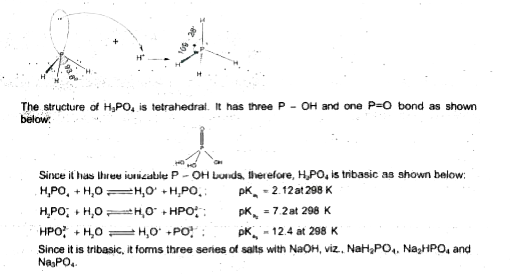
(iv) What is the basicity of `H_(3)PO_(4)`?

Text Solution

Verified by Experts
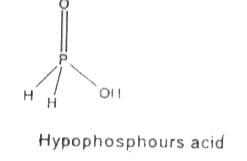
(i)The structure of `H_(3)PO_(2)` has two P-H bonds. Due to the presence of these P-H bonds, H3PO, acts as a strong reducing agent. For example, it reduces A educes `AgNO_(3)` to metallic Ag and arenediazonium salts to arenes.
`4AgNO_(3)+H_(3)PO_(2)+2H_(2)Oto4Ag+H_(3)PO_(4)+4HNO_(3)`
(ii)The elements of group 15 have five electrons (two in the s- and three in the p-orbitals) in their respective Valence shells. Since it is difficult to lose all the three electrons to form Eo or even more difficult to lose all the five valence electrons two S- and three p.) to E ions, therefore, higher elements have no tendency to form ionic compounds. Instead they form covalent compounds by sharing of electrons. Since elements in the +5 oxidation state have less tendency to lose electrons than in the +3 oxidation state, therefore elements in the +5 oxidation have more tendency to share electrons than in the +3 oxidation state. Thus, elements in the +5 oxidation state are more covalent than in the +3 oxidation state. In other words, pentahalides are more covalent than trihalides.
(iii)P in `PH_(3)` is sp -hybridized. It has three bond pairs and one lone pair around P. Due to stronger lone pair - bond pair repulsions than bond pair repulsions, the tetrahedral angle decreases from `109^(@)` - 28" to 93.6". As a result, `PH_(3)` is Pyramidal. However, when it reacts with a proton, it forms PH, ion which has four bond pairs and no lone pair. Due to the absence of lone pair - bond pair repulsions and presence of four identical bond pair - bond pair interactions, PH assumes tetrahedral geo-metry with a bond angle of `109^(@) -28`.. This explains why the bond angle in  higher than in `PH_(3)`

Promotional Banner

Topper's Solved these Questions

  • PREPARATION AND PROPERTIES OF COMPOUNDS AND GENERAL DISCUSSION OF S-AND P-BLOCK ELEMENTS

    FIITJEE|Exercise ASSIGNMENT PROBLEMS (SUBJECTIVE) LEVEL-I(short-Answer tpye question)|5 Videos
  • PREPARATION AND PROPERTIES OF COMPOUNDS AND GENERAL DISCUSSION OF S-AND P-BLOCK ELEMENTS

    FIITJEE|Exercise ASSIGNMENT PROBLEMS (SUBJECTIVE) LEVEL-I(Give reasons: )|5 Videos
  • PREPARATION AND PROPERTIES OF COMPOUNDS AND GENERAL DISCUSSION OF S-AND P-BLOCK ELEMENTS

    FIITJEE|Exercise SINGLE INTEGER ANSWER TYPE QUESTIONS|2 Videos
  • PERIODIC PROTERTIES OF ELEMENTS

    FIITJEE|Exercise COMPREHENSION|13 Videos
  • QUALITATIVE ANALYSIS

    FIITJEE|Exercise Single interger answer type|3 Videos

Similar Questions

Explore conceptually related problems

What is the basicity of H_(3)PO_(3) ?

Bond angle in PH_4^(o+) is higher than that in PH_3 Why?

Bond angle in PH_(4)^(+) is higher than that in PH_(3) .Why ?

How do you account for reducing behaviour of H_(3)PO_(2) on the basis of its structure?

Strong reducing behaviour of H_(3)PO_(2) is due to

FIITJEE-PREPARATION AND PROPERTIES OF COMPOUNDS AND GENERAL DISCUSSION OF S-AND P-BLOCK ELEMENTS-Exercise
  1. Which oxide of N is formed when NH(4)NO(3), is heated?

    Text Solution

    |

  2. What type of pi-bonding is present in the compound of type POX(3) ?

    Text Solution

    |

  3. How do you account for the reducing behaviour of H(3)PO(2)? Why are pe...

    Text Solution

    |

  4. What is the geometry of [Cu(H(2)O)(4)]^(2+) ?

    Text Solution

    |

  5. (i)Magnetic moment of [Ag(CN)(2)] is zero .How many unpaired electrons...

    Text Solution

    |

  6. What would be electronic configuration of the following in the absence...

    Text Solution

    |

  7. Arrango He, Li, Be, C. B ,N,OF ,Ne Non increasing second ionization en...

    Text Solution

    |

  8. Identity (A), (B),(C), (D) and (E) in the following: Alkali.metal (A)...

    Text Solution

    |

  9. Match the following column with column

    Text Solution

    |

  10. What are (A), (B), (C) and (D)

    Text Solution

    |

  11. Sodium forms two oxides (A) and (B) having 25.81 % and 41.03% oxygen r...

    Text Solution

    |

  12. 3 mof of mixture of NaHCO(3) and Na(2)CO(3) is strongly heated at 200°...

    Text Solution

    |

  13. 3 mof of mixture of NaHCO(3) and Na(2)CO(3) is strongly heated at 200°...

    Text Solution

    |

  14. Predict whether Tit will disproportionate in aqueous solution, given t...

    Text Solution

    |

  15. Why the first ionisation energy of carbon atom is greater than that of...

    Text Solution

    |

  16. PbCI(2) exists white PbBr and PbI do not exist.

    Text Solution

    |

  17. Which among the following oxides of lead is strong oxidizing agent? Pb...

    Text Solution

    |

  18. Account for the following : (i)The experimentally determined N-F bon...

    Text Solution

    |

  19. PF(5) is known but NF(5) is not. Explain.

    Text Solution

    |

  20. The electronegativity of both nitrogen and chlorine is the same. But n...

    Text Solution

    |