Home
Class 12
CHEMISTRY
Consider two covalent compounds AL(n(1))...

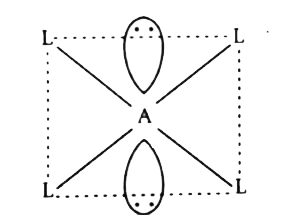
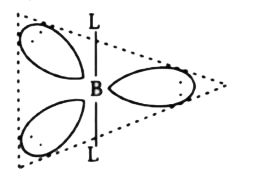
Consider two covalent compounds `AL_(n_(1)) and BL_(n_(2))`, if central atom (A) of first compounds has total six electron pairs and central atom (B) of second compound contains total five electron pairs in its valence shell and both compounds are planar and non-polar then calculate value of experssion `(n_(1)-n_(2))^(2)`.
[Where `n_(1) and n_(2)` are number of monovalent surrounding atom (L)]

Text Solution

Verified by Experts

The correct Answer is:
`4`

`implies AL_(n_(1))`: implies` Number of electron pair on A=6
`implies` Non-polar
`implies` planar
Hence `n_(1)=4`
`implies BL_(2):
`implies` Number of electron pair on B=5
`implies` Non-polar
`implies` planar
Hence `n_(2)=2`
`(n_(1)-n_(2))^(2)=(4-2)^(2)=4`
Promotional Banner

Topper's Solved these Questions

  • CHEMICAL BONDING (ADVANCED)

    VK JAISWAL|Exercise ASSERTION-REASON TYPE QUESTIONS|58 Videos
  • CHEMICAL BONDING (BASIC)

    VK JAISWAL|Exercise Level 3 (Passive 11)|6 Videos

Similar Questions

Explore conceptually related problems

Consider the following table Than calculate value of experssion |(n_(1)+n_(2)+n_(3)+n_(4))/(m_(1)+m_(2)+m_(3)+m_(4))|^(2) .

A natural atom of an element has 2K,8L, 9M and 2N electrons .The atomic number of element is : The total number of unpaired electons are

If hydrolysis of interhalogen compound can be represented by following general reaction: XY_(n_(1))overset(water)to n_(1)HY+HXO_(n_(2)) If given interhalogen compound is polarr and non-planar, then calculate value of n_(1)+n_(2) .

Consider the following three compounds (i)AX_(2n)^(n-) , (ii) AX_(3n) and (ii) AX_(4n)^(n+) , where central atom A is 15th group element and their maximum covalency is 3n. If total number of proton in surrounding atom X is n and value of n is one, then calculate value of x^(3)+y^(2)+z^(2) . (where x, y and z are total number of lone pair at central atom in compounds (i), (ii) and (iii) respectively.

State the total number of electron pairs surrounding the central atom in XeF_2,XeF_4 and XeF_6 .

A natural atom of an element has 2K,8L, 9M and 2N electrons .The atomic number of element is : The total number of s electons are

A natural atom of an element has 2K,8L, 9M and 2N electrons .The atomic number of element is : The total number of p electons are

A natural atom of an element has 2K,8L, 9M and 2N electrons .The atomic number of element is : The total number of d electons are

VK JAISWAL-CHEMICAL BONDING (ADVANCED)-SUBJECTIVE PROBLEMS
  1. Consider the following species O(Me)(2), N(SiH(3))(3), CO, O(SiH(3))(2...

    Text Solution

    |

  2. Total number of molecules which can form H-bond among themselves. Si...

    Text Solution

    |

  3. Consider two covalent compounds AL(n(1)) and BL(n(2)), if central atom...

    Text Solution

    |

  4. Calculate the I-I distance in (Å) for given compound H(2)C(2) I(2) if ...

    Text Solution

    |

  5. There are some arrangements of atomic orbitals which are given below: ...

    Text Solution

    |

  6. Number of hybrid orbital C atoms which have 33% p-character in C(CN)(4...

    Text Solution

    |

  7. Max. no. of equal P-O bonds in P(2)O(7)^(4-) ion is :

    Text Solution

    |

  8. Consider the following species: (i) CH(3)^(+) (ii) (C(3)H(5))(3)Al...

    Text Solution

    |

  9. Calculate value of |x-y|, here x and y are the total number of bonds i...

    Text Solution

    |

  10. Consider the following compounds : (i) IF(5) " " (ii) ClI(4)^(-) "...

    Text Solution

    |

  11. Consider the following Calculate value of p+q, here p and q are tot...

    Text Solution

    |

  12. Consider the following orbitals (i)3p(x) (ii)4d(x^(2)) (iii)3d(x^(2)...

    Text Solution

    |

  13. Consider the following oxyanions : PO(4)^(3-), P(2)O(6)^(4-), SO(4)^...

    Text Solution

    |

  14. Consider the following three compounds (i)AX(2n)^(n-), (ii)AX(3n) and...

    Text Solution

    |

  15. Consider the following compounds and Calculate the value of ((P^(2)-Q^...

    Text Solution

    |

  16. Consider the following compounds (1)H(3)CF (2)H(2)CF(2) (3) CH(4) ...

    Text Solution

    |

  17. There are some species given below. (i)O(2)^(+) (ii)CO (iii)B(2) ...

    Text Solution

    |

  18. Following compounds A and B have similar structure with delocalization...

    Text Solution

    |

  19. The hybridization of central atoms of compounds A, B, C and D are sp^(...

    Text Solution

    |

  20. In compound PCl(x)F(5-x), possible values of x are 0 to 5, then calcul...

    Text Solution

    |

