Home
Class 12
CHEMISTRY
Consider the following reactions and ans...

Consider the following reactions and answer the following questions.
M(Double salt)+`NH_(4)Cl(s)+NH_(4)OH to `No ppt.
M(double salt)+`NaOH` solution`toN uarr+Pdarr` (coloured ppt.)
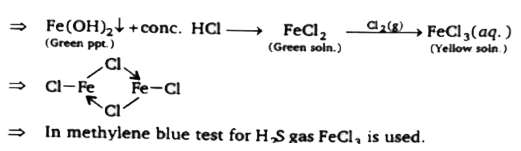
Q. `Pdarr+`conc. `HCl to Q`(coloured solution)
Incorrect statement about Q is:

A

It can exist in dimeric form

B

Its aqueous solution is acidic

C

It is used in methylene blue test for `H_(2)S`

D

On passing `Cl_(2)` gas colour of aqueous solution of Q changes

Text Solution

Verified by Experts

The correct Answer is:
C

Promotional Banner

Topper's Solved these Questions

  • TYPES OF REACTIONS

    VK JAISWAL|Exercise ONE OR MORE ANSWERS IS/ARE CORRECT|40 Videos
  • TYPES OF REACTIONS

    VK JAISWAL|Exercise MATCH THE COLUMN|18 Videos
  • TYPES OF REACTIONS

    VK JAISWAL|Exercise LEVEL 2|196 Videos
  • s-BLOCK ELEMENTS

    VK JAISWAL|Exercise SUBJECTIVE PROBLEMS|2 Videos

Similar Questions

Explore conceptually related problems

Consider the following reactions and answer the following questions. M(Double salt)+ NH_(4)Cl(s)+NH_(4)OH to No ppt. M(double salt)+ NaOH solution toN uarr+Pdarr (coloured ppt.) Q. Reaction does not occur with salt M and gas N:

Consider the following reactions and answer the following questions. M(Double salt)+ NH_(4)Cl(s)+NH_(4)OH to No ppt. M(double salt)+ NaOH solution toN uarr+Pdarr (coloured ppt.) Q. Which of the following pair of cations are present in salt M?

Indicate the correct answer out of the following for the reaction: NH_(4)Cl+H_(2)OhArrNH_(4)OH+HCl

Consider the following salts. Which one(s) when dissolved in water will produce a basic solution? 1. RbClO_(4) , 2. NaNO_(2) , 3. NH_(4)Cl , 4. NaCl

Consider the following salts. Which one(s) when dissolved in water will produce an acidic solution? 1. NH_(4)Cl , 2. KHSO_(4) , 3. NaCN , 4. KNO_(3)

VK JAISWAL-TYPES OF REACTIONS-LEVEL 3
  1. Consider three P, Q, R, salts among them P and Q salts have different ...

    Text Solution

    |

  2. Consider three P, Q, R, salts among them P and Q salts have different ...

    Text Solution

    |

  3. Consider three P, Q, R, salts among them P and Q salts have different ...

    Text Solution

    |

  4. Three compound X, Y and Z were taken into three different laboratory v...

    Text Solution

    |

  5. Three compound X, Y and Z were taken into three different laboratory v...

    Text Solution

    |

  6. Three compound X, Y and Z were taken into three different laboratory v...

    Text Solution

    |

  7. In salts of polyatomic anion, as polarising power of cation increases,...

    Text Solution

    |

  8. In salts of polyatomic anion, as polarising power of cation increases,...

    Text Solution

    |

  9. Dioxygen directly reacts with nearly all metals annd non-metals except...

    Text Solution

    |

  10. Dioxygen directly reacts with nearly all metals annd non-metals except...

    Text Solution

    |

  11. Dioxygen directly reacts with nearly all metals annd non-metals except...

    Text Solution

    |

  12. Consider the following reactions and answer the following questions. ...

    Text Solution

    |

  13. Consider the following reactions and answer the following questions. ...

    Text Solution

    |

  14. Consider the following reactions and answer the following questions. ...

    Text Solution

    |

  15. Q. Compound 'X' is:

    Text Solution

    |

  16. Q. Incorrect statement 'Y' changes on heating:

    Text Solution

    |

  17. The unique behaviour of CU, having a positive E^(@) (reduction potenti...

    Text Solution

    |

  18. The unique behaviour of CU, having a positive E^(@) (reduction potenti...

    Text Solution

    |

  19. Q. When H(2)S gas was passed into filtrate (P), a coloured precipitate...

    Text Solution

    |

  20. Q. Precipitate (Q) was treated withdil. HCl and coloured solution was ...

    Text Solution

    |

