

Home
Class 11
PHYSICS
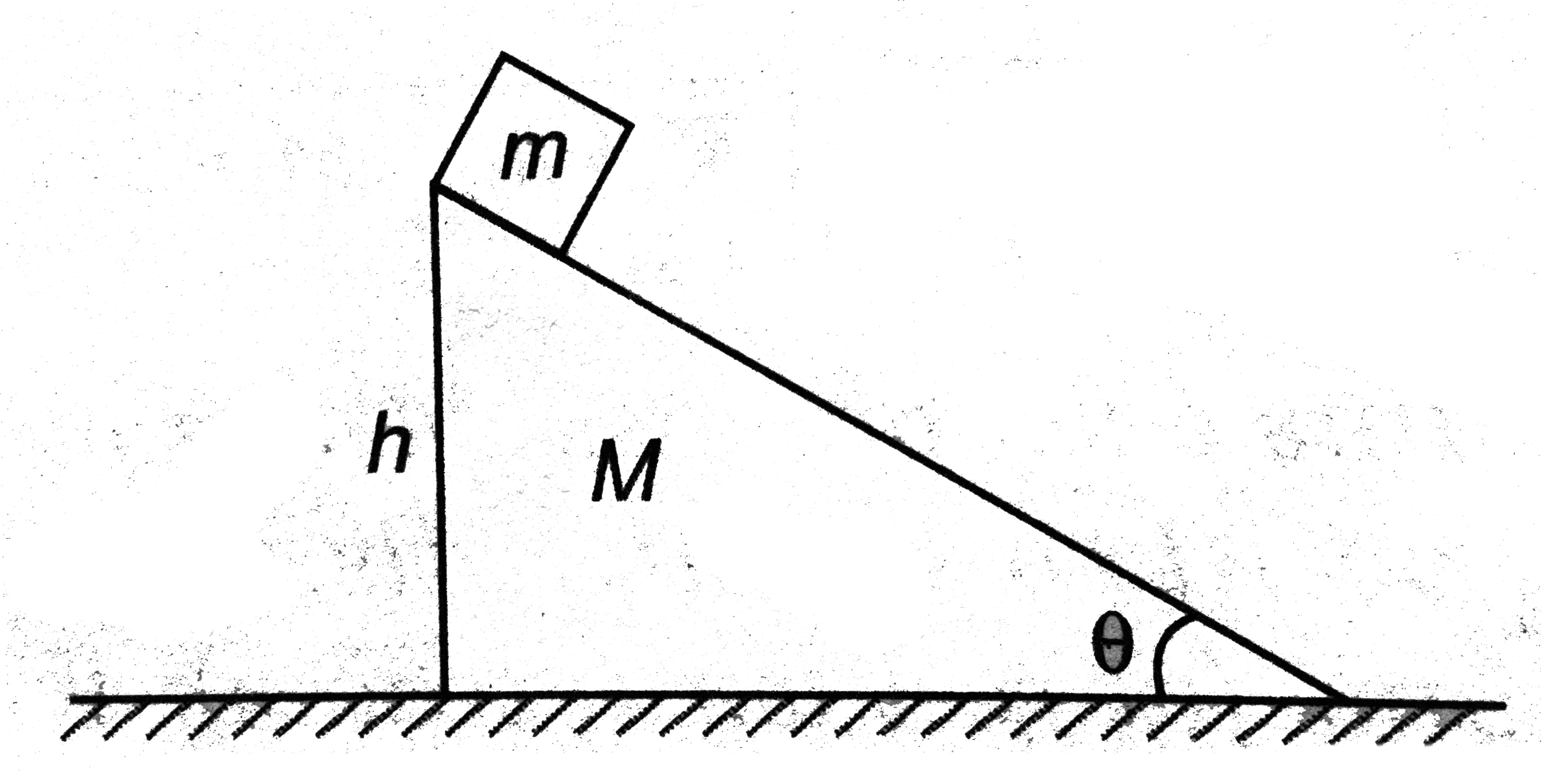
All surfaces shown in figure are smooth....

All surfaces shown in figure are smooth. Find velocity of wedge (of mass M) when the block (of mass m) reaches the bottom of the wedge.

Promotional Banner

Similar Questions

Explore conceptually related problems

A block of mass m is released from the top of a wedge of mass M as shown in figure. Find the displacement of wedges on the horizontal ground when the block reaches the bottom of the wedges. Neglect friction everywhere.

A block of mass m is released from the top of a wedge of mass M as shown in figure. Find the displacement of wedges on the horizontal ground when the block reaches the bottom of the wedges. Neglect friction everywhere.

A block of mass m is initially lying on a wedge of mass M with an angle of inclination theta as shown in figure. Calculate the displacement of the wedge when the block is released and reaches to the bottom of the wedge.

All surfaces shown in figure are smooth. Wedges of mass 'M' is free to move. Block of mass 'm' is given a horizontal velocity v_0 as shown. Find the maximum height 'h' attained by 'm' (over the wedges or outside it).

All surfaces shown in figure are smooth. Wedges of mass 'M' is free to move. Block of mass 'm' is given a horizontal velocity v_0 as shown. Find the maximum height 'h' attained by 'm' (over the wedges or outside it).

A particle of mass m is placed at rest on the top of a smooth wedge of mass M, which in turn is placed at rest on a smooth horizontal surface as shown in figure. Then the distance moved by the wedge as the particle reaches the foot of the wedge is :

A particle of mass m is placed at rest on the top of a smooth wedge of mass M, which in turn is placed at rest on a smooth horizontal surface as shown in figure. Then the distance moved by the wedge as the particle reaches the foot of the wedge is :

For the figure shown, block of mass m is released from the rest. Find the distance of the wedge from initial position, when block m arrives at the bottom of the wedge. All surfaces are frictionless.

A block of mass m is pushed towards a movable wedge of mass nm and height h , with a velocity u . All surfaces are smooth. The minimum value of u for which the block will reach the top of the wedge is

A block of mass m is pushed towards a movable wedge of mass nm and height h , with a velocity u . All surfaces are smooth. The minimum value of u for which the block will reach the top of the wedge is