Home
Class 12
MATHS
f(x)=|a x-b|+c|x|AAx in (-oo,oo), where ...

`f(x)=|a x-b|+c|x|AAx in (-oo,oo),` where `a >0, b >0,c > 0.` Find the condition if `f(x)` attains the minimum value only at one point.

Text Solution

Verified by Experts
`" "f(x)= {{:(b-ax-cx",",,xlt0), (b-ax+cx",",,0le x lt(b)/(a)), (ax-b+cx",",,x ge (b)/(a)):}`
`" "={{:(b-(a+c)x",",,xlt0), (b+(c-a)x",",,0lexlt(b)/(a)),((a+c)x-b",",,xge(b)/(a)):}`
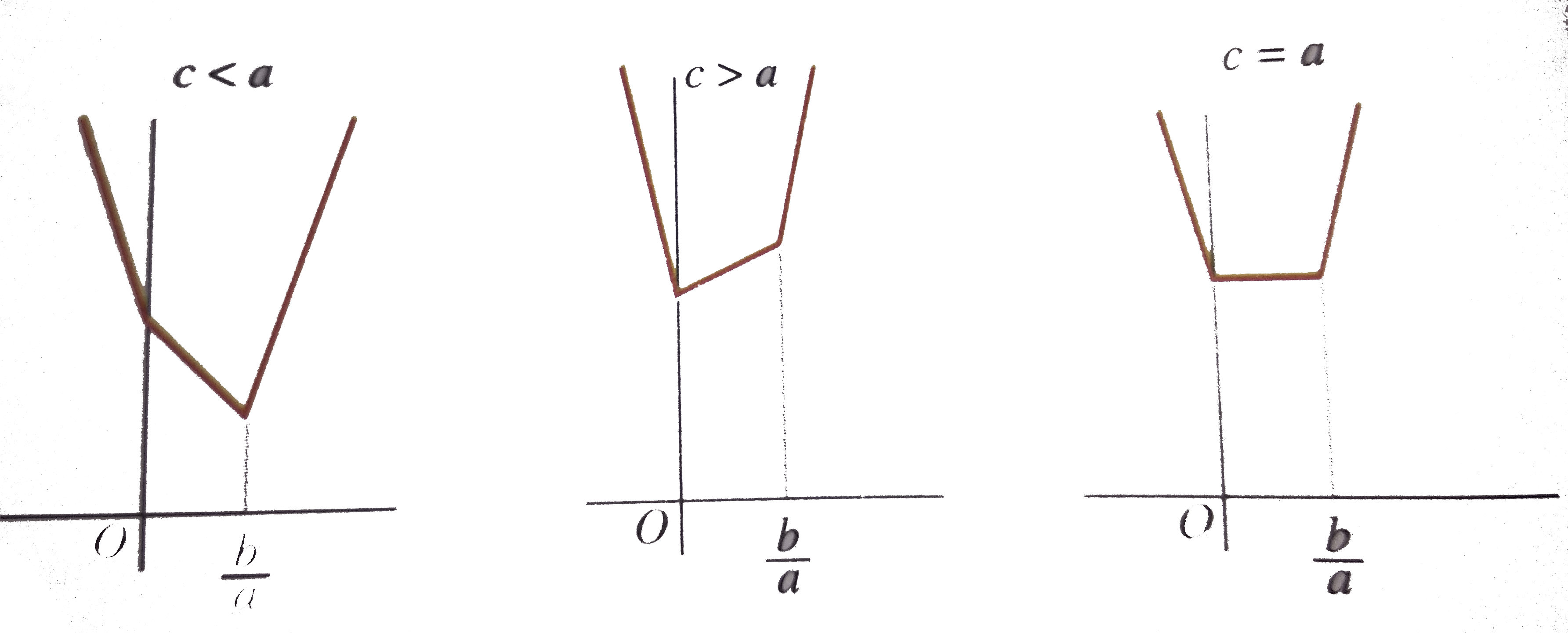
The graphs of the function for different situations are as shown in the following figures.

From the figure, we can see that for `c lt a and c gt a`, there is only point of minima.
For `c=a`, there are infinite points of minima.
Thus, for exactly one point of minima, `c ne a`.
Promotional Banner

Topper's Solved these Questions

  • GRAPHS OF ELEMENTARY FUNCTIONS

    CENGAGE|Exercise Exercise|34 Videos
  • GRAPHS OF POLYNOMIAL AND RATIONAL FUNCTIONS

    CENGAGE|Exercise Exercise|13 Videos
  • GRAPHS OF TRIGONOMETRIC FUNCTIONS

    CENGAGE|Exercise Exercise|22 Videos

Similar Questions

Explore conceptually related problems

f(x)=|ax-b|+c|x|AA x in(-oo,oo) where a>0,b>0,c>0. Find the condition if f(x) attains the minimum value only at one point.

Consider the function f:(-oo,oo)vec(-oo,oo) defined by f(x)=(x^2+a)/(x^2+a),a >0, which of the following is not true? maximum value of f is not attained even though f is bounded. f(x) is increasing on (0,oo) and has minimum at ,=0 f(x) is decreasing on (-oo,0) and has minimum at x=0. f(x) is increasing on (-oo,oo) and has neither a local maximum nor a local minimum at x=0.

Let f(x)=a+b|x|+c|x|^(4), where a,b, and c are real constants.Then,f(x) is differentiable at x=0, if a=0( b) b=0 (c) c=0( d) none of these

Let f(x) lt 0 AA x in (-oo, 0) and f (x) gt 0 AA x in (0,oo) also f (0)=0, Again f'(x) lt 0 AA x in (-oo, -1) and f '(x) gt AA x in (-1,oo) also f '(-1)=0 given lim _(x to oo) f (x)=0 and lim _(x to oo) f (x)=oo and function is twice differentiable. The minimum number of points where f'(x) is zero is:

If the range of the function f(x)=3x^(2)+bx+c is [0,oo) then value of (b^(2))/(3c) is

Let f(x)=a+b|x|+c|x|^(4), where a,b and c are real constants.Then,f(x) is differentiable at x=0, if a=0 (b) b=0( c) c=0(d) none of these

The value of b for which the function f(x)=sin x-bx+c is decreasing in the interval (-oo,oo) is given by

A function f(x) having the following properties, (i) f(x) is continuous except at x=3 (ii) f(x) is differentiable except at x=-2 and x=3 (iii) f(0) =0 lim_(x to 3) f(x) to - oo lim_(x to oo) f(x) =3 , lim_(x to oo) f(x)=0 (iv) f'(x) gt 0 AA in (-oo, -2) uu (3,oo) " and " f'(x) le 0 AA x in (-2,3) (v) f''(x) gt 0 AA x in (-oo,-2) uu (-2,0)" and "f''(x) lt 0 AA x in (0,3) uu(3,oo) Then answer the following questions Find the Maximum possible number of solutions of f(x)=|x|

CENGAGE-GRAPHS OF ELEMENTARY FUNCTIONS -Exercise
  1. f(x)=|a x-b|+c|x|AAx in (-oo,oo), where a >0, b >0,c > 0. Find the con...

    Text Solution

    |

  2. Draw the graph of y= (1)/((1//x)).

    Text Solution

    |

  3. (a) Draw the graph of f(x) = ={{:(1",",, |x| ge 1), ((1)/(n^(2)) ",",,...

    Text Solution

    |

  4. Sketch the regions which points satisfy |x+y| ge 2.

    Text Solution

    |

  5. Sketch the region satisfying |x| lt |y|.

    Text Solution

    |

  6. For a point P in the plane, let d1(P)a n dd2(P) be the distances of th...

    Text Solution

    |

  7. Draw the graph of y= (x-1)/(x-2).

    Text Solution

    |

  8. The following figure shows the graph of f(x) =ax^(2)+bx +c, then find ...

    Text Solution

    |

  9. The entire graph of the equation y=x^2+k x-x+9 in strictly above the x...

    Text Solution

    |

  10. If x^2+2a x+a<0AAx in [1,2], the find the values of adot

    Text Solution

    |

  11. Draw the graph of f(x) = x|x|.

    Text Solution

    |

  12. Draw the graph of the function: Solve |(x^2)/(x-1)|lt=1 using the grap...

    Text Solution

    |

  13. Draw the graph of y = |x^(2) - 2x|-x.

    Text Solution

    |

  14. Draw the graph of y = {{:(2^(x)",",, x^(2)-2x le 0 ),( 1+3.5 x- x^(2),...

    Text Solution

    |

  15. Draw the graph of f(x) = |x-1|+ |2x-3|. Find the range of the functio...

    Text Solution

    |

  16. Draw the graph of y= |x-1|+3|x-2|-5|x-4| and find the values of lamda ...

    Text Solution

    |

  17. Find the set of real value(s) of a for which the equation |2x+3|+2x-3|...

    Text Solution

    |

  18. Draw the graph of y= 2^(((|x|+x))/(x)).

    Text Solution

    |

  19. Draw the graph of y= x ^((1)/(log(e)x)).

    Text Solution

    |

  20. Find the number of solutions to the question x+log(e)x=0.

    Text Solution

    |

  21. draw the graph of f(x)=x+[x], [.] denotes greatest integer function.

    Text Solution

    |

