Home
Class 12
MATHS
Consider a square with vertices at (1,1)...

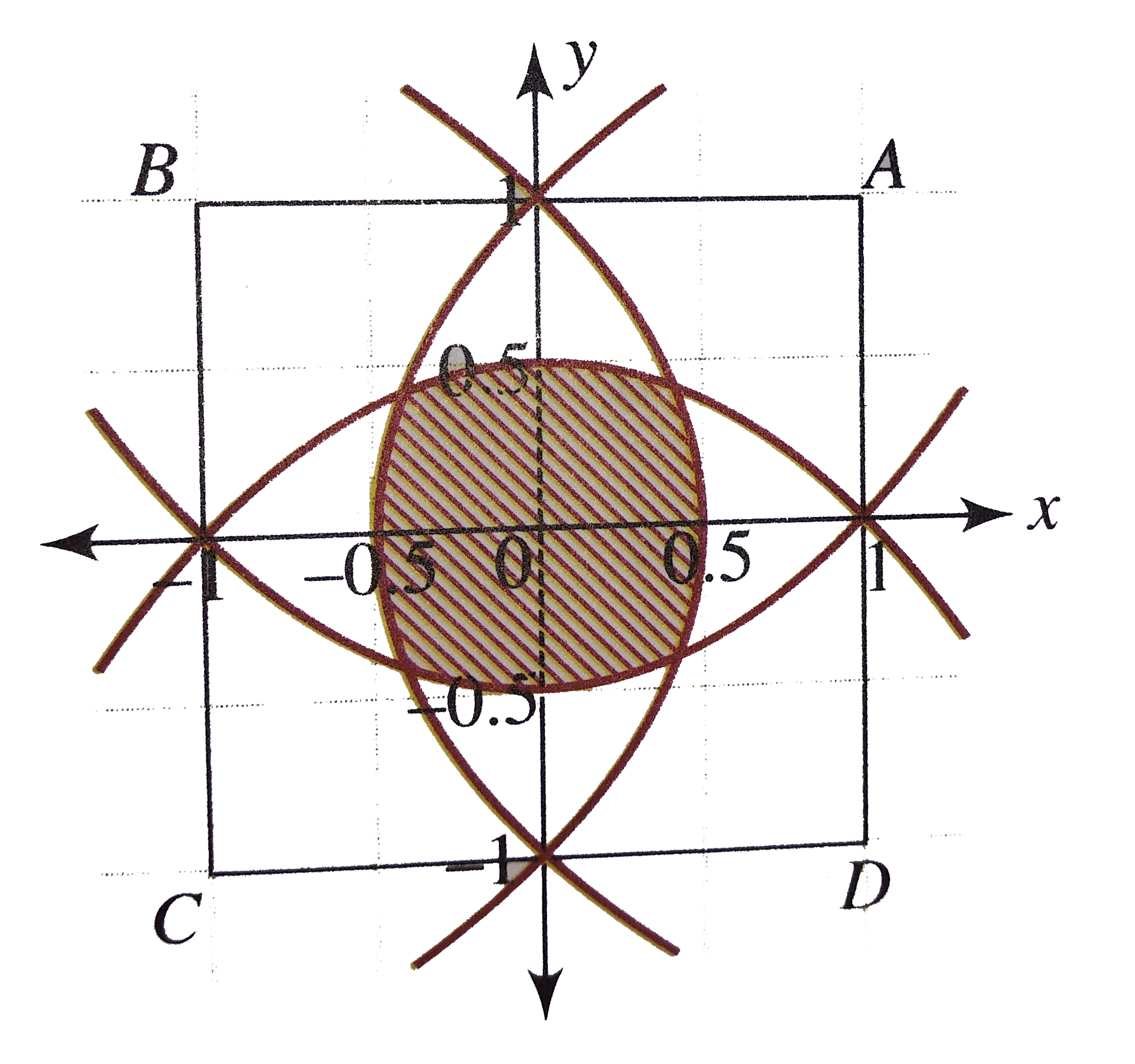
Consider a square with vertices at `(1,1),(-1,1),(-1,-1),a n d(1,-1)dot` Set `S` be the region consisting of all points inside the square which are nearer to the origin than to any edge. Sketch the region `S` and find its area.

Text Solution

Verified by Experts
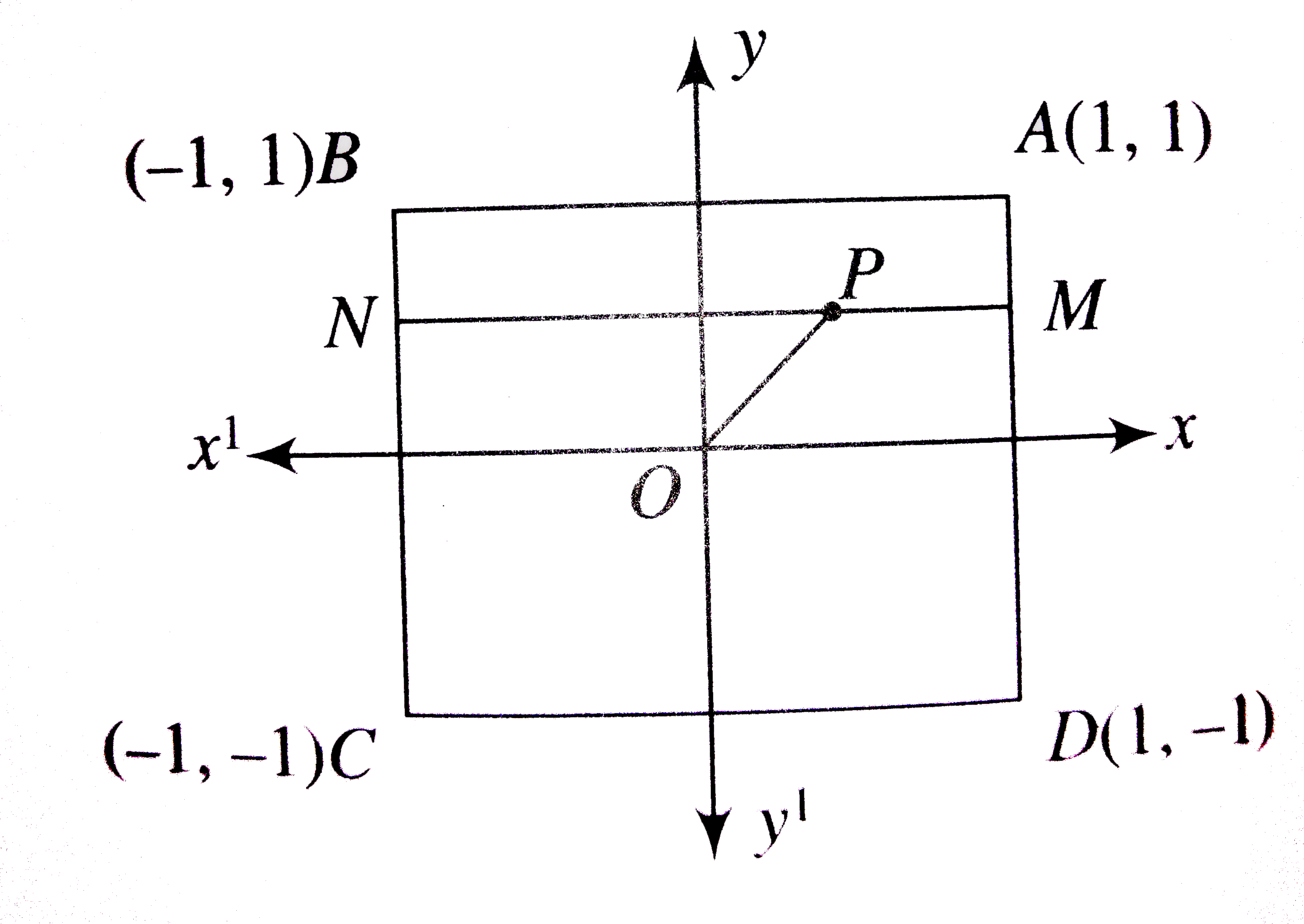
Let us consider any point `(x, y)` inside the square such that its distance from the origin `le` its distace from any of the edges, say AD.
`therefore " "OP lt PM`
`rArr" "sqrt((x^(2) +y^(2))) lt 1-x `
`rArr" "y^(2) le -2 (x- (1)/(2))" "`(i)
Above represents all points within and on the parabola `P_(1)`.
If we consider the edges BC, then `OP lt PN` will imply
`" "y^(2) le 2 (x+ (1)/(2))" "` (ii)
Similarly, if we consider the edges AB and CD, we will have
`" "x^(2) le -2(y -(1)/(2))" "`(iii)
`" " x^(2) le 2 (y + (1)/(2) ) " "`(iv)
Hence S consists of the region bounded by the four parabolas meeting the axes at `(pm (1)/(2), 0) and (0, pm (1)/(2))`.

Promotional Banner

Topper's Solved these Questions

  • GRAPHS OF ELEMENTARY FUNCTIONS

    CENGAGE|Exercise Exercise|34 Videos
  • GRAPHS OF POLYNOMIAL AND RATIONAL FUNCTIONS

    CENGAGE|Exercise Exercise|13 Videos
  • GRAPHS OF TRIGONOMETRIC FUNCTIONS

    CENGAGE|Exercise Exercise|22 Videos

Similar Questions

Explore conceptually related problems

Consider a square with vertices at (1,1)(-1,1)(-1,-1)and(1,-1). Let S be the region consisting of all points inside the square which are nearer to the origin than to any edge. Sketch the region S and find its area.

Let O(0,0),A(2,0),a n dB(1 1/(sqrt(3))) be the vertices of a triangle. Let R be the region consisting of all those points P inside O A B which satisfy d(P , O A)lt=min[d(p ,O B),d(P ,A B)] , where d denotes the distance from the point to the corresponding line. Sketch the region R and find its area.

Show that the points P(2,1), Q(-1,3) , R (-5,-3) and S (-2,-5) are the vertices of a square .

Sketch the region bounded by the curves y=sqrt(5-x^(2)) and y=|x-1| and find its area.

Show that the points A(2, 1), B(0,3), C(-2, 1) and D(0, -1) are the vertices of a square.

Show that the points (-2,4,1),(-1,5,5),(2,2,5) and (1,1,1) are the vertices of a square.

Area of the triangle having vertices (1,2,3),(2,-1,1) and (1,2,4) in square units is

In Fig 1, a square of diagonal 8 cm is inserted in a circle. Find the area ol the shaded region.

CENGAGE-GRAPHS OF ELEMENTARY FUNCTIONS -Exercise
  1. Consider a square with vertices at (1,1),(-1,1),(-1,-1),a n d(1,-1)dot...

    Text Solution

    |

  2. Draw the graph of y= (1)/((1//x)).

    Text Solution

    |

  3. (a) Draw the graph of f(x) = ={{:(1",",, |x| ge 1), ((1)/(n^(2)) ",",,...

    Text Solution

    |

  4. Sketch the regions which points satisfy |x+y| ge 2.

    Text Solution

    |

  5. Sketch the region satisfying |x| lt |y|.

    Text Solution

    |

  6. For a point P in the plane, let d1(P)a n dd2(P) be the distances of th...

    Text Solution

    |

  7. Draw the graph of y= (x-1)/(x-2).

    Text Solution

    |

  8. The following figure shows the graph of f(x) =ax^(2)+bx +c, then find ...

    Text Solution

    |

  9. The entire graph of the equation y=x^2+k x-x+9 in strictly above the x...

    Text Solution

    |

  10. If x^2+2a x+a<0AAx in [1,2], the find the values of adot

    Text Solution

    |

  11. Draw the graph of f(x) = x|x|.

    Text Solution

    |

  12. Draw the graph of the function: Solve |(x^2)/(x-1)|lt=1 using the grap...

    Text Solution

    |

  13. Draw the graph of y = |x^(2) - 2x|-x.

    Text Solution

    |

  14. Draw the graph of y = {{:(2^(x)",",, x^(2)-2x le 0 ),( 1+3.5 x- x^(2),...

    Text Solution

    |

  15. Draw the graph of f(x) = |x-1|+ |2x-3|. Find the range of the functio...

    Text Solution

    |

  16. Draw the graph of y= |x-1|+3|x-2|-5|x-4| and find the values of lamda ...

    Text Solution

    |

  17. Find the set of real value(s) of a for which the equation |2x+3|+2x-3|...

    Text Solution

    |

  18. Draw the graph of y= 2^(((|x|+x))/(x)).

    Text Solution

    |

  19. Draw the graph of y= x ^((1)/(log(e)x)).

    Text Solution

    |

  20. Find the number of solutions to the question x+log(e)x=0.

    Text Solution

    |

  21. draw the graph of f(x)=x+[x], [.] denotes greatest integer function.

    Text Solution

    |