Home
Class 12
MATHS
Let f(x) = ([x]+1)/({x}+1) for f: [0, (...

Let `f(x) = ([x]+1)/({x}+1) ` for `f: [0, (5)/(2) ) to ((1)/(2) , 3]`, where `[*]` represents the greatest integer function and `{*}` represents the fractional part of x.
Draw the graph of `y= f(x)`. Prove that `y=f(x)` is bijective. Also find the range of the function.

Text Solution

Verified by Experts
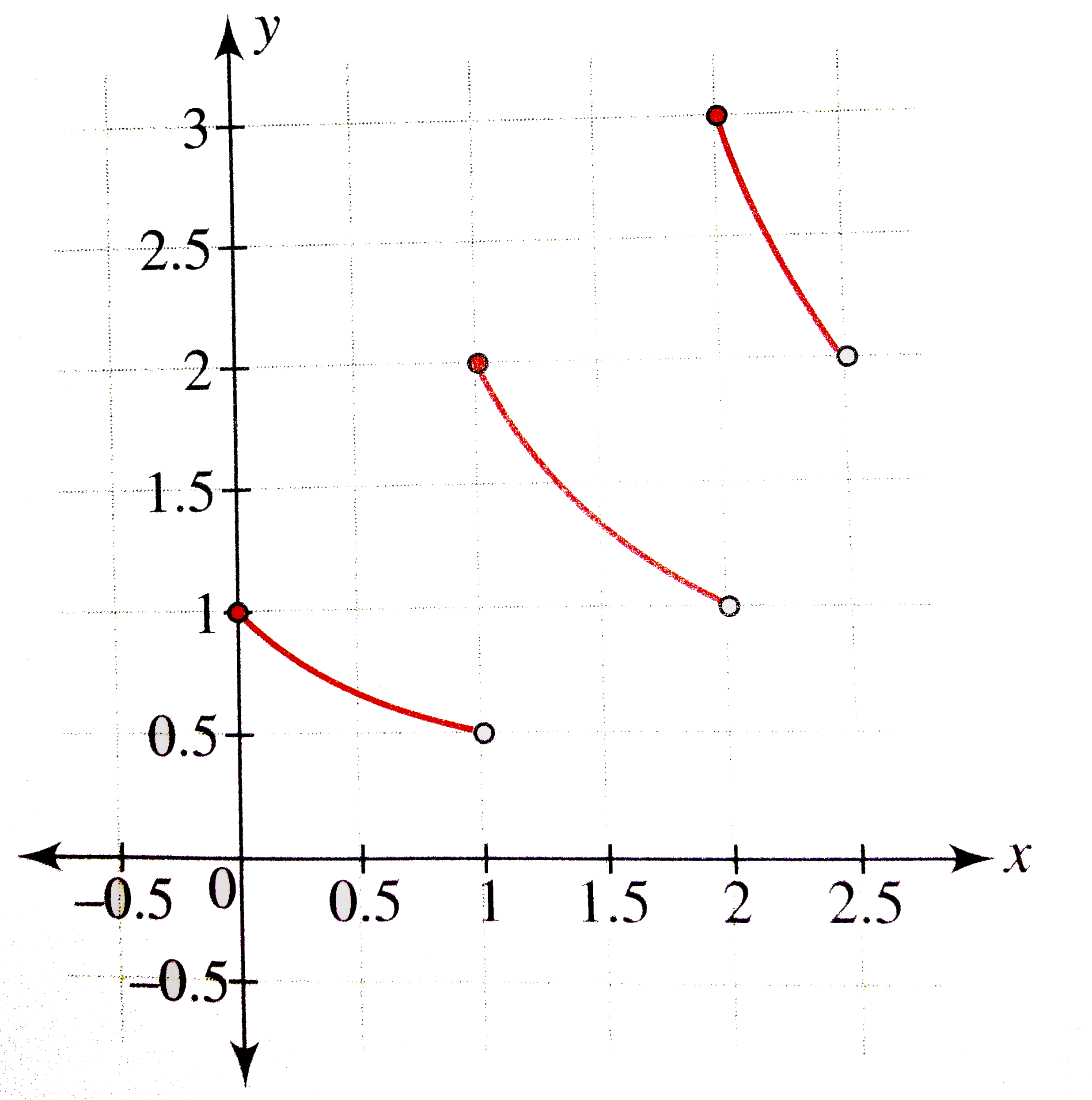
We have `f(x) = ([x]+1)/({x}+1)`
`" "={{:((1)/(x+1)",",, 0le x lt 1), ((2)/(x)",",,1le xlt 2), ((3)/(x-1)",",,2le x lt (5)/(2)):}`
Each branch of the function is part of a rectangular hyperbola.
The graph of the function is as shown in the function is as shown in the following figure.

From the figure, the range of the function is `[1//2, 3]`.
Clearly, `f(x)` is a bijective function.
Promotional Banner

Topper's Solved these Questions

  • GRAPHS OF ELEMENTARY FUNCTIONS

    CENGAGE|Exercise Exercise|34 Videos
  • GRAPHS OF POLYNOMIAL AND RATIONAL FUNCTIONS

    CENGAGE|Exercise Exercise|13 Videos
  • GRAPHS OF TRIGONOMETRIC FUNCTIONS

    CENGAGE|Exercise Exercise|22 Videos

Similar Questions

Explore conceptually related problems

Let f(x) = [x] and [] represents the greatest integer function, then

Let [.] represent the greatest integer function and f(x)=[tan^(2)x] then :

Let f(x)=(-1)^([x]) where [.] denotes the greatest integer function),then

f:(2,3)rarr(0,1) defined by f(x)=x-[x], where [.] represents the greatest integer function.

Find the range of f(x)=(x-[x])/(1-[x]+x'), where [] represents the greatest integer function.

Draw the graph of f(x) = cos pi[x] , where [*] represents the greatest integer function. Find the period of the function.

Let f(x) = ([x] - ["sin" x])/(1 - "sin" [cos x]) and g (x) = (1)/(f(x)) and [] represents the greatest integer function, then

CENGAGE-GRAPHS OF ELEMENTARY FUNCTIONS -Exercise
  1. Draw the graph of y= |x-1|+3|x-2|-5|x-4| and find the values of lamda ...

    Text Solution

    |

  2. Find the set of real value(s) of a for which the equation |2x+3|+2x-3|...

    Text Solution

    |

  3. Draw the graph of y= 2^(((|x|+x))/(x)).

    Text Solution

    |

  4. Draw the graph of y= x ^((1)/(log(e)x)).

    Text Solution

    |

  5. Find the number of solutions to the question x+log(e)x=0.

    Text Solution

    |

  6. draw the graph of f(x)=x+[x], [.] denotes greatest integer function.

    Text Solution

    |

  7. Given f(x) is a periodic function with period 2 and it is defined as ...

    Text Solution

    |

  8. Draw the region of relation [x][y]= 6, x, y ge 0. Here [*] denotes the...

    Text Solution

    |

  9. Draw the graph of y= {x}^(2), where [*] represents the fractional part...

    Text Solution

    |

  10. Let f(x) = ([x]+1)/({x}+1) for f: [0, (5)/(2) ) to ((1)/(2) , 3], whe...

    Text Solution

    |

  11. Draw the graph of y= 2^({x}), where {*} represents the fractional part...

    Text Solution

    |

  12. Find tha area of the region containing the points (x, y) satisfying 4...

    Text Solution

    |

  13. Draw the graph of y= -sqrt(x^(2)+2)

    Text Solution

    |

  14. Draw the graph of y= |x|^(1//2) from -1 le x le 1.

    Text Solution

    |

  15. Draw the graph of f(x) = "sgn(log(0.5) x).

    Text Solution

    |

  16. Graph of y= f(x) is given as shown in the following figure. Draw the...

    Text Solution

    |

  17. Draw the graph of the function y= f(x) = lim(n to oo) (x^(2n)-1)/(x^(...

    Text Solution

    |

  18. An even periodic function f:R to R with period 4 is such that f(x)=...

    Text Solution

    |

  19. The function f(x) = max. {(1-x), (1+x), 2}, x in (-oo, oo) is

    Text Solution

    |

  20. Check the differentiability if f(x) = min. {1, x^(2), x^(3)}.

    Text Solution

    |

