Home
Class 12
MATHS
The function f(x) = max. {(1-x), (1+x), ...

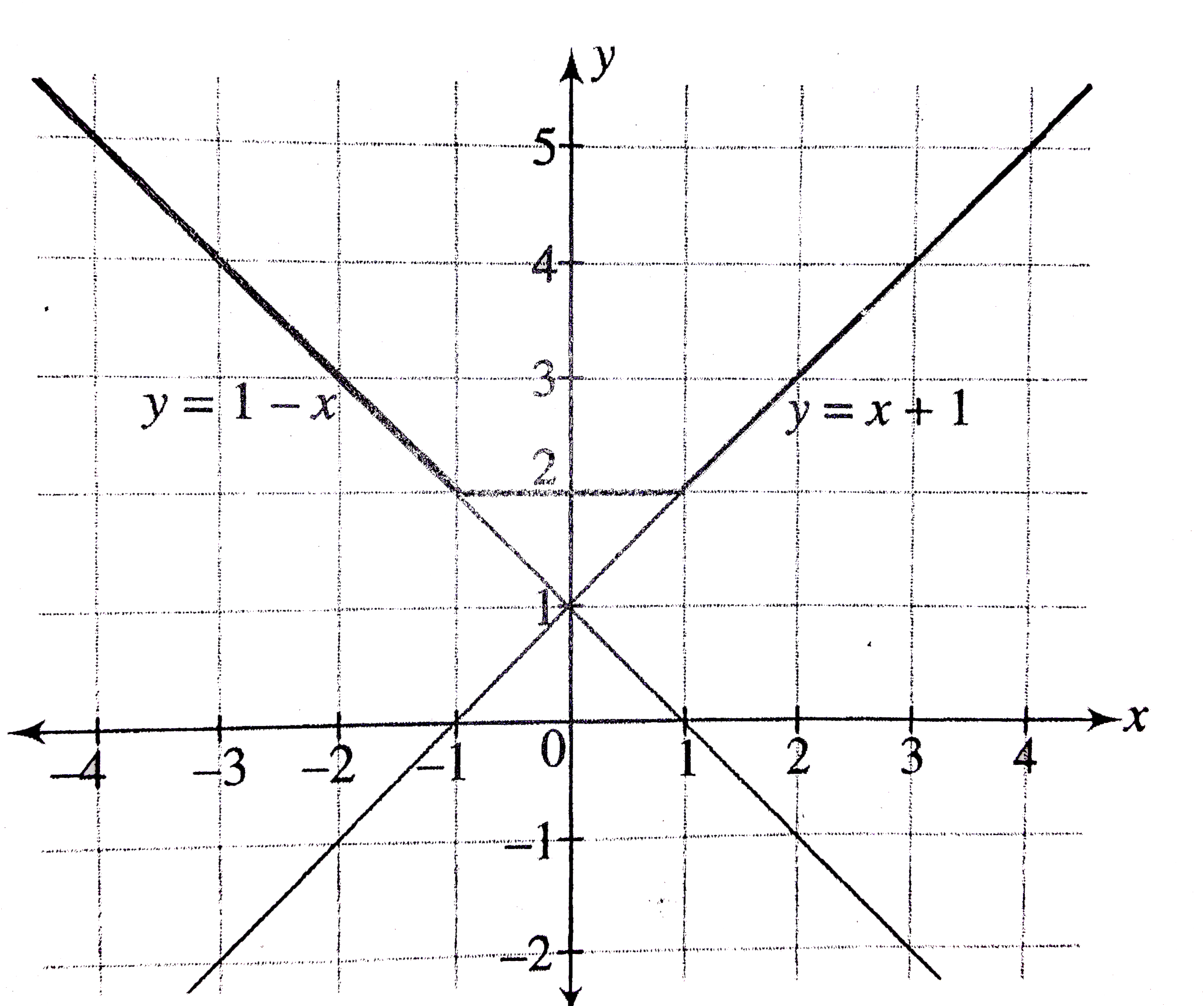
The function `f(x) = max. {(1-x), (1+x), 2}, x in (-oo, oo)` is

A

Continuous at all points

B

Differentiable at all points

C

Differentiable at all points except at `x=1 and x=-1`

D

Continuous at all points except at `x=1 and x=-1`, where it is discontinuous

Text Solution

Verified by Experts


From the graph, `y= f(x)` is non-differentiable at `x=pm 1`.
Promotional Banner

Topper's Solved these Questions

  • GRAPHS OF ELEMENTARY FUNCTIONS

    CENGAGE|Exercise Exercise|34 Videos
  • GRAPHS OF POLYNOMIAL AND RATIONAL FUNCTIONS

    CENGAGE|Exercise Exercise|13 Videos
  • GRAPHS OF TRIGONOMETRIC FUNCTIONS

    CENGAGE|Exercise Exercise|22 Videos

Similar Questions

Explore conceptually related problems

The function f(x)=max_( is equivalent to ){(1-x),(1+x),2},x in(-oo,oo) is equivalent to

Find the number of integral vaues of 'a' for which the range of function f (x) = (x ^(2) -ax +1)/(x ^(2) -3x+2) is (-oo,oo),

The domain of the function f(x) = sin ^(-1) ((|x| +5)/(x^2 +1)) is ( -oo , -a ] uu [ a,oo ). then a is equal to :

The greatest and the least value of the function, f(x)=sqrt(1-2x+x^(2))-sqrt(1+2x+x^(2)),x in(-oo,oo) are

The function f(x) = [ 1/4(3x^2 + 1), -oo< x<= 1; 5-4x, 1 < x< 4; 4-x, 4 <=x < oo is

The function f(x)= (x)/(1+|x|) is differentiable on (A) (0 oo) 0 oo) (B) (-oo 0) (C) (D) all the above

The function f(x)=log x-(2x)/(x+2) is increasing for all A) x in(-oo,0) , B) x in(-oo,1) C) x in(-1,oo) D) x in(0,oo)

if f(x)=max{x^(2),x^(3),(1)/(64)} for all x in(0,oo)

The number of points at which the function f(x)=max{a-x,a+x,b},-oo

The domain of the function f(x)=1/(sqrt(|x|-x)) is: (1) (-oo,oo) (2) (0,oo (3) (-oo,""0) (4) (-oo,oo)"-"{0}

CENGAGE-GRAPHS OF ELEMENTARY FUNCTIONS -Exercise
  1. Draw the graph of y= |x-1|+3|x-2|-5|x-4| and find the values of lamda ...

    Text Solution

    |

  2. Find the set of real value(s) of a for which the equation |2x+3|+2x-3|...

    Text Solution

    |

  3. Draw the graph of y= 2^(((|x|+x))/(x)).

    Text Solution

    |

  4. Draw the graph of y= x ^((1)/(log(e)x)).

    Text Solution

    |

  5. Find the number of solutions to the question x+log(e)x=0.

    Text Solution

    |

  6. draw the graph of f(x)=x+[x], [.] denotes greatest integer function.

    Text Solution

    |

  7. Given f(x) is a periodic function with period 2 and it is defined as ...

    Text Solution

    |

  8. Draw the region of relation [x][y]= 6, x, y ge 0. Here [*] denotes the...

    Text Solution

    |

  9. Draw the graph of y= {x}^(2), where [*] represents the fractional part...

    Text Solution

    |

  10. Let f(x) = ([x]+1)/({x}+1) for f: [0, (5)/(2) ) to ((1)/(2) , 3], whe...

    Text Solution

    |

  11. Draw the graph of y= 2^({x}), where {*} represents the fractional part...

    Text Solution

    |

  12. Find tha area of the region containing the points (x, y) satisfying 4...

    Text Solution

    |

  13. Draw the graph of y= -sqrt(x^(2)+2)

    Text Solution

    |

  14. Draw the graph of y= |x|^(1//2) from -1 le x le 1.

    Text Solution

    |

  15. Draw the graph of f(x) = "sgn(log(0.5) x).

    Text Solution

    |

  16. Graph of y= f(x) is given as shown in the following figure. Draw the...

    Text Solution

    |

  17. Draw the graph of the function y= f(x) = lim(n to oo) (x^(2n)-1)/(x^(...

    Text Solution

    |

  18. An even periodic function f:R to R with period 4 is such that f(x)=...

    Text Solution

    |

  19. The function f(x) = max. {(1-x), (1+x), 2}, x in (-oo, oo) is

    Text Solution

    |

  20. Check the differentiability if f(x) = min. {1, x^(2), x^(3)}.

    Text Solution

    |