Home
Class 12
MATHS
A B C is an equilateral triangle with A(...

`A B C` is an equilateral triangle with `A(0,0)` and `B(a ,0)` , (a>0). L, M and `N` are the foot of the perpendiculars drawn from a point `P` to the side `A B ,B C ,a n dC A` , respectively. If `P` lies inside the triangle and satisfies the condition `P L^2=P MdotP N ,` then find the locus of `Pdot`

Text Solution

Verified by Experts
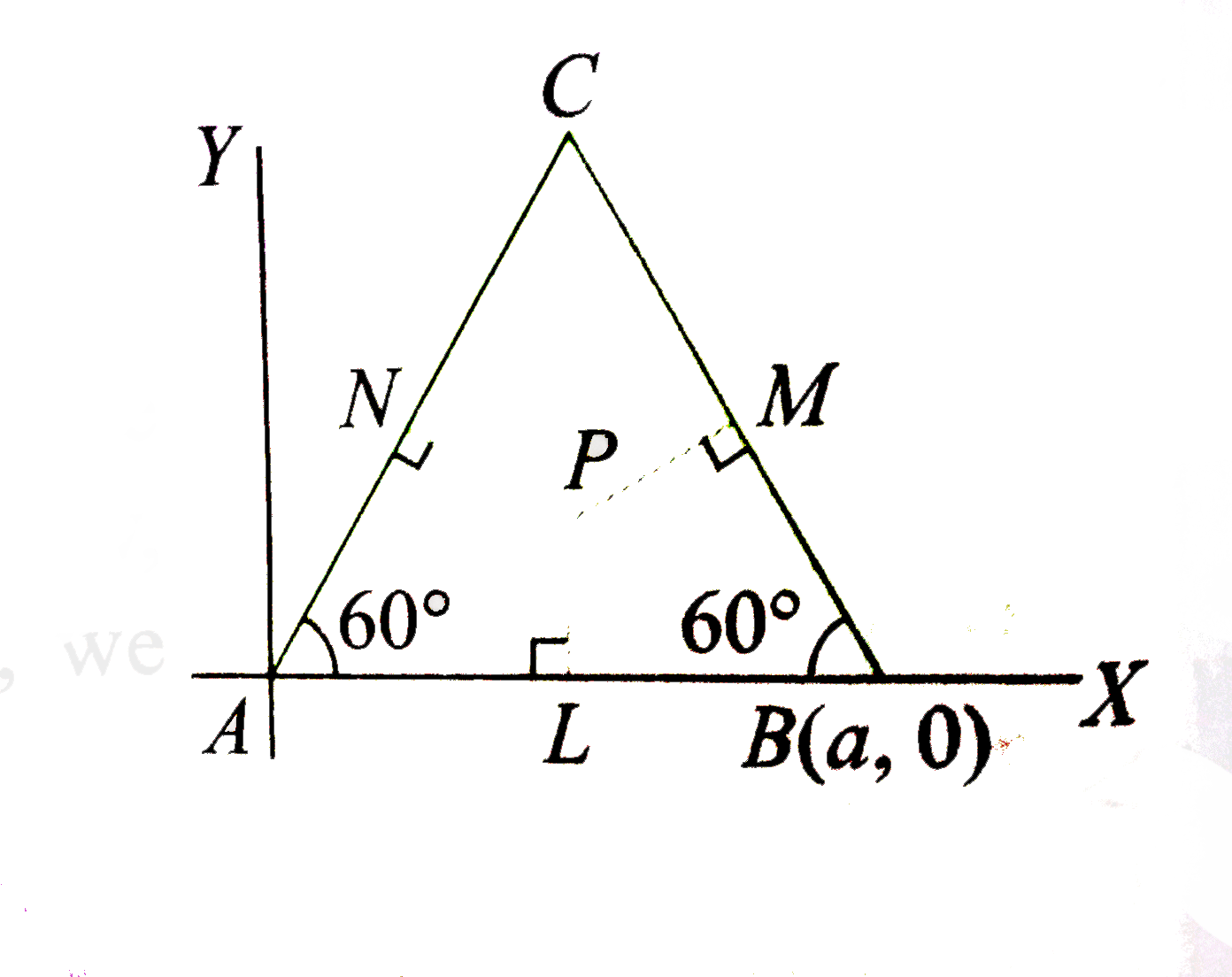

The equations of lines AC and BC are, respectively, given by
`y-sqrt(3) x =0`
`y+sqrt(3)(x-a) =0`
Let P(h,k) be the coordinates of the point whose locus is to be found. Now, according to the given condition, we have
`PL^(2) = PM*PN`
`i.e., k^(2) = (|k-sqrt(3)h|)/(2) * (|k+sqrt(3)(h-a)|)/(2)`
`i.e., 4k^(2) = (k-sqrt(3)h)[k+sqrt(3)(h-a)] " " [because "P lies below both the lines"]`
`i.e., 3(h^(2)+k^(2))-3ah + sqrt(3) ak = 0`
`i.e., h^(2)+k^(2)-ah + (a)/(sqrt(3)) k = 0`
Putting (x,y) in place of (h,k) gives the equation of the required locus as
` x^(2)+y^(2)-ax + (a)/(sqrt(3))y = 0`
Promotional Banner

Topper's Solved these Questions

  • STRAIGHT LINES

    CENGAGE|Exercise Exercise 2.1|23 Videos
  • STRAIGHT LINES

    CENGAGE|Exercise Exercise 2.2|4 Videos
  • STRAIGHT LINE

    CENGAGE|Exercise Multiple Correct Answers Type|8 Videos
  • THEORY OF EQUATIONS

    CENGAGE|Exercise JEE Advanced Previous Year|9 Videos

Similar Questions

Explore conceptually related problems

ABC is an equilateral triangle with A(0,0) and B(a,0),(a>0). L,M and N are the foot of the perpendiculars drawn from a point P to the side AB,BC, and CA, respectively.If P lies inside the triangle and satisfies the condition PL^(2)=PM.PN, then find the locus of P.

In a triangle ABC if angleA=theta and perpendiculars drawn from vertices B and C to respective opposite sides meet in P then find the value of angleBPC in terms of theta .

The lengths of the perpendiculars drawn from any point in the interior of an equilateral triangle to the respective sides are P_1 . P_2 and P_3 . The length of each side of the triangle is

The length of the perpendicular drawn from any point in the interior of an equilateral triangle to the respective sides are p_(1), p_(2) and p_(3) . The length of each side of the triangle is

In Delta P Q R , if P Q=Q R and L ,M and N are the mid-points of the sides P Q ,Q R and R P respectively. Prove that L N=M Ndot

O A and O B are fixed straight lines, P is any point and P M and P N are the perpendiculars from P on O Aa n dO B , respectively. Find the locus of P if the quadrilateral O M P N is of constant area.

Let O(0.0),A(6,0) and B(3,sqrt3) be the vertices of triangle OAB. Let R those points P inside triangle OAB which satisfy d(P, OA) minimum (d(P,OB),d(P,AB) where d(P, OA), d(P, OB) and d(P, AB) represent the distance of P from the sides OA, OB and AFB respectively. If the area of region R is 9 (a -sqrtb) where a and b are coprime, then find the value of (a+ b)

