Home
Class 12
MATHS
Line L has intercepts aa n db on the coo...

Line `L` has intercepts `aa n db` on the coordinate axes. When the axes are rotated through a given angle keeping the origin fixed, the same line `L` has intercepts `pa n dqdot` Then `a^2+b^2=p^2+q^2` `1/(a^2)+1/(b^2)=1/(p^2)+1/(q^2)` `a^2+p^2=b^2+q^2` (d) `1/(a^2)+1/(p^2)=1/(b^2)+1/(q^2)`

Text Solution

Verified by Experts
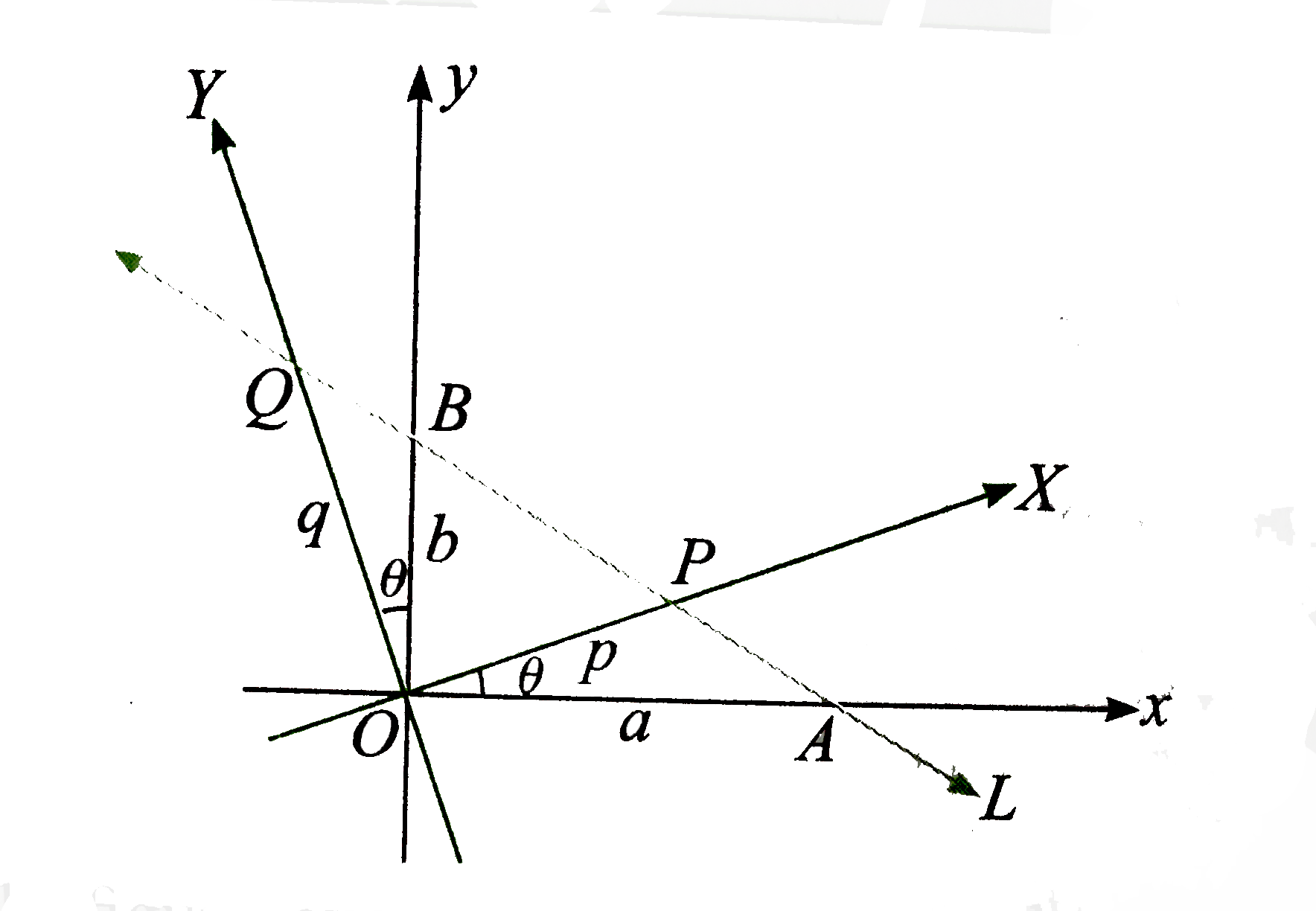

As shown in the figure, axes are rotated by an angle `theta` about origin in anticlockwise direction.
Line L has intercepts a and b on original axes and intercepts p and q on rotated axes.
Equation of line L w.r.t. original axes is
`(x)/(a) + (y)/(b)-1= 0 " " (1)`
Equation of line L w.r.t. rotated axes is
`(x)/(p) + (y)/(q)-1= 0 " " (2)`
Since origin and line L are not changing their positions, distance of line from origin remains the same even though the axes are rotated.
So, comaring distances of lines given by equations (1) and (2) from origin, we get
`(|(0)/(a) + (0)/(b)-1|)/(sqrt((1)/(a^(2))+ (1)/(b^(2)))) = (|(0)/(p) + (0)/(q)-1|)/(sqrt((1)/(p^(2))+ (1)/(q^(2))))`
`rArr (1)/(a^(2)) + (1)/(b^(2)) = (1)/(p^(2)) + (1)/(q^(2))`
Promotional Banner

Topper's Solved these Questions

  • STRAIGHT LINES

    CENGAGE|Exercise Exercise 2.1|23 Videos
  • STRAIGHT LINES

    CENGAGE|Exercise Exercise 2.2|4 Videos
  • STRAIGHT LINE

    CENGAGE|Exercise Multiple Correct Answers Type|8 Videos
  • THEORY OF EQUATIONS

    CENGAGE|Exercise JEE Advanced Previous Year|9 Videos

Similar Questions

Explore conceptually related problems

Line L has intercepts a and b on the coordinate axes. When, the axes area rotated through a given angle, keeping the origin fixed, the same line L has intercepts p and q , then

Line L has intercepts aa n db on the coordinate axes. When the axes are rotated through a given angle keeping the origin fixed, the same line L has intercepts pa n dqdot Then (a) a^2+b^2=p^2+q^2 (b)1/(a^2)+1/(b^2)=1/(p^2)+1/(q^2) (c)a^2+p^2=b^2+q^2 (d) 1/(a^2)+1/(p^2)=1/(b^2)+1/(q^2)

The line L has intercepts a and b on the coordinate axes. The coordinate axes are rotated through a fixed angle, keeping the origin fixed. If p and q are the intercepts of the line L on the new axes, then (1)/(a^(2))-(1)/(p^(2))+(1)/(b^(2))-(1)/(q^(2)) is equal to

Thu Line L has intercept a and b on the co- ordinate axes.When keeping the origin fixed, the coordinate axis are rotated around a fixed angle,then the line has intercepts p and q on rotate axis,then

If p is the length of perpendicular from the origin to the line whose intercepts on the axes are a and b,then show that (1)/(p^(2))=(1)/(a^(2))+(1)/(b^(2))

If p is the length of perpendicular from the origin to the line whose intercepts on the axes are a and b,then show that (1)/(p^(2))=(1)/(a^(2))+(1)/(b^(2))

If 'p' be the measure of the perpendicular segment from the origin on the line whose intercepts on the axes are 'a' and 'b'.then prove that : (1)/(p^(2)) = (1)/(a^(2)) + (1)/(b^(2))

